
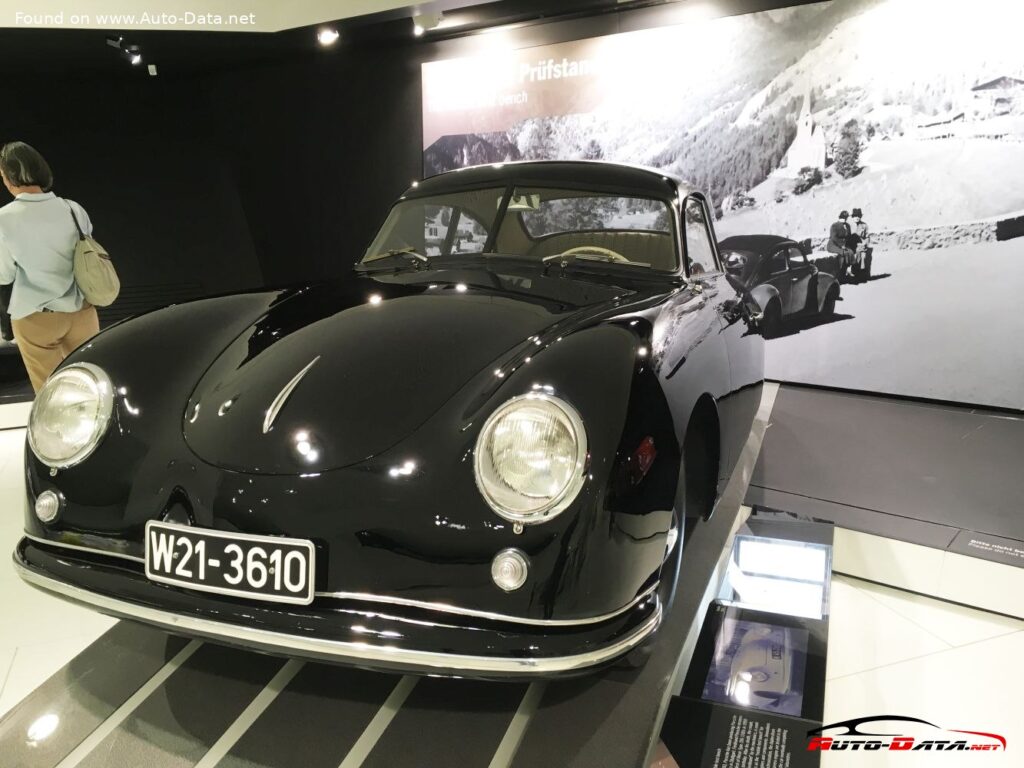
The automotive landscape of the early 1950s was irrevocably shaped by the emergence of Porsche, a brand that quickly established itself as a purveyor of finely engineered sports cars. Among its foundational models, the Porsche 356 Coupe 1500 Super (70 Hp) stands as a pivotal early iteration, embodying the nascent spirit of the Zuffenhausen marque. Produced between 1950 and 1955, this generation of the 356 Coupe was not merely a car; it was a statement of intent, laying the groundwork for Porsche’s enduring legacy in performance and precision. As the first production automobile to bear the Porsche name, the 356 was a direct descendant of Ferdinand Porsche’s vision, combining lightweight construction, a distinctive aerodynamic silhouette, and a rear-mounted, air-cooled boxer engine. The 1500 Super variant, with its enhanced 70 horsepower output, represented a significant step up in performance for its time, catering to enthusiasts seeking a more spirited driving experience in a compact, two-door coupe package. Its market segment was niche, targeting discerning buyers in Europe and beyond who valued sophisticated engineering and driving purity over ostentatious luxury, establishing a benchmark for small-displacement sports cars.
Engineering Prowess: The Porsche 356 Coupe 1500 Super (70 Hp) Powertrain
At the heart of the Porsche 356 Coupe 1500 Super (70 Hp) lies its distinctive powertrain, a testament to Porsche’s innovative engineering philosophy that prioritized efficiency and performance. The vehicle features an internal combustion engine architecture, specifically a rear-mounted, longitudinally positioned boxer engine. This configuration, a hallmark of Porsche’s early designs, offered several advantages including a low center of gravity, excellent weight distribution for enhanced handling, and efficient air-cooling. With an engine displacement of 1488 cubic centimeters (approximately 1.5 liters or 90.8 cubic inches), this four-cylinder unit delivered a respectable 70 horsepower at 5000 revolutions per minute. This power output translated to a power-per-liter ratio of 47 horsepower per liter, an impressive figure for its era, showcasing the engine’s high specific output achieved through meticulous design and tuning.
The engine’s internal mechanics were equally sophisticated. Featuring a cylinder bore of 80 millimeters (3.15 inches) and a piston stroke of 74 millimeters (2.91 inches), it utilized an overhead valve (OHV) valvetrain with two valves per cylinder. Fuel delivery was managed by a carburetor system, a standard technology for the period, ensuring a naturally aspirated air intake. The compression ratio of 8.2:1 allowed for efficient combustion, contributing to both power and the vehicle’s modest fuel consumption. Despite its sporting intentions, the 356 Coupe 1500 Super offered a combined fuel economy ranging from 21.4 to 19.6 US miles per gallon, a practical consideration even for a performance-oriented machine of the 1950s. The engine’s oil capacity was 3.5 liters (3.7 US quarts), indicative of its compact yet robust design.
Performance figures for the 1500 Super were quite compelling. The car could achieve a maximum speed of 170 kilometers per hour, or approximately 105.63 miles per hour, placing it among the faster sports cars of its day. This speed was facilitated by an excellent weight-to-power ratio of 10.9 kilograms per horsepower, or 91.5 horsepower per tonne, highlighting the car’s lightweight construction. Power was transmitted to the rear wheels via a precise 4-speed manual transmission, offering the driver direct engagement and control over the vehicle’s capabilities. This rear-wheel-drive architecture, combined with the lightweight chassis and responsive engine, contributed to the Porsche 356’s reputation for agile handling and an exhilarating driving experience, distinguishing it from many of its contemporaries.
Iconic Form and Functional Design
Design and Features of the Porsche 356 Coupe
The design of the Porsche 356 Coupe 1500 Super (70 Hp) is instantly recognizable and has become an iconic silhouette in automotive history. Its two-door coupe body type, designed by Erwin Komenda, exudes a timeless elegance characterized by smooth, flowing lines and an aerodynamic profile. The car’s compact dimensions—a length of 3870 millimeters (152.36 inches), a width of 1655 millimeters (65.16 inches), and a height of 1300 millimeters (51.18 inches)—contributed to its nimble character and distinctive visual appeal. The short wheelbase of 2100 millimeters (82.68 inches) further enhanced its agility, allowing for a tight minimum turning circle of 10.2 meters (33.46 feet), making it adept in both spirited driving and urban environments.
Inside, the 356 Coupe offered a focused, driver-centric environment with seating for two. While not opulent by modern standards, the interior was functional and well-appointed for its time, emphasizing ergonomics and a direct connection between the driver and the road. The emphasis was on simplicity and lightweight construction, with a kerb weight of just 765 kilograms (1686.54 pounds). This low mass was crucial for performance, contributing significantly to both acceleration and braking efficiency. The maximum permissible weight for the vehicle was 1200 kilograms (2645.55 pounds), allowing for a maximum load of 435 kilograms (959.01 pounds), accommodating luggage for touring or a passenger.
The chassis and suspension systems were engineered for spirited driving. Both the front and rear suspensions utilized a torsion bar setup, providing a firm yet compliant ride characteristic of sports cars from the period. This design, while simple, was effective in managing body roll and maintaining tire contact with the road during enthusiastic cornering. Braking power for the 356 Coupe 1500 Super was handled by 280-millimeter drum brakes on all four wheels. While drum brakes are less common in modern performance vehicles, these units were robust and effective for the car’s weight and speed capabilities in the 1950s. Steering was managed by a worm-reduction unit, complemented by hydraulic power steering, providing a precise and communicative feel to the driver, a quality highly valued by sports car enthusiasts.
Other practical features included a 55-liter (14.53 US gallons) fuel tank capacity, offering a reasonable range for touring. The ground clearance of 175 millimeters (6.89 inches) was adequate for various road conditions, though clearly designed for paved surfaces. The car’s overall architecture, from its powertrain layout to its suspension and braking systems, was meticulously designed to deliver a cohesive and engaging driving experience. The Porsche 356 Coupe 1500 Super (70 Hp) represented a harmonious blend of form and function, establishing a design language and engineering philosophy that would continue to define Porsche for decades to come, solidifying its status as a timeless classic and a significant piece of automotive heritage.
Technical Specifications
| Brand | Porsche |
| Model | 356 |
| Generation | 356 Coupe |
| Type (Engine) | 1500 Super (70 Hp) |
| Start of production | 1950 year |
| End of production | 1955 year |
| Powertrain Architecture | Internal Combustion engine |
| Body type | Coupe |
| Seats | 2 |
| Doors | 2 |
| Fuel consumption (economy) – combined | 11-12 l/100 km (21.4 – 19.6 US mpg, 25.7 – 23.5 UK mpg, 9.1 – 8.3 km/l) |
| Fuel Type | Petrol (Gasoline) |
| Maximum speed | 170 km/h (105.63 mph) |
| Weight-to-power ratio | 10.9 kg/Hp, 91.5 Hp/tonne |
| Power | 70 Hp @ 5000 rpm |
| Power per litre | 47 Hp/l |
| Engine layout | Rear, Longitudinal |
| Engine displacement | 1488 cm3 (90.8 cu. in.) |
| Number of cylinders | 4 |
| Engine configuration | Boxer |
| Cylinder Bore | 80 mm (3.15 in.) |
| Piston Stroke | 74 mm (2.91 in.) |
| Compression ratio | 8.2:1 |
| Number of valves per cylinder | 2 |
| Fuel injection system | Carburetor |
| Engine aspiration | Naturally aspirated engine |
| Valvetrain | OHV |
| Engine oil capacity | 3.5 l (3.7 US qt | 3.08 UK qt) |
| Kerb Weight | 765 kg (1686.54 lbs.) |
| Max. weight | 1200 kg (2645.55 lbs.) |
| Max load | 435 kg (959.01 lbs.) |
| Fuel tank capacity | 55 l (14.53 US gal | 12.1 UK gal) |
| Length | 3870 mm (152.36 in.) |
| Width | 1655 mm (65.16 in.) |
| Height | 1300 mm (51.18 in.) |
| Wheelbase | 2100 mm (82.68 in.) |
| Front track | 1250 mm (49.21 in.) |
| Rear (Back) track | 1290 mm (50.79 in.) |
| Ride height (ground clearance) | 175 mm (6.89 in.) |
| Minimum turning circle (turning diameter) | 10.2 m (33.46 ft.) |
| Drivetrain Architecture | The Internal combustion engine (ICE) drives the rear wheels of the vehicle. |
| Drive wheel | Rear wheel drive |
| Number of gears and type of gearbox | 4 gears, manual transmission |
| Front suspension | Torsion |
| Rear suspension | Torsion |
| Front brakes | Drum, 280 mm |
| Rear brakes | Drum, 280 mm |
| Steering type | Worm-reduction unit |
| Power steering | Hydraulic Steering |
