
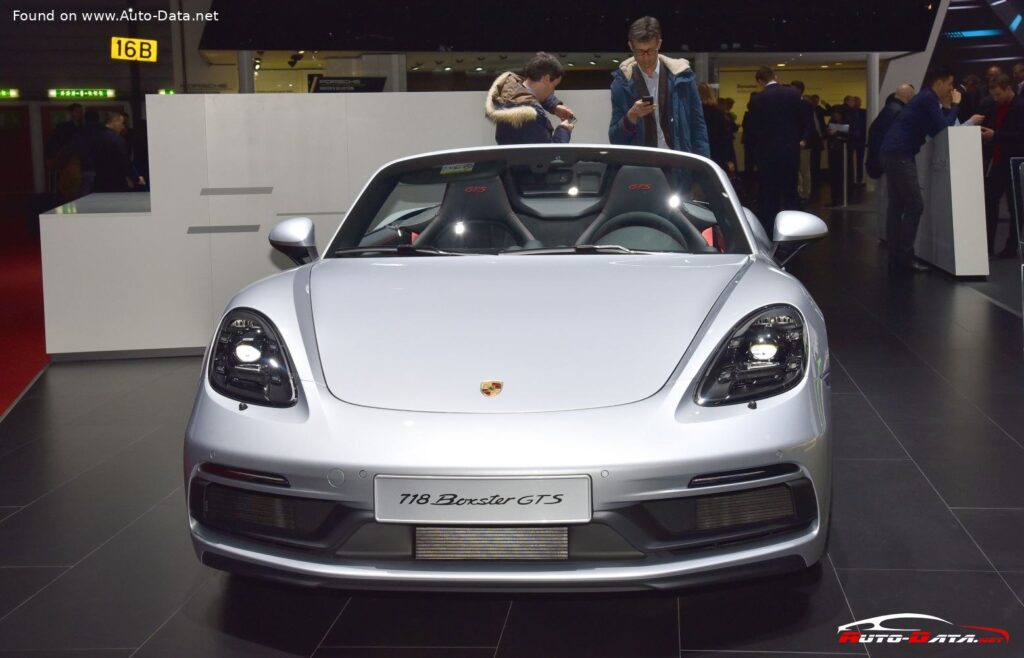
The Porsche 718 Boxster (982) 2.0 (300 Hp) represents a pivotal moment in the lineage of Porsche’s acclaimed mid-engine roadster. Introduced in September 2016 as part of the 982 generation, this model marked a significant departure from its predecessors by embracing a turbocharged flat-four engine, replacing the naturally aspirated flat-sixes that had long defined the Boxster’s character. Positioned as a premium two-seat cabriolet, the 718 Boxster continued Porsche’s tradition of delivering an exhilarating open-top driving experience, combining agile handling with impressive performance. Its production run, spanning from September 2016 to August 2018, saw it establish a new benchmark for efficiency and power delivery within its segment, appealing to enthusiasts seeking a pure, unadulterated sports car feel with modern engineering prowess. The 718 designation itself was a nod to Porsche’s historic four-cylinder racing cars, underscoring a commitment to lightweight performance and dynamic agility.
Engine and Performance: The Heart of the Porsche 718 Boxster (982) 2.0 (300 Hp)
At the core of the Porsche 718 Boxster (982) 2.0 (300 Hp) lies a sophisticated 2.0-liter (121.32 cu. in.) turbocharged flat-four Boxer engine, a revolutionary change for the Boxster line. This powerplant, designated MDD.PB, is longitudinally mounted in a mid-engine layout, contributing to the car’s exceptional balance and handling dynamics. The Boxer configuration, with its horizontally opposed cylinders, inherently provides a low center of gravity, enhancing stability and reducing body roll during spirited driving. This engine generates a robust 300 horsepower at 6500 rpm, translating to an impressive power output of 150.9 Hp per liter, a testament to Porsche’s engineering expertise in maximizing efficiency from a smaller displacement. Torque figures are equally compelling, with 280.27 lb.-ft. available across a broad rev range from 1950 to 4500 rpm. This wide torque band ensures strong, responsive acceleration from virtually any engine speed, making the car incredibly engaging on both road and track.
The integration of a turbocharger and intercooler is key to this engine’s performance characteristics. Unlike the linear power delivery of the previous naturally aspirated engines, the turbocharged unit offers a surge of torque that propels the 718 Boxster with remarkable urgency. This setup not only boosts power but also contributes to improved fuel efficiency. The direct injection fuel system precisely meters fuel into the combustion chambers, optimizing combustion for both performance and emissions control. With a compression ratio of 9.5:1 and four valves per cylinder, the engine is designed for optimal breathing and power extraction.
Performance metrics underscore the Boxster’s capabilities. The 2.0 (300 Hp) variant accelerates from 0 to 60 mph in a swift 4.8 seconds, with 0-100 km/h achieved in 5.1 seconds. Its maximum speed is an impressive 170.88 mph (275 km/h), demonstrating its prowess as a true high-performance sports car. Power is routed to the rear wheels via a precise 6-speed manual transmission, offering drivers an intimate and engaging connection with the vehicle. This rear-wheel-drive architecture, combined with the mid-engine layout, provides a driving experience renowned for its balance and agility. Despite its performance, the Boxster maintains a respectable level of fuel economy, with a combined rating of 31.8 US mpg (7.4 l/100 km). It complies with Euro 6 emission standards, emitting 168 g/km of CO2, reflecting Porsche’s commitment to environmental responsibility alongside performance.
Design, Features, and Driving Dynamics
The Porsche 718 Boxster (982) maintains the iconic cabriolet body type, a two-door, two-seat configuration that has defined the Boxster since its inception. Its exterior design is a harmonious blend of classic Porsche aesthetics and modern aerodynamic principles. Measuring 172.4 inches (4379 mm) in length, 70.91 inches (1801 mm) in width (78.5 inches or 1994 mm including mirrors), and 50.43 inches (1281 mm) in height, the Boxster possesses compact dimensions that contribute to its nimble handling. The 97.44-inch (2475 mm) wheelbase ensures stability at high speeds while maintaining agility in tighter corners. A low drag coefficient of 0.31 Cd further enhances its aerodynamic efficiency, contributing to both performance and fuel economy.
Underneath its sculpted bodywork, the 718 Boxster is engineered for dynamic excellence. The suspension system features independent McPherson struts with coil springs and an anti-roll bar at the front, complemented by a McPherson setup at the rear. This configuration provides a precise and compliant ride, absorbing road imperfections while maintaining exceptional body control during aggressive maneuvers. Stopping power is handled by ventilated disc brakes on both the front and rear axles, ensuring consistent and powerful deceleration. An Anti-lock Braking System (ABS) comes standard, enhancing safety by preventing wheel lock-up during hard braking. The electric power steering system, a rack and pinion type, offers responsive and accurate feedback, allowing the driver to precisely place the car on the road.
The 718 Boxster rides on a staggered wheel and tire setup, with 235/35 ZR 18 tires on 8J x 18 ET 57 rims at the front and wider 265/45 ZR 18 tires on 9.5J x 18 ET 49 rims at the rear. This combination provides optimal grip and enhances the car’s athletic stance. With a minimum turning circle of 36.02 ft (10.98 m), the Boxster is surprisingly maneuverable in urban environments despite its sports car pedigree. The convertible top, an integral part of the Boxster experience, offers the exhilaration of open-air driving with the convenience of a power-operated mechanism. Inside, while specific features are not detailed, Porsche interiors are known for their driver-centric design, high-quality materials, and ergonomic controls. Practicality is also considered, with a trunk space of 9.71 cu. ft. (275 liters) and a fuel tank capacity of 14.27 US gallons (54 liters), allowing for enjoyable road trips. The curb weight of 2943.17 lbs (1335 kg) and a maximum permissible weight of 3648.65 lbs (1655 kg) highlight its lightweight construction and robust chassis, capable of handling its potent performance.
Technical Specifications
| Brand | Porsche |
| Model | 718 |
| Generation | 718 Boxster (982) |
| Type (Engine) | 2.0 (300 Hp) |
| Start of production | September, 2016 year |
| End of production | August, 2018 year |
| Powertrain Architecture | Internal Combustion engine |
| Body type | Cabriolet |
| Seats | 2 |
| Doors | 2 |
| Fuel consumption (economy) – urban | 9.9 l/100 km (23.8 US mpg) |
| Fuel consumption (economy) – extra urban | 6 l/100 km (39.2 US mpg) |
| Fuel consumption (economy) – combined | 7.4 l/100 km (31.8 US mpg) |
| CO2 emissions | 168 g/km |
| Fuel Type | Petrol (Gasoline) |
| Acceleration 0 – 60 mph (Calculated) | 4.8 sec |
| Acceleration 0 – 100 km/h | 5.1 sec |
| Maximum speed | 275 km/h (170.88 mph) |
| Emission standard | Euro 6 |
| Weight-to-power ratio | 4.5 kg/Hp (224.7 Hp/tonne) |
| Weight-to-torque ratio | 3.5 kg/Nm (284.6 Nm/tonne) |
| Power | 300 Hp @ 6500 rpm |
| Power per litre | 150.9 Hp/l |
| Torque | 380 Nm @ 1950-4500 rpm (280.27 lb.-ft.) |
| Engine layout | Middle, Longitudinal |
| Engine Model/Code | MDD.PB |
| Engine displacement | 1988 cm3 (121.32 cu. in.) |
| Number of cylinders | 4 |
| Engine configuration | Boxer |
| Cylinder Bore | 91 mm (3.58 in.) |
| Piston Stroke | 76.4 mm (3.01 in.) |
| Compression ratio | 9.5:1 |
| Number of valves per cylinder | 4 |
| Fuel injection system | Direct injection |
| Engine aspiration | Turbocharger, Intercooler |
| Engine oil capacity | 5.7 l (6.02 US qt) |
| Kerb Weight | 1335 kg (2943.17 lbs.) |
| Max. weight | 1655 kg (3648.65 lbs.) |
| Max load | 320 kg (705.48 lbs.) |
| Trunk (boot) space – minimum | 275 l (9.71 cu. ft.) |
| Fuel tank capacity | 54 l (14.27 US gal) |
| Length | 4379 mm (172.4 in.) |
| Width | 1801 mm (70.91 in.) |
| Width including mirrors | 1994 mm (78.5 in.) |
| Height | 1281 mm (50.43 in.) |
| Wheelbase | 2475 mm (97.44 in.) |
| Front track | 1515 mm (59.65 in.) |
| Rear (Back) track | 1532 mm (60.31 in.) |
| Drag coefficient (Cd) | 0.31 |
| Minimum turning circle (turning diameter) | 10.98 m (36.02 ft.) |
| Drivetrain Architecture | Internal combustion engine drives the rear wheels. |
| Drive wheel | Rear wheel drive |
| Number of gears and type of gearbox | 6 gears, manual transmission |
| Front suspension | Independent, type McPherson with coil spring and anti-roll bar |
| Rear suspension | McPherson |
| Front brakes | Ventilated discs |
| Rear brakes | Ventilated discs |
| Assisting systems | ABS (Anti-lock braking system) |
| Steering type | Steering rack and pinion |
| Power steering | Electric Steering |
| Tires size | Front: 235/35 ZR 18; Rear: 265/45 ZR 18 |
| Wheel rims size | Front: 8J x 18 ET 57; Rear: 9.5J x 18 ET 49 |
