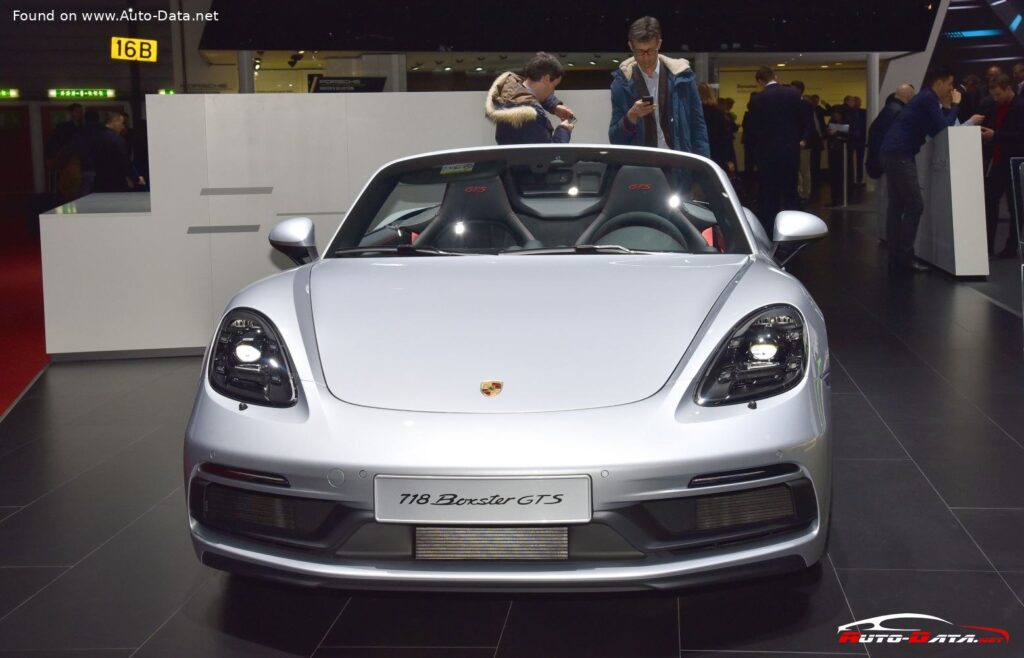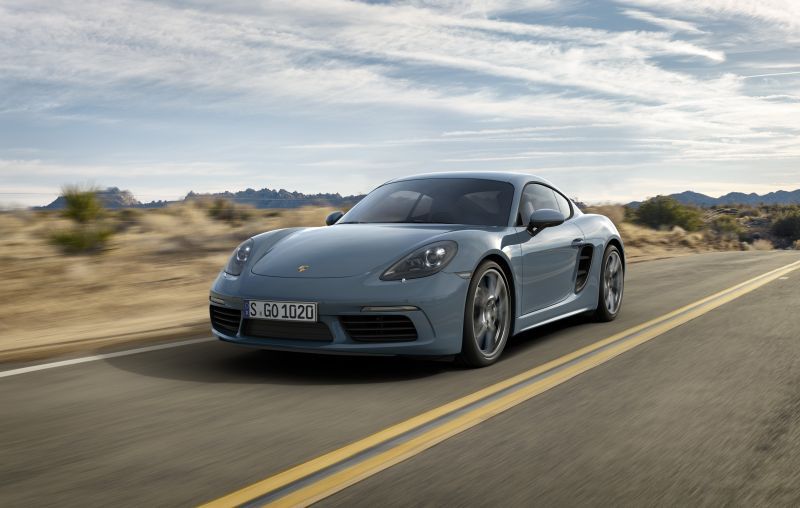
The Porsche 718 Cayman (982) T 2.0, introduced in June 2020, represents a focused iteration of Porsche’s mid-engine sports car. Positioned within the premium sports car segment, the 718 Cayman series, and specifically the ‘T’ variant, aims to deliver a purist driving experience emphasizing agility and driver engagement. The ‘T’ designation, historically used by Porsche for touring-focused models, signifies a lighter weight, a more responsive chassis, and a standard six-speed manual transmission (though a PDK dual-clutch transmission is available, as detailed here). This model builds upon the foundation laid by the 981 generation Cayman, transitioning to turbocharged four-cylinder engines to improve efficiency and broaden the powerband.
Porsche 718 Cayman (982) T 2.0: A Driver-Focused Sports Car
The 982 generation Cayman marked a significant departure from its predecessors with the adoption of a downsized, turbocharged engine lineup. The ‘T 2.0’ model, equipped with a 2.0-liter flat-four engine, delivers 300 horsepower and 380 Nm (280.27 lb.-ft.) of torque. This configuration balances performance with improved fuel economy and reduced emissions, aligning with increasingly stringent environmental regulations. The Cayman’s mid-engine layout contributes to its exceptional handling characteristics, providing a low center of gravity and near-perfect weight distribution. The ‘T’ model further enhances this by reducing weight through features like lighter seats and the omission of certain sound insulation materials.
Engine & Performance
At the heart of the 718 Cayman T 2.0 lies a 1988 cc (121.32 cu. in.) direct-injection turbocharged boxer-four engine, designated DDPB. This engine produces a maximum power output of 300 Hp at 6500 rpm and a peak torque of 380 Nm (280.27 lb.-ft.) available from 2150 to 4500 rpm. The turbocharger and intercooler work in concert to deliver responsive acceleration and a broad torque curve. The engine boasts a compression ratio of 9.5:1 and a maximum engine speed of 7500 rpm. Paired with the optional seven-speed Porsche Doppelkupplung (PDK) dual-clutch transmission, the Cayman T 2.0 achieves a 0-100 km/h (0-62 mph) acceleration time of 4.7-4.9 seconds, and a 0-60 mph time of 4.5-4.7 seconds. The vehicle reaches a maximum speed of 275 km/h (170.88 mph). The weight-to-power ratio stands at 4.6 kg/Hp, and the weight-to-torque ratio is 3.6 kg/Nm, highlighting the car’s performance potential.
Design & Features
The 718 Cayman T 2.0 is a two-door, two-seat coupe characterized by its sleek and aerodynamic profile. The mid-engine layout dictates the car’s proportions, with a long hood, a short rear deck, and pronounced wheel arches. The ‘T’ model features subtle styling cues that distinguish it from other Cayman variants, including unique badging and interior trim. The interior is driver-focused, with a low seating position and ergonomically designed controls. Standard features include a Porsche Communication Management (PCM) infotainment system, a sport steering wheel, and partial leather upholstery. Safety features include ABS (Anti-lock braking system) and a comprehensive airbag system. The trunk offers a minimum capacity of 275 liters (9.71 cu. ft.), providing adequate space for luggage. The car’s drag coefficient is rated at 0.30, contributing to its aerodynamic efficiency.
Technical Specifications
| Brand | Porsche |
| Model | 718 |
| Generation | 718 Cayman (982) |
| Type (Engine) | T 2.0 (300 Hp) PDK |
| Start of production | June, 2020 |
| Powertrain Architecture | Internal Combustion engine |
| Body type | Coupe |
| Seats | 2 |
| Doors | 2 |
| Fuel consumption (urban) | 10.8 l/100 km (21.8 US mpg, 26.2 UK mpg, 9.3 km/l) |
| Fuel consumption (extra urban) | 6.5 l/100 km (36.2 US mpg, 43.5 UK mpg, 15.4 km/l) |
| Fuel consumption (combined) | 8.1 l/100 km (29 US mpg, 34.9 UK mpg, 12.3 km/l) |
| CO2 emissions | 185 g/km |
| Fuel Type | Petrol (Gasoline) |
| Acceleration 0 – 100 km/h | 4.7-4.9 sec |
| Acceleration 0 – 62 mph | 4.7-4.9 sec |
| Acceleration 0 – 60 mph | 4.5-4.7 sec |
| Acceleration 0 – 200 km/h | 17.8-18.1 sec |
| Maximum speed | 275 km/h (170.88 mph) |
| Emission standard | Euro 6d-ISC-FCM |
| Weight-to-power ratio | 4.6 kg/Hp |
| Weight-to-torque ratio | 3.6 kg/Nm |
| Power | 300 Hp @ 6500 rpm |
| Torque | 380 Nm @ 2150-4500 rpm (280.27 lb.-ft. @ 2150-4500 rpm) |
| Maximum engine speed | 7500 rpm |
| Engine layout | Middle, Longitudinal |
| Engine Model/Code | DDPB |
| Engine displacement | 1988 cm3 (121.32 cu. in.) |
| Number of cylinders | 4 |
| Engine configuration | Boxer |
| Cylinder Bore | 91.01 mm (3.58 in.) |
| Piston Stroke | 76.4 mm (3.01 in.) |
| Compression ratio | 9.5:1 |
| Number of valves per cylinder | 4 |
| Fuel injection system | Direct injection |
| Engine aspiration | Turbocharger, Intercooler |
| Engine oil capacity | 5.7 l (6.02 US qt | 5.02 UK qt) |
| Kerb Weight | 1380 kg (3042.38 lbs.) |
| Max. weight | 1685 kg (3714.79 lbs.) |
| Max load | 305 kg (672.41 lbs.) |
| Trunk (boot) space – minimum | 275 l (9.71 cu. ft.) |
| Fuel tank capacity | 54 l (14.27 US gal | 11.88 UK gal) |
| Length | 4379 mm (172.4 in.) |
| Width | 1801 mm (70.91 in.) |
| Width including mirrors | 1994 mm (78.5 in.) |
| Height | 1276 mm (50.24 in.) |
| Wheelbase | 2475 mm (97.44 in.) |
| Front track | 1528 mm (60.16 in.) |
| Rear (Back) track | 1534 mm (60.39 in.) |
| Drag coefficient (Cd) | 0.30 |
| Minimum turning circle (turning diameter) | 10.98 m (36.02 ft.) |
| Drivetrain Architecture | Rear wheel drive |
| Number of gears and type of gearbox | 7 gears, automatic transmission PDK |
| Front suspension | Independent type McPherson |
| Rear suspension | McPherson |
| Front brakes | Ventilated discs, 330×28 mm |
| Rear brakes | Ventilated discs, 299×20 mm |
| Tires size | Front wheel tires: 235/35 ZR20 Rear wheel tires: 265/35 ZR20 |
| Wheel rims size | Front wheel rims: 8J x 18 Rear wheel rims: 10J x 20 |
The Porsche 718 Cayman T 2.0 (982) represents a compelling offering for driving enthusiasts seeking a balanced and engaging sports car experience. Its combination of a potent turbocharged engine, precise handling, and relatively lightweight construction makes it a formidable competitor in its segment.