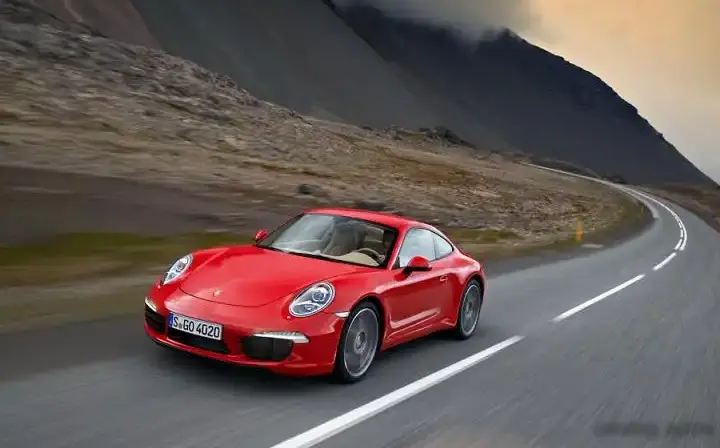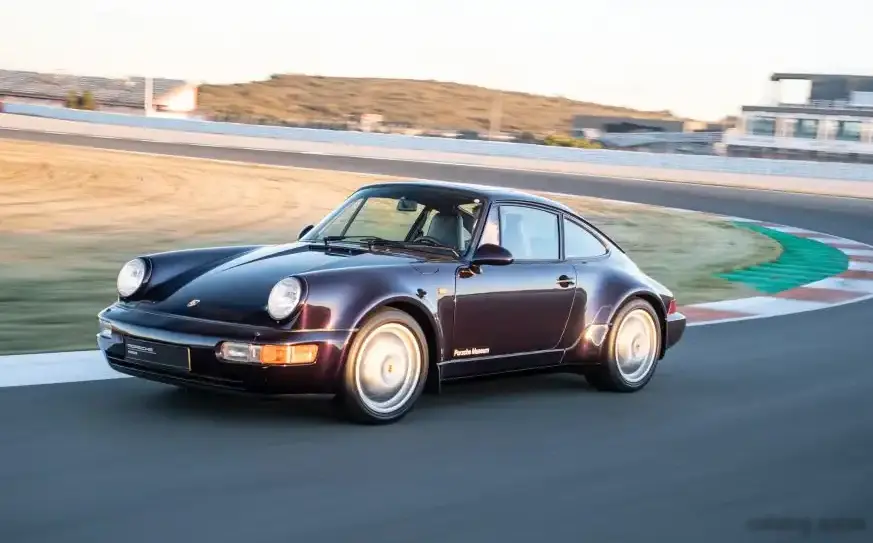
The Porsche 911 (964) Turbo 3.3, produced from 1990 to 1993, represented a significant evolution of Porsche’s iconic sports car. Positioned as the flagship performance variant of the 964 generation (which spanned 1989-1994), the Turbo 3.3 offered a substantial increase in power and performance over the naturally aspirated 964 models. It served as a bridge between the earlier 930 Turbo and the fully redesigned 993 generation, embodying the classic 911 silhouette with updated technology and a more refined driving experience. The 964 platform itself was a major overhaul of the 911, with approximately 85% of the components being new, yet retaining the rear-engined, air-cooled flat-six layout that defined the model.
Technical Specifications
| Brand | Porsche |
| Model | 911 |
| Generation | 911 (964) |
| Type (Engine) | Turbo 3.3 (320 Hp) |
| Start of production | 1990 |
| End of production | 1993 |
| Powertrain Architecture | Internal Combustion engine |
| Body type | Coupe |
| Seats | 4 |
| Doors | 2 |
| Fuel consumption (economy) – urban | 21 l/100 km (11.2 US mpg) |
| Fuel consumption (economy) – extra urban | 8.5 l/100 km (27.7 US mpg) |
| Fuel Type | Petrol (Gasoline) |
| Acceleration 0 – 100 km/h | 5 sec |
| Acceleration 0 – 62 mph | 5 sec |
| Acceleration 0 – 60 mph | 4.8 sec |
| Maximum speed | 270 km/h (167.77 mph) |
| Weight-to-power ratio | 4.6 kg/Hp |
| Weight-to-torque ratio | 3.3 kg/Nm |
| Power | 320 Hp @ 5750 rpm |
| Power per litre | 97 Hp/l |
| Torque | 450 Nm @ 4500 rpm (331.9 lb.-ft. @ 4500 rpm) |
| Engine layout | Rear, Longitudinal |
| Engine Model/Code | M30.69 |
| Engine displacement | 3299 cm3 (201.32 cu. in.) |
| Number of cylinders | 6 |
| Engine configuration | Boxer |
| Cylinder Bore | 97 mm (3.82 in.) |
| Piston Stroke | 74.4 mm (2.93 in.) |
| Compression ratio | 7:1 |
| Number of valves per cylinder | 2 |
| Fuel injection system | Multi-port manifold injection |
| Engine aspiration | Turbocharger |
| Engine oil capacity | 10 l (10.57 US qt | 8.8 UK qt) |
| Kerb Weight | 1470 kg (3240.8 lbs.) |
| Max. weight | 1810 kg (3990.37 lbs.) |
| Max load | 340 kg (749.57 lbs.) |
| Trunk (boot) space – maximum | 90 l (3.18 cu. ft.) |
| Fuel tank capacity | 77 l (20.34 US gal | 16.94 UK gal) |
| Length | 4250 mm (167.32 in.) |
| Width | 1775 mm (69.88 in.) |
| Height | 1310 mm (51.57 in.) |
| Wheelbase | 2270 mm (89.37 in.) |
| Front track | 1434 mm (56.46 in.) |
| Rear (Back) track | 1493 mm (58.78 in.) |
| Minimum turning circle | 11.45 m (37.57 ft.) |
| Drivetrain Architecture | Rear wheel drive |
| Number of gears and type of gearbox | 5 gears, manual transmission |
| Front suspension | Independent type McPherson, Wishbone |
| Rear suspension | Independent coil spring |
| Front brakes | Ventilated discs |
| Rear brakes | Ventilated discs |
| Assisting systems | ABS (Anti-lock braking system) |
| Steering type | Steering rack and pinion |
| Power steering | Hydraulic Steering |
| Tires size | 205/50 R17; 255/40 R17 |
| Wheel rims size | 7J x 17; 9J x 17 |
Powertrain & Engine Architecture
The heart of the 964 Turbo 3.3 is the M30.69 engine, a 3.3-liter, air-cooled flat-six. This engine builds upon the 3.2-liter unit found in the preceding 930 Turbo, but with significant enhancements. Key upgrades included larger cylinder bores, revised crankshaft and connecting rods, and a more sophisticated Bosch Motronic engine management system. The single turbocharger, a KKK K27 unit, provided substantial boost, contributing to the engine’s 320 horsepower and 331 lb-ft of torque. The engine utilized a multi-port fuel injection system, delivering fuel directly into each intake port. The 964 Turbo exclusively came with a 5-speed manual transmission, known for its robust construction and precise shift feel. This transmission was specifically strengthened to handle the increased power output of the turbocharged engine.
Driving Characteristics
The 964 Turbo 3.3 delivered a thrilling, yet demanding, driving experience. The combination of rear-wheel drive and a powerful turbocharged engine meant that careful throttle control was essential, particularly in wet or slippery conditions. The turbo lag was noticeable, but once the boost came on, the acceleration was truly impressive. The 0-60 mph sprint was dispatched in around 4.8 seconds, and the car could reach a top speed of 167.77 mph. Compared to the naturally aspirated 964 Carrera 2, the Turbo 3.3 offered a significantly more visceral and engaging driving experience, but at the cost of some everyday usability. The manual transmission provided precise control, allowing drivers to fully exploit the engine’s power band. The suspension, while firm, offered a good balance between ride comfort and handling precision.
Equipment & Trim Levels
The 964 Turbo 3.3 was relatively sparsely equipped compared to modern luxury cars, but it did offer a range of options. Standard features included power windows, central locking, and a basic stereo system. Leather upholstery was standard, and buyers could choose from a variety of colors. Optional extras included a limited-slip differential, sport seats, a sunroof, and upgraded audio systems. The interior design was functional and driver-focused, with clear analog gauges and a straightforward layout. The Turbo 3.3 also featured a distinctive rear wing and wider wheel arches, visually differentiating it from other 964 models.
Chassis & Braking
The 964 Turbo 3.3 utilized a modified version of the 964 chassis, with reinforced components to handle the increased power. The suspension featured independent coil springs at all four corners, with McPherson struts at the front and semi-trailing arms at the rear. The braking system consisted of ventilated discs on all four wheels, providing ample stopping power. An ABS system was standard, enhancing safety and stability. The car’s relatively lightweight construction (around 3240 lbs) contributed to its agile handling characteristics. The wider track compared to the standard 964 models further improved stability and cornering grip.
Market Reception & Comparison
The 964 Turbo 3.3 was widely praised by automotive journalists for its performance and driving dynamics. Critics noted its raw power, responsive handling, and iconic status. However, some also pointed to its demanding nature and potential for oversteer. Compared to the naturally aspirated 964 Carrera 2, the Turbo 3.3 offered a significant performance upgrade, but at a higher price point. It also required more skilled driving to fully exploit its capabilities. Compared to the later 993 Turbo, the 964 Turbo 3.3 was considered to be slightly less refined, but it retained a certain charm and character that appealed to enthusiasts.
Legacy
The Porsche 964 Turbo 3.3 remains a highly sought-after classic Porsche. Its combination of performance, rarity, and iconic design has made it a favorite among collectors and enthusiasts. The M30.69 engine is known for its durability, but regular maintenance is essential to keep it running smoothly. The 964 Turbo 3.3 represents a pivotal moment in the evolution of the 911, bridging the gap between the classic air-cooled era and the modern water-cooled generation. Today, well-maintained examples command high prices in the used car market, reflecting their enduring appeal and historical significance. The car’s legacy continues to inspire Porsche enthusiasts and serves as a reminder of the brand’s commitment to performance and innovation.