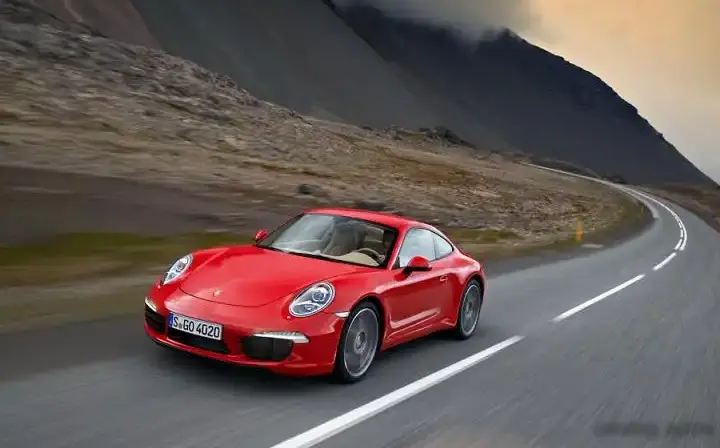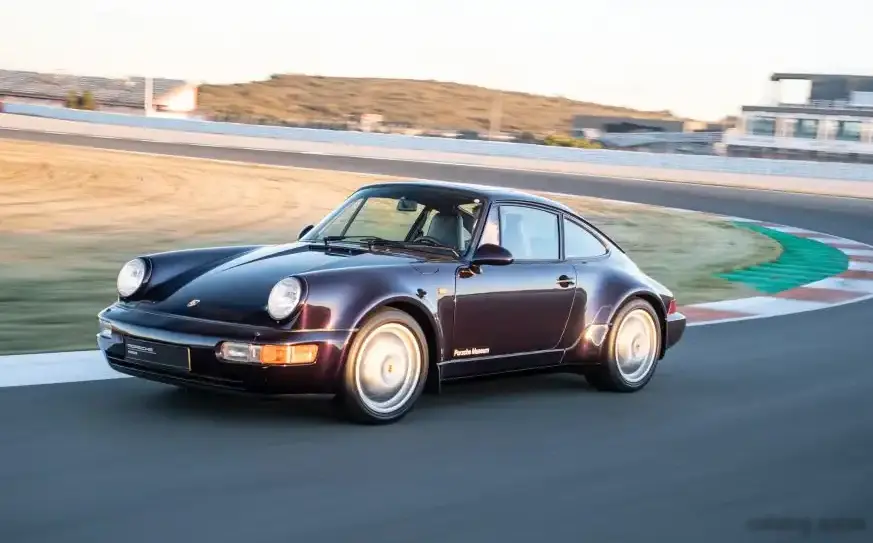
The Porsche 911 (964) Turbo 3.6, produced for the 1993 model year, represented the pinnacle of the 964 generation’s performance capabilities. It was a limited-production model, serving as a final, potent iteration before the introduction of the 993. Built on the 964 platform – a significant evolution of the iconic 911 silhouette – the Turbo 3.6 aimed to deliver uncompromising performance for discerning enthusiasts. This variant occupied the top-tier performance position within the 964 lineup, exceeding the capabilities of the standard 964 and the earlier 3.3-liter Turbo models.
Technical Specifications
| Brand | Porsche |
| Model | 911 |
| Generation | 911 (964) |
| Type (Engine) | Turbo 3.6 (360 Hp) |
| Start of production | 1993 |
| End of production | 1993 |
| Powertrain Architecture | Internal Combustion engine |
| Body type | Coupe |
| Seats | 4 |
| Doors | 2 |
| Fuel consumption (economy) – urban | 21.3 l/100 km (11 US mpg, 13.3 UK mpg, 4.7 km/l) |
| Fuel consumption (economy) – extra urban | 8.3 l/100 km (28.3 US mpg, 34 UK mpg, 12 km/l) |
| Fuel consumption (economy) – combined | 10.3 l/100 km (22.8 US mpg, 27.4 UK mpg, 9.7 km/l) |
| Fuel Type | Petrol (Gasoline) |
| Acceleration 0 – 100 km/h | 4.8 sec |
| Acceleration 0 – 62 mph | 4.8 sec |
| Acceleration 0 – 60 mph | 4.6 sec |
| Maximum speed | 280 km/h (173.98 mph) |
| Power | 360 Hp @ 5500 rpm |
| Power per litre | 100 Hp/l |
| Torque | 520 Nm @ 4200 rpm (383.53 lb.-ft. @ 4200 rpm) |
| Engine layout | Rear, Longitudinal |
| Engine Model/Code | M64.50 |
| Engine displacement | 3600 cm3 (219.69 cu. in.) |
| Number of cylinders | 6 |
| Engine configuration | Boxer |
| Cylinder Bore | 100 mm (3.94 in.) |
| Piston Stroke | 76.4 mm (3.01 in.) |
| Compression ratio | 7.5:1 |
| Number of valves per cylinder | 2 |
| Fuel injection system | Multi-port manifold injection |
| Engine aspiration | Turbocharger |
| Engine oil capacity | 13 l (13.74 US qt, 11.44 UK qt) |
| Trunk (boot) space – minimum | 90 l (3.18 cu. ft.) |
| Fuel tank capacity | 77 l (20.34 US gal, 16.94 UK gal) |
| Length | 4275 mm (168.31 in.) |
| Width | 1775 mm (69.88 in.) |
| Height | 1290 mm (50.79 in.) |
| Wheelbase | 2270 mm (89.37 in.) |
| Front track | 1440 mm (56.69 in.) |
| Rear (Back) track | 1490 mm (58.66 in.) |
| Drivetrain Architecture | Rear wheel drive |
| Number of gears and type of gearbox | 5 gears, manual transmission |
| Front suspension | Independent type McPherson |
| Rear suspension | Independent coil spring |
| Front brakes | Ventilated discs |
| Rear brakes | Ventilated discs |
| Assisting systems | ABS (Anti-lock braking system) |
| Steering type | Steering rack and pinion |
| Power steering | Hydraulic Steering |
| Tires size | 225/40 ZR18 |
| Wheel rims size | 8J x 18 |
INTRODUCTION
The 964 Turbo 3.6 marked a significant leap forward from the preceding 3.3-liter Turbo. Porsche engineers addressed criticisms of the earlier model’s somewhat temperamental handling and turbo lag by increasing displacement and refining the engine management system. The 3.6-liter engine, designated M64.50, was a substantial upgrade, delivering a more linear power delivery and improved drivability. Production was limited to approximately 1,428 units worldwide, making it a highly sought-after collector’s item today. It represented a bridge between the classic, air-cooled 911s and the more modern, water-cooled iterations.
Powertrain & Engine Architecture
The heart of the 964 Turbo 3.6 is its 3.6-liter, twin-turbocharged flat-six engine. This engine built upon the foundation of the 3.3-liter Turbo engine but featured a larger displacement achieved through an increased bore and stroke. The M64.50 engine utilized a single KKK turbocharger, a departure from the twin-turbo setup found in later 911 Turbo models. Fuel delivery was managed by a Bosch Motronic engine management system with multi-port fuel injection. The engine’s compression ratio was lowered to 7.5:1 to accommodate the increased boost pressure. The five-speed manual transmission was the only gearbox option, chosen for its robustness and direct connection to the engine’s power. The transmission featured revised gear ratios optimized for the increased power output.
Driving Characteristics
The 964 Turbo 3.6 offered a dramatically different driving experience compared to earlier 911s and even the 3.3-liter Turbo. The increased displacement and refined turbocharger system resulted in significantly reduced turbo lag and a broader, more usable powerband. Acceleration was exhilarating, with 0-60 mph times consistently recorded in the mid-4-second range. The car felt planted and stable at high speeds, thanks to its all-wheel-drive system and revised suspension geometry. While still demanding to drive, the 3.6-liter Turbo was more forgiving than its predecessors, making it accessible to a wider range of drivers. The manual transmission provided a direct and engaging driving experience, allowing the driver to fully exploit the engine’s power.
Equipment & Trim Levels
The 964 Turbo 3.6 was relatively sparsely equipped by modern standards, focusing on performance rather than luxury. Standard features included power windows, central locking, and a basic audio system. Leather upholstery was standard, and customers could choose from a limited range of colors. Optional extras included a sunroof, limited-slip differential, and upgraded audio systems. The interior design was functional and driver-focused, with a three-spoke steering wheel and analog gauges providing essential information. Air conditioning was a popular option, given the car’s performance capabilities and potential for spirited driving in warm climates.
Chassis & Braking
The 964 Turbo 3.6 featured a reinforced chassis and upgraded suspension components to handle the increased power output. The suspension utilized independent coil springs and shock absorbers at all four corners, with anti-roll bars to reduce body roll. Braking duties were handled by ventilated disc brakes on all four wheels, providing ample stopping power. An ABS anti-lock braking system was standard, enhancing safety and stability. The car rode on 18-inch wheels with high-performance tires, contributing to its excellent grip and handling characteristics. The all-wheel-drive system, a key feature of the 964 Turbo, provided enhanced traction and stability, particularly in challenging conditions.
Market Reception & Comparison
The 964 Turbo 3.6 was widely praised by automotive journalists for its exceptional performance and improved drivability. Critics noted the significant reduction in turbo lag and the more linear power delivery compared to the 3.3-liter Turbo. The car’s handling was also lauded, with reviewers praising its stability and responsiveness. Compared to the standard 964 Carrera 2, the Turbo 3.6 offered a substantial performance upgrade, but at a significantly higher price. The 3.6-liter Turbo was also more expensive to maintain than the naturally aspirated Carrera models, due to the complexity of the turbocharged engine and all-wheel-drive system. Fuel economy, while not a primary concern for buyers of this vehicle, was relatively poor, averaging around 22.8 US mpg in combined driving.
Legacy
The Porsche 964 Turbo 3.6 has become a highly collectible and sought-after model among Porsche enthusiasts. Its limited production numbers and exceptional performance have contributed to its increasing value in the used car market. The M64.50 engine is known for its robustness and reliability, provided it is properly maintained. However, the car’s age and complexity mean that regular maintenance and occasional repairs are inevitable. Today, the 964 Turbo 3.6 represents a significant chapter in the history of the Porsche 911, embodying the spirit of performance and innovation that has defined the model for decades. It remains a thrilling and rewarding driving experience, offering a unique blend of classic 911 character and modern performance capabilities.