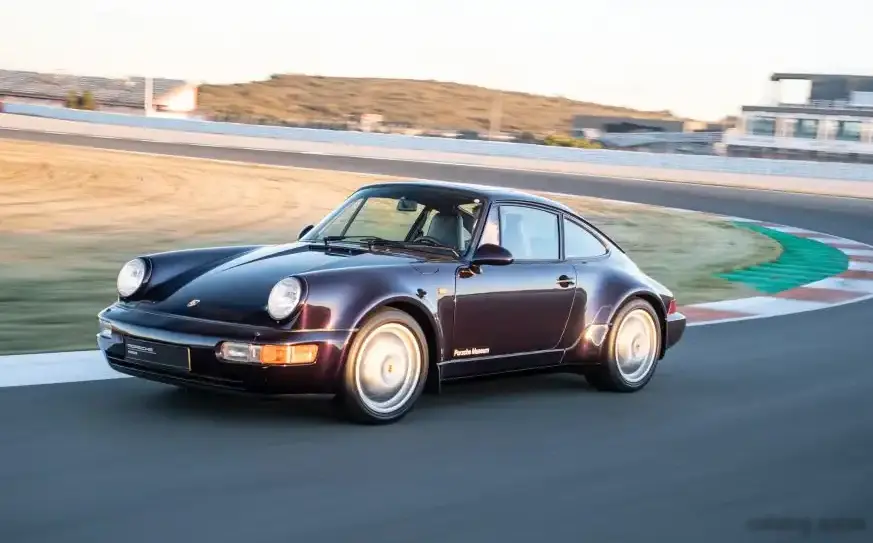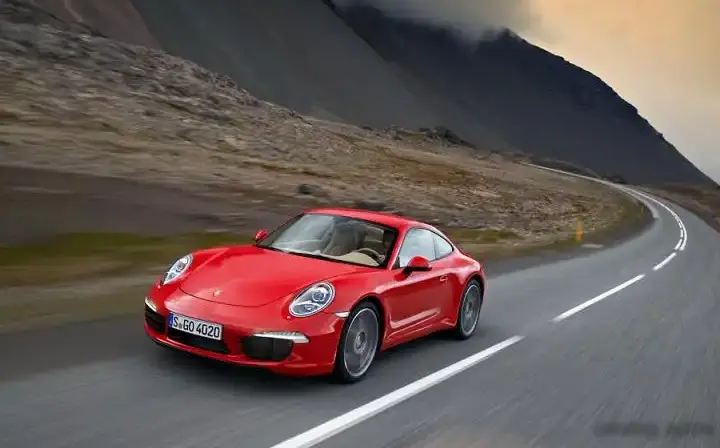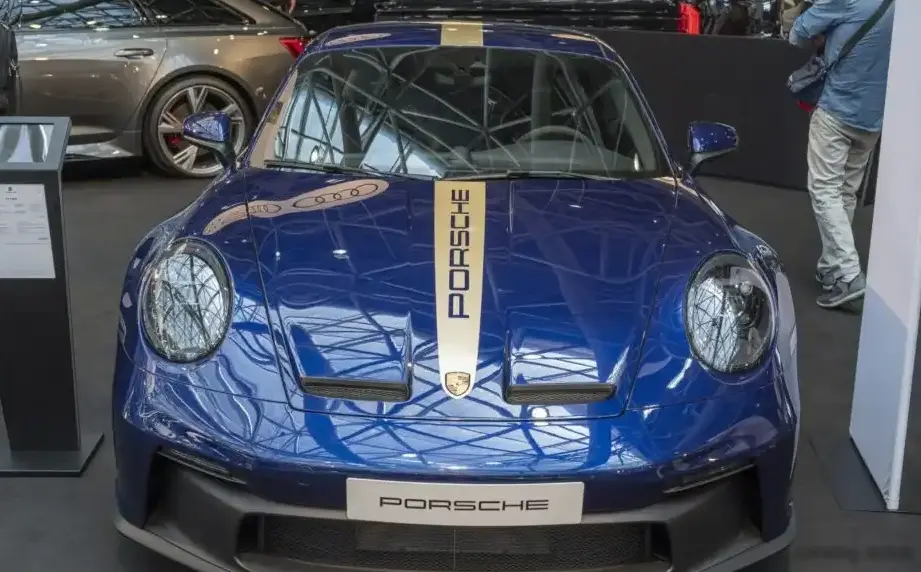
The Porsche 911 (992) GT3 4.0 with the PDK dual-clutch transmission, produced from May 2021 to May 2024, represents a focused, high-performance iteration of Porsche’s iconic sports car. Positioned as the most track-capable variant of the 992 generation (introduced in 2019), the GT3 4.0 builds upon the foundation of the standard 992 Carrera models, but with significant enhancements to its engine, aerodynamics, and chassis. It slots above the Carrera and Carrera S in terms of performance and price, and serves as a stepping stone to even more extreme models like the GT3 RS. The “4.0” designation refers to the naturally aspirated 4.0-liter flat-six engine, a return to a larger displacement for the GT3 lineage, and the PDK transmission offers quicker shifts than the available six-speed manual.
Technical Specifications
| Brand | Porsche |
| Model | 911 |
| Generation | 911 (992) |
| Type (Engine) | GT3 4.0 (510 Hp) PDK |
| Start of production | May, 2021 |
| End of production | May, 2024 |
| Powertrain Architecture | Internal Combustion engine |
| Body type | Coupe |
| Seats | 2 |
| Doors | 2 |
| Fuel consumption (economy) – urban (NEDC) | 17.3 l/100 km (13.6 US mpg, 16.3 UK mpg, 5.8 km/l) |
| Fuel consumption (economy) – extra urban (NEDC) | 9.5 l/100 km (24.8 US mpg, 29.7 UK mpg, 10.5 km/l) |
| Fuel consumption (economy) – combined (NEDC) | 12.4 l/100 km (19 US mpg, 22.8 UK mpg, 8.1 km/l) |
| CO2 emissions (NEDC) | 283 g/km |
| Fuel Type | Petrol (Gasoline) |
| Acceleration 0 – 100 km/h | 3.4 sec |
| Acceleration 0 – 62 mph | 3.4 sec |
| Acceleration 0 – 60 mph | 3.2 sec |
| Acceleration 0 – 200 km/h | 10.8 sec |
| Maximum speed | 318 km/h (197.6 mph) |
| Emission standard | Euro 6d-ISC-FCM |
| Weight-to-power ratio | 2.8 kg/Hp, 355.4 Hp/tonne |
| Weight-to-torque ratio | 3.1 kg/Nm, 327.5 Nm/tonne |
| Power | 510 Hp @ 8400 rpm |
| Power per litre | 127.6 Hp/l |
| Torque | 470 Nm @ 6100 rpm (346.65 lb.-ft. @ 6100 rpm) |
| Maximum engine speed | 9000 rpm |
| Engine layout | Rear, Longitudinal |
| Engine Model/Code | DRM |
| Engine displacement | 3996 cm3 (243.85 cu. in.) |
| Number of cylinders | 6 |
| Engine configuration | Boxer |
| Cylinder Bore | 102 mm (4.02 in.) |
| Piston Stroke | 81.5 mm (3.21 in.) |
| Compression ratio | 13.3:1 |
| Number of valves per cylinder | 4 |
| Fuel injection system | Direct injection |
| Kerb Weight | 1435 kg (3163.63 lbs.) |
| Max. weight | 1782 kg (3928.64 lbs.) |
| Max load | 347 kg (765 lbs.) |
| Trunk (boot) space – minimum | 132 l (4.66 cu. ft.) |
| Fuel tank capacity | 64 l (16.91 US gal, 14.08 UK gal) |
| Length | 4573 mm (180.04 in.) |
| Width | 1852 mm (72.91 in.) |
| Width including mirrors | 2027 mm (79.8 in.) |
| Height | 1279 mm (50.35 in.) |
| Wheelbase | 2457 mm (96.73 in.) |
| Front track | 1601 mm (63.03 in.) |
| Rear (Back) track | 1553 mm (61.14 in.) |
| Drag coefficient (Cd) | 0.34 |
| Minimum turning circle (turning diameter) | 10.4 m (34.12 ft.) |
| Drivetrain Architecture | Rear wheel drive |
| Number of gears and type of gearbox | 7 gears, automatic transmission PDK |
| Front suspension | Double wishbone |
| Rear suspension | Independent multi-link suspension |
| Front brakes | Ventilated discs, 408×34 mm |
| Rear brakes | Ventilated discs, 380×30 mm |
| Assisting systems | ABS (Anti-lock braking system) |
| Steering type | Steering rack and pinion |
| Power steering | Electric Steering |
| Tires size | Front wheel tires: 255/35 ZR 20, Rear wheel tires: 315/30 ZR 21 |
| Wheel rims size | Front wheel rims: 9.5 J x 20, Rear wheel rims: 12 J x 21 |
Powertrain & Engine Architecture
The heart of the 992 GT3 4.0 PDK is the 4.0-liter naturally aspirated flat-six engine, designated DRM. This engine is directly derived from the 911 RSR race car, showcasing Porsche’s commitment to transferring motorsport technology to its production vehicles. It features a dry-sump lubrication system, enabling a lower center of gravity and improved oil supply during aggressive cornering. The engine utilizes direct fuel injection and a high 13.3:1 compression ratio to maximize power and efficiency. The valvetrain employs titanium connecting rods and a lightweight crankshaft, contributing to the engine’s ability to rev to a remarkable 9,000 rpm. The seven-speed PDK dual-clutch transmission provides incredibly fast and precise gear changes, optimized for both road and track use. Unlike some PDK variants, the GT3’s PDK is tuned for more aggressive shift points and a more direct feel.
Driving Characteristics
The 911 GT3 4.0 PDK delivers a driving experience that is both exhilarating and remarkably precise. The 510 horsepower and 346 lb-ft of torque are readily available, providing strong acceleration throughout the rev range. The PDK transmission eliminates any lag in gear changes, allowing the driver to maintain momentum and fully exploit the engine’s power. Compared to the six-speed manual version, the PDK offers slightly quicker acceleration times, but some purists prefer the greater engagement of the manual gearbox. The GT3’s suspension, featuring adaptive dampers, provides exceptional body control and minimizes roll during cornering. The steering is incredibly responsive and provides excellent feedback, inspiring confidence in the driver. The car feels balanced and predictable, making it a joy to drive on both winding roads and the racetrack.
Equipment & Trim Levels
The GT3 4.0 PDK came relatively well-equipped as standard, focusing on performance-oriented features. Standard interior appointments included sport seats with enhanced bolstering, a GT Sport steering wheel, and carbon fiber trim. While not overtly luxurious, the interior prioritized functionality and driver focus. Optional extras were extensive, allowing buyers to personalize their GT3 to their specific preferences. Popular options included a carbon fiber roof, ceramic composite brakes (PCCB), and a Club Sport package, which added a roll cage, six-point harnesses, and a fire extinguisher. Exterior options included various wheel finishes, paint colors, and aerodynamic enhancements.
Chassis & Braking
The GT3 4.0 features a significantly revised chassis compared to the standard 992 Carrera. It benefits from a wider track, stiffer springs, and more aggressive suspension geometry. The rear wheels are wider than those on other 911 models, providing increased grip. The braking system consists of large, ventilated discs with six-piston calipers at the front and four-piston calipers at the rear. ABS (Anti-lock Braking System) is standard, providing enhanced stopping power and stability. The car’s lightweight construction, achieved through the use of aluminum and carbon fiber, contributes to its agile handling and responsive driving dynamics.
Market Reception & Comparison
The 911 GT3 4.0 PDK was widely praised by automotive critics for its exceptional performance, handling, and driver engagement. It was lauded as one of the most rewarding sports cars available, offering a pure and visceral driving experience. Compared to the standard 911 Carrera and Carrera S, the GT3 4.0 represents a significant step up in terms of performance and track capability. While the GT3’s fuel economy is relatively poor (19 US mpg combined), this is a secondary concern for its target audience. Compared to the GT3 with a manual transmission, the PDK version offered slightly quicker lap times but was often seen as less engaging by driving enthusiasts.
Legacy
The 992 GT3 4.0 PDK has quickly established itself as a highly sought-after model in the used car market. Its combination of performance, exclusivity, and Porsche’s reputation for reliability has made it a desirable collector’s item. The DRM engine is known for its durability, and with proper maintenance, it is expected to provide many years of reliable service. The PDK transmission has also proven to be robust and dependable. As a testament to its engineering excellence, the 992 GT3 4.0 PDK continues to be a benchmark for high-performance sports cars, and its influence can be seen in subsequent Porsche models.