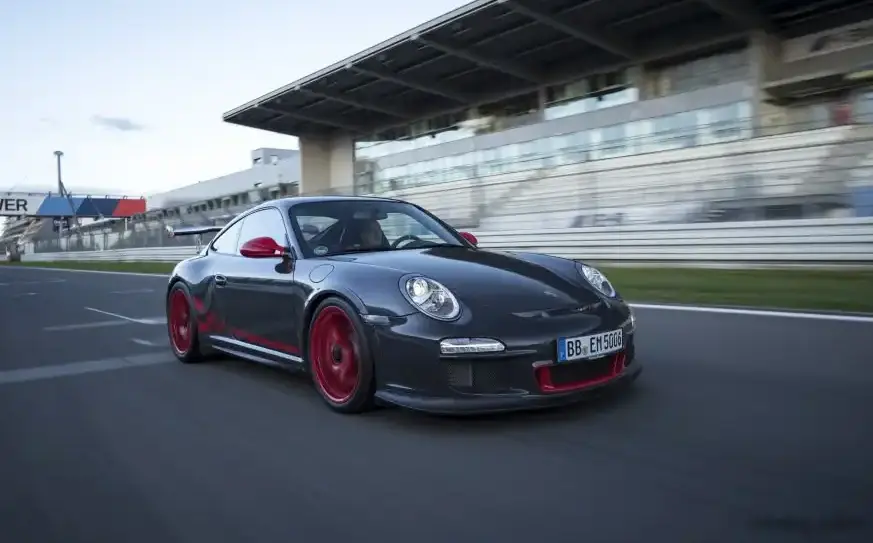
The Porsche 911 (997) GT3 RS 3.8, produced from 2009 to 2011, represents a focused, high-performance iteration of the 997 generation 911. Positioned as the most track-oriented variant of the 997.2 facelift, the GT3 RS 3.8 built upon the foundation of the standard GT3, offering increased power, reduced weight, and enhanced aerodynamic elements. It was designed for serious enthusiasts and track day participants, offering a visceral driving experience largely uncompromised by daily-driver considerations. The 997.2 generation itself was a significant refresh of the 997 platform, introducing direct fuel injection and a revised engine management system across the range.
Technical Specifications
| Brand | Porsche |
| Model | 911 |
| Generation | 911 (997, facelift 2008) |
| Type (Engine) | GT3 RS 3.8 (450 Hp) |
| Start of production | 2009 |
| End of production | 2011 |
| Powertrain Architecture | Internal Combustion engine |
| Body type | Coupe |
| Seats | 2-4 |
| Doors | 2 |
| Fuel consumption (economy) – urban | 19.4 l/100 km (12.1 US mpg, 14.6 UK mpg, 5.2 km/l) |
| Fuel consumption (economy) – extra urban | 9.6 l/100 km (24.5 US mpg, 29.4 UK mpg, 10.4 km/l) |
| Fuel consumption (economy) – combined | 13.2 l/100 km (17.8 US mpg, 21.4 UK mpg, 7.6 km/l) |
| CO2 emissions | 314 g/km |
| Fuel Type | Petrol (Gasoline) |
| Acceleration 0 – 100 km/h | 4 sec |
| Acceleration 0 – 62 mph | 4 sec |
| Acceleration 0 – 60 mph | 3.8 sec |
| Maximum speed | 310 km/h (192.63 mph) |
| Emission standard | Euro 5 |
| Weight-to-power ratio | 3 kg/Hp, 328.5 Hp/tonne |
| Weight-to-torque ratio | 3.2 kg/Nm, 313.9 Nm/tonne |
| Power | 450 Hp @ 7900 rpm |
| Power per litre | 118.5 Hp/l |
| Torque | 430 Nm @ 6750 rpm (317.15 lb.-ft. @ 6750 rpm) |
| Engine layout | Rear, Longitudinal |
| Engine Model/Code | M97.77 |
| Engine displacement | 3797 cm3 (231.71 cu. in.) |
| Number of cylinders | 6 |
| Engine configuration | Boxer |
| Compression ratio | 12.2:1 |
| Number of valves per cylinder | 4 |
| Fuel injection system | Direct injection |
| Engine aspiration | Naturally aspirated engine |
| Valvetrain | DOHC |
| Engine oil capacity | 9 l (9.51 US qt | 7.92 UK qt) |
| Coolant | 28 l (29.59 US qt | 24.64 UK qt) |
| Kerb Weight | 1370 kg (3020.33 lbs) |
| Max. weight | 1680 kg (3703.77 lbs) |
| Max load | 310 kg (683.43 lbs) |
| Trunk (boot) space – maximum | 105 l (3.71 cu. ft.) |
| Fuel tank capacity | 67 l (17.7 US gal | 14.74 UK gal) |
| Length | 4460 mm (175.59 in) |
| Width | 1808 mm (71.18 in) |
| Width including mirrors | 1952 mm (76.85 in) |
| Height | 1280 mm (50.39 in) |
| Wheelbase | 2355 mm (92.72 in) |
| Drag coefficient (Cd) | 0.33 |
| Minimum turning circle | 10.9 m (35.76 ft) |
| Drivetrain Architecture | Rear wheel drive |
| Number of gears and type of gearbox | 6 gears, manual transmission |
| Front suspension | Independent type McPherson |
| Rear suspension | Independent multi-link suspension |
| Front brakes | Ventilated discs, 380 mm |
| Rear brakes | Ventilated discs, 350 mm |
| Assisting systems | ABS (Anti-lock braking system) |
| Steering type | Steering rack and pinion |
| Power steering | Hydraulic Steering |
| Tires size | 245/35 ZR19; 325/30 ZR19 |
| Wheel rims size | 9J x 19; 12J x 19 |
Powertrain & Engine Architecture
At the heart of the GT3 RS 3.8 lies the M97.77 engine, a 3.8-liter naturally aspirated flat-six. This engine is a direct descendant of the engines used in Porsche’s motorsport programs, benefiting from extensive development and refinement. The key upgrade over the standard 997.2 GT3 was the increased displacement, achieved through a larger bore and stroke. Direct fuel injection (DFI) was a crucial component, optimizing combustion efficiency and contributing to the engine’s high output. The engine featured a dry-sump lubrication system, essential for maintaining oil supply during the high g-forces experienced on track. The valvetrain employed dual overhead camshafts (DOHC) with four valves per cylinder, allowing for precise control of airflow and optimal engine breathing. The sole transmission option was a six-speed manual gearbox, chosen for its direct connection and driver engagement. The gearbox featured shorter ratios compared to the standard 911, further enhancing acceleration.
Driving Characteristics
The driving experience in the GT3 RS 3.8 is defined by its raw, unfiltered connection to the road. The 450 horsepower engine delivers a linear powerband, peaking at 7,900 rpm, encouraging drivers to exploit the full rev range. The manual transmission, with its precise shift action, allows for complete control over the powertrain. The shorter gear ratios contribute to blistering acceleration, with 0-60 mph times consistently under 4 seconds. The car feels incredibly responsive, with minimal understeer and a willingness to rotate on corner entry. The suspension, tuned for track performance, is firm but communicative, providing excellent body control. While not entirely forgiving on rough surfaces, the GT3 RS 3.8 excels in providing feedback and inspiring confidence at high speeds. Compared to the standard GT3, the RS model felt noticeably more aggressive and focused, sacrificing some everyday usability for enhanced track performance.
Equipment & Trim Levels
The GT3 RS 3.8 was purposefully stripped of unnecessary weight. Interior appointments were focused on functionality rather than luxury. Standard features included sport seats with carbon fiber backing, a Clubsport package (including a roll cage and six-point harnesses – often deleted by buyers), and Alcantara trim throughout the cabin. Air conditioning and a radio were optional extras, with many owners opting to delete them to save weight. Exterior features included a distinctive fixed rear wing, aggressive front and rear bumpers, and lightweight alloy wheels. Paint options were limited to a selection of solid colors and a few special order shades.
Chassis & Braking
The chassis of the GT3 RS 3.8 was heavily modified for track use. The suspension featured adjustable dampers and stiffer springs compared to the standard 911. A wider track and revised suspension geometry further enhanced handling stability. Braking performance was exceptional, thanks to large ventilated discs and high-performance calipers. ABS was standard, but the system was tuned to allow for more aggressive braking inputs. The car rode on 19-inch wheels wrapped in high-grip tires, maximizing mechanical grip.
Market Reception & Comparison
The GT3 RS 3.8 was widely praised by automotive journalists for its exceptional performance and engaging driving experience. Critics lauded its raw power, precise handling, and track-focused design. Compared to the standard GT3, the RS model was considered a more serious track weapon, offering a more intense and rewarding driving experience. However, its firm ride and lack of creature comforts made it less suitable for everyday use. Fuel economy, unsurprisingly, was poor, reflecting the car’s high-performance nature. Reliability was generally good, although the high-revving engine and track-focused components required diligent maintenance.
Legacy
The Porsche 911 (997) GT3 RS 3.8 has become a highly sought-after collector’s item. Its limited production numbers and exceptional performance have driven up values in the used car market. The M97.77 engine is known for its durability when properly maintained, although regular oil changes and valve adjustments are crucial. The GT3 RS 3.8 represents a high point in the evolution of the 911, embodying Porsche’s commitment to delivering uncompromising performance and a pure driving experience. It remains a benchmark for track-focused sports cars, and a testament to the enduring appeal of the naturally aspirated engine.