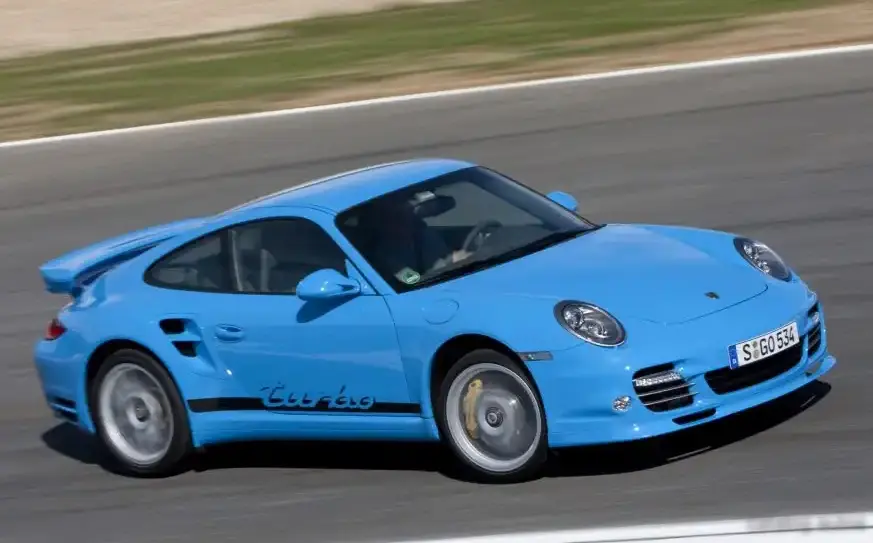
The Porsche 911 Turbo (997.2) represents the pinnacle of performance within the 997 generation of Porsche’s iconic sports car. Introduced for the 2010 model year and continuing through 2011, this facelifted version of the 997 brought significant enhancements over its predecessor, most notably a revised engine, updated styling, and the widespread adoption of Porsche’s dual-clutch PDK transmission. Positioned as the flagship model, the 911 Turbo offered a substantial leap in power and technology, catering to enthusiasts seeking uncompromising performance and exclusivity. It built upon the established 997 platform (derived from the Porsche 911 Carrera) but distinguished itself with unique bodywork, a wider track, and a more potent powertrain.
Technical Specifications
| Brand | Porsche |
| Model | 911 |
| Generation | 911 (997, facelift 2008) |
| Type (Engine) | Turbo 3.8 (500 Hp) PDK |
| Start of production | 2009 |
| End of production | 2011 |
| Powertrain Architecture | Internal Combustion engine |
| Body type | Coupe |
| Seats | 4 |
| Doors | 2 |
| Fuel consumption (economy) – urban | 16.5 l/100 km (14.3 US mpg, 17.1 UK mpg, 6.1 km/l) |
| Fuel consumption (economy) – extra urban | 8.1 l/100 km (29 US mpg, 34.9 UK mpg, 12.3 km/l) |
| Fuel consumption (economy) – combined | 11.4 l/100 km (20.6 US mpg, 24.8 UK mpg, 8.8 km/l) |
| CO2 emissions | 268 g/km |
| Fuel Type | Petrol (Gasoline) |
| Acceleration 0 – 100 km/h | 3.4-3.6 sec |
| Acceleration 0 – 62 mph | 3.4-3.6 sec |
| Acceleration 0 – 60 mph | 3.2 sec |
| Maximum speed | 312 km/h (193.87 mph) |
| Emission standard | Euro 5 |
| Weight-to-power ratio | 3.2 kg/Hp, 313.5 Hp/tonne |
| Weight-to-torque ratio | 2.5 kg/Nm, 407.5 Nm/tonne |
| Power | 500 Hp @ 6000-6500 rpm |
| Power per litre | 131.6 Hp/l |
| Torque | 650 Nm @ 1950-5000 rpm (479.42 lb.-ft. @ 1950-5000 rpm) |
| Engine layout | Front, Longitudinal |
| Engine Model/Code | MA1.70 |
| Engine displacement | 3800 cm3 (231.89 cu. in.) |
| Number of cylinders | 6 |
| Engine configuration | Boxer |
| Compression ratio | 9.8:1 |
| Number of valves per cylinder | 4 |
| Fuel injection system | Direct injection |
| Engine aspiration | Turbocharger, Intercooler |
| Engine oil capacity | 8 l (8.45 US qt | 7.04 UK qt) |
| Coolant | 29 l (30.64 US qt | 25.52 UK qt) |
| Kerb Weight | 1595 kg (3516.37 lbs.) |
| Max. weight | 1960 kg (4321.06 lbs.) |
| Max load | 365 kg (804.69 lbs.) |
| Trunk (boot) space – maximum | 105 l (3.71 cu. ft.) |
| Fuel tank capacity | 67 l (17.7 US gal | 14.74 UK gal) |
| Length | 4450 mm (175.2 in.) |
| Width | 1852 mm (72.91 in.) |
| Width including mirrors | 1952 mm (76.85 in.) |
| Height | 1300 mm (51.18 in.) |
| Wheelbase | 2350 mm (92.52 in.) |
| Drag coefficient (Cd) | 0.31 |
| Minimum turning circle | 10.9 m (35.76 ft.) |
| Drive wheel | All wheel drive (4×4) |
| Number of gears and type of gearbox | 7 gears, automatic transmission PDK |
| Front suspension | Independent type McPherson |
| Rear suspension | Independent multi-link suspension |
| Front brakes | Ventilated discs, 350 mm |
| Rear brakes | Ventilated discs, 350 mm |
| Assisting systems | ABS (Anti-lock braking system) |
| Steering type | Steering rack and pinion |
| Power steering | Hydraulic Steering |
| Tires size | 235/35 ZR19; 305/30 ZR19 |
| Wheel rims size | 8.5J x 19; 11J x 19 |
Powertrain & Engine Architecture
At the heart of the 997.2 Turbo lies a 3.8-liter twin-turbocharged flat-six engine, designated the MA1.70. This engine represented a significant upgrade from the 3.6-liter unit in the previous 997 Turbo. Key improvements included revised cylinder heads, direct fuel injection, and larger turbochargers. The direct injection system allowed for more precise fuel delivery, enhancing both power and efficiency. The engine produced 500 horsepower at 6,000-6,500 rpm and a substantial 650 Nm (479 lb-ft) of torque available from a remarkably low 1,950 rpm, sustaining through 5,000 rpm. This broad torque curve was a hallmark of the engine’s usability. The engine’s flat-six configuration (a “boxer” engine) contributes to a low center of gravity, improving handling characteristics. The vast majority of 997.2 Turbos were equipped with Porsche’s seven-speed PDK dual-clutch transmission. This transmission offered incredibly fast and smooth gear changes, contributing significantly to the car’s acceleration and overall driving experience. A six-speed manual transmission was available, but it was a relatively rare option.
Driving Characteristics
The 911 Turbo (997.2) with the PDK transmission delivers breathtaking acceleration. The 0-60 mph sprint is dispatched in around 3.2 seconds, and top speed is electronically limited to 193 mph. The PDK transmission’s quick shifts and intelligent programming ensure minimal interruption of power delivery. Compared to the standard Carrera models, the Turbo offers a significantly more powerful and responsive driving experience. The wider track and revised suspension tuning provide increased stability and grip, particularly during cornering. While the Turbo is undeniably a performance-focused machine, the PDK transmission and sophisticated electronic systems make it surprisingly tractable for everyday driving. The engine’s abundant torque means that strong acceleration is available in virtually any gear. The all-wheel-drive system provides excellent traction, even in inclement weather.
Equipment & Trim Levels
The 911 Turbo (997.2) came standard with a comprehensive list of features, befitting its flagship status. These included leather upholstery, a Bose audio system, bi-xenon headlights, automatic climate control, and Porsche’s Active Suspension Management (PASM) system. Optional extras were plentiful, allowing buyers to personalize their vehicles. Popular options included carbon fiber interior trim, sport seats, a sunroof, and Porsche’s Ceramic Composite Brakes (PCCB). The interior design was largely consistent with other 997 models, but the Turbo featured unique trim elements and badging to distinguish it from the Carrera variants.
Chassis & Braking
The 997.2 Turbo’s chassis was specifically tuned to handle the increased power and performance. It featured a wider track than the standard Carrera, along with stiffer springs and dampers. Porsche’s Active Suspension Management (PASM) system allowed drivers to adjust the suspension settings to suit their preferences. Braking duties were handled by large, ventilated disc brakes on all four wheels. The standard brakes provided ample stopping power, but many buyers opted for the optional PCCB ceramic composite brakes, which offered even greater fade resistance and reduced weight. The all-wheel-drive system distributed power to all four wheels, maximizing traction and stability.
Market Reception & Comparison
The 911 Turbo (997.2) was widely praised by automotive critics for its exceptional performance, handling, and refinement. It was consistently ranked among the fastest and most capable sports cars on the market. Compared to the naturally aspirated 911 Carrera models, the Turbo offered a significant performance advantage, but at a substantial price premium. The Turbo also competed with other high-performance sports cars, such as the Audi R8 and the Lamborghini Gallardo. Fuel economy, while not a primary concern for buyers in this segment, was reasonable for a car of this performance level, averaging around 20.6 US mpg in combined driving. Reliability was generally good, although the complex twin-turbocharged engine and PDK transmission required regular maintenance.
Legacy
The Porsche 911 Turbo (997.2) remains a highly sought-after sports car in the used car market. Its combination of performance, luxury, and exclusivity has ensured its enduring appeal. The PDK transmission has proven to be remarkably reliable, although regular fluid changes are essential. The twin-turbocharged engine is generally robust, but preventative maintenance is crucial to avoid costly repairs. The 997.2 Turbo represents a sweet spot in the 911 lineage, offering a compelling blend of classic Porsche character and modern technology. It continues to be a benchmark for performance and driving enjoyment.