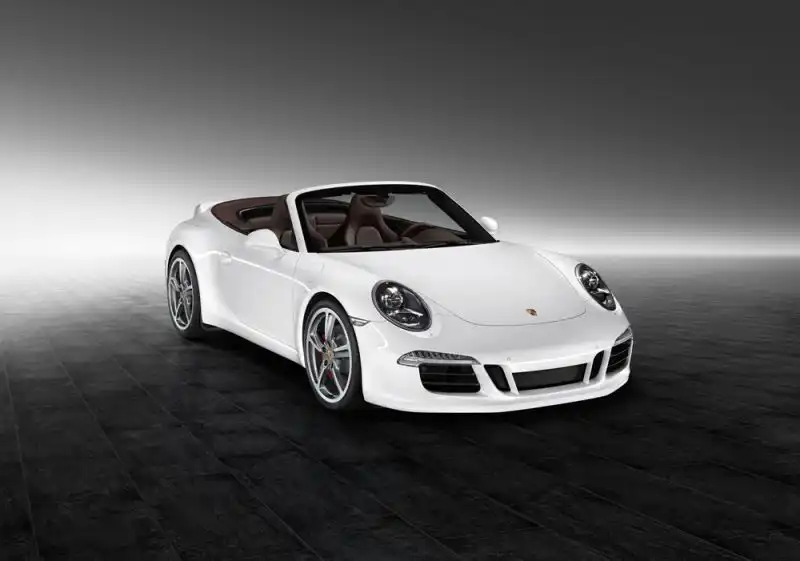
The Porsche 911 Turbo Cabriolet (991) represents the pinnacle of open-top performance within the 991 generation of the iconic 911. Produced from 2013 to 2016, this variant combined the exhilarating performance of the 911 Turbo with the added enjoyment of open-air driving. It occupied the top-tier performance position within the 991 Cabriolet range, sitting above the Carrera and Carrera S models, and offering a more focused driving experience than the Targa variants. The 991 generation itself was a significant evolution of the 911, featuring a longer wheelbase, a wider track, and a more sophisticated chassis compared to its predecessor, the 997.
Technical Specifications
| Brand | Porsche |
| Model | 911 |
| Generation | 911 Cabriolet (991) |
| Type (Engine) | Turbo 3.8 (520 Hp) PDK |
| Start of production | 2013 |
| End of production | 2016 |
| Powertrain Architecture | Internal Combustion engine |
| Body type | Cabriolet |
| Seats | 4 |
| Doors | 2 |
| Fuel consumption (economy) – urban | 13.4 l/100 km (17.6 US mpg, 21.1 UK mpg, 7.5 km/l) |
| Fuel consumption (economy) – extra urban | 7.8 l/100 km (30.2 US mpg, 36.2 UK mpg, 12.8 km/l) |
| Fuel consumption (economy) – combined | 9.9 l/100 km (23.8 US mpg, 28.5 UK mpg, 10.1 km/l) |
| CO2 emissions | 231 g/km |
| Fuel Type | Petrol (Gasoline) |
| Acceleration 0 – 100 km/h | 3.5 sec |
| Acceleration 0 – 62 mph | 3.5 sec |
| Acceleration 0 – 60 mph | 3.3 sec |
| Maximum speed | 315 km/h (195.73 mph) |
| Emission standard | Euro 6 |
| Weight-to-power ratio | 3.2 kg/Hp, 312.3 Hp/tonne |
| Weight-to-torque ratio | 2.5 kg/Nm, 396.4 Nm/tonne |
| Power | 520 Hp @ 6000-6500 rpm |
| Power per litre | 136.8 Hp/l |
| Torque | 660 Nm @ 1950-5000 rpm (486.79 lb.-ft. @ 1950-5000 rpm) |
| Engine layout | Rear, Longitudinal |
| Engine Model/Code | MA1.71 |
| Engine displacement | 3800 cm3 (231.89 cu. in.) |
| Number of cylinders | 6 |
| Engine configuration | Boxer |
| Cylinder Bore | 102 mm (4.02 in.) |
| Piston Stroke | 77.5 mm (3.05 in.) |
| Compression ratio | 9.8:1 |
| Number of valves per cylinder | 4 |
| Fuel injection system | Direct injection |
| Engine aspiration | Twin-Turbo, Intercooler |
| Engine oil capacity | 7.5 l (7.93 US qt | 6.6 UK qt) |
| Coolant | 26.3 l (27.79 US qt | 23.14 UK qt) |
| Kerb Weight | 1665 kg (3670.7 lbs.) |
| Max. weight | 2045 kg (4508.45 lbs.) |
| Max load | 380 kg (837.76 lbs.) |
| Trunk (boot) space – minimum | 275 l (9.71 cu. ft.) |
| Fuel tank capacity | 68 l (17.96 US gal | 14.96 UK gal) |
| Length | 4506 mm (177.4 in.) |
| Width | 1880 mm (74.02 in.) |
| Height | 1292 mm (50.87 in.) |
| Wheelbase | 2450 mm (96.46 in.) |
| Front track | 1541 mm (60.67 in.) |
| Rear (Back) track | 1590 mm (62.6 in.) |
| Drag coefficient (Cd) | 0.31 |
| Minimum turning circle | 10.4 m (34.12 ft.) |
| Drive wheel | All wheel drive (4×4) |
| Number of gears and type of gearbox | 7 gears, automatic transmission PDK |
| Front suspension | Independent type McPherson |
| Rear suspension | Independent multi-link suspension |
| Front brakes | Ventilated discs, 380 mm |
| Rear brakes | Ventilated discs, 380 mm |
| Assisting systems | ABS (Anti-lock braking system) |
| Steering type | Steering rack and pinion |
| Power steering | Electric Steering |
| Tires size | 245/35 ZR20; 305/30 ZR20 |
| Wheel rims size | 8.5J x 20; 11J x 20 |
Powertrain & Engine Architecture
At the heart of the 911 Turbo Cabriolet (991) lies the MA1.71 engine, a 3.8-liter twin-turbocharged flat-six (boxer) engine. This engine is a direct descendant of the engines used in previous 911 Turbo models, but significantly refined for increased power and efficiency. The engine utilizes direct fuel injection, delivering fuel directly into the combustion chambers for precise control and improved combustion. Each cylinder features four valves, enhancing airflow and contributing to the engine’s high output. The twin turbochargers, with variable turbine geometry, minimize turbo lag and provide a broad, flat torque curve. The engine is mounted longitudinally at the rear of the vehicle, a defining characteristic of the 911. Paired with the engine is Porsche’s seven-speed PDK (Porsche Doppelkupplung) dual-clutch transmission. This transmission offers incredibly fast and smooth gear changes, contributing to the car’s exceptional acceleration. The PDK transmission allows for both fully automatic operation and manual gear selection via steering wheel-mounted paddles.
Driving Characteristics
The 911 Turbo Cabriolet (991) delivers a truly exhilarating driving experience. The 520 horsepower and 660 lb-ft of torque provide immense acceleration, with a 0-60 mph time of just 3.3 seconds. The PDK transmission ensures that power is delivered seamlessly, with minimal interruption. The all-wheel-drive system provides exceptional traction, allowing the car to put its power down effectively even in challenging conditions. Compared to the naturally aspirated Carrera models, the Turbo Cabriolet offers a significantly more powerful and responsive driving experience. While the Carrera models prioritize a more engaging, analog feel, the Turbo focuses on sheer performance and technological sophistication. The gear ratios in the PDK transmission are optimized for both acceleration and high-speed cruising. The suspension is tuned to provide a balance between comfort and handling, offering a surprisingly compliant ride for a high-performance sports car.
Equipment & Trim Levels
The 911 Turbo Cabriolet (991) came standard with a comprehensive list of features, reflecting its position as the flagship Cabriolet model. Standard equipment included a power-retractable soft top, leather upholstery, heated and ventilated front seats, a premium sound system, and Porsche’s Communication Management system with navigation. Optional extras were plentiful, allowing buyers to personalize their vehicles to a high degree. Popular options included carbon fiber interior trim, sport seats with increased bolstering, and a lift system to raise the front of the car for navigating speed bumps. The interior design was focused on driver ergonomics and luxury, with high-quality materials and a clean, modern aesthetic.
Chassis & Braking
The 991 generation 911 featured a significantly improved chassis compared to previous generations. The longer wheelbase and wider track contribute to increased stability and handling precision. The suspension utilizes independent McPherson struts at the front and a multi-link setup at the rear. Porsche’s Active Suspension Management (PASM) system, which electronically adjusts the damping characteristics, was standard equipment. Braking performance is exceptional, thanks to large ventilated discs at all four corners. The braking system is further enhanced by Porsche Ceramic Composite Brakes (PCCB) as an optional upgrade. The steering is precise and responsive, providing excellent feedback to the driver.
Market Reception & Comparison
The 911 Turbo Cabriolet (991) was widely praised by automotive critics for its exceptional performance, handling, and refinement. It was consistently ranked among the best high-performance sports cars available. Compared to other high-performance convertibles, such as the Ferrari 458 Spider and the McLaren 12C Spider, the 911 Turbo Cabriolet offered a unique blend of performance, practicality, and everyday usability. While the Ferrari and McLaren focused on delivering a more visceral and exotic driving experience, the Porsche provided a more comfortable and refined experience, making it a more suitable choice for daily driving. Fuel economy, while not a primary concern for buyers in this segment, was respectable for a car of this performance level.
Legacy
The 911 Turbo Cabriolet (991) has proven to be a reliable and durable sports car. The MA1.71 engine is known for its robust construction and longevity, provided it is properly maintained. The PDK transmission is also highly reliable. In the used car market, these models hold their value well, reflecting their desirability and performance credentials. They remain a popular choice for enthusiasts seeking a high-performance, open-top sports car that can be enjoyed both on the road and on the track. The 991 Turbo Cabriolet represents a significant milestone in the evolution of the 911, showcasing Porsche’s commitment to innovation and performance.