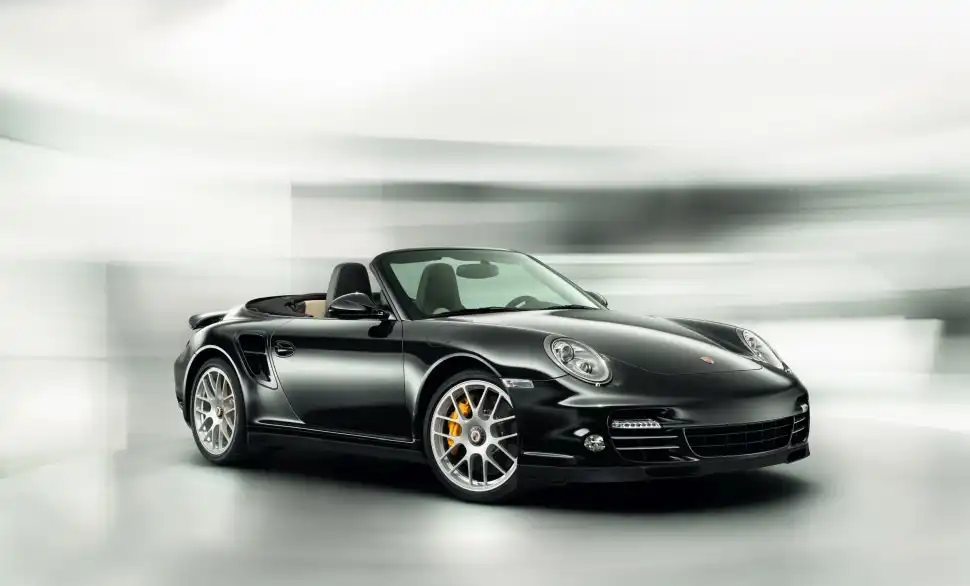
The Porsche 911 Carrera 4 GTS Cabriolet, produced from 2010 to 2011, represents a high-performance iteration of the 997.2 generation 911. Positioned as a premium offering within the 911 Cabriolet range, the GTS bridged the gap between the standard Carrera models and the more track-focused GT3. It combined the open-air enjoyment of a convertible with enhanced power, upgraded suspension, and distinctive styling cues. This variant was a key part of Porsche’s strategy to offer a wider spectrum of 911 experiences, catering to drivers seeking both everyday usability and exhilarating performance.
Technical Specifications
| Brand | Porsche |
| Model | 911 |
| Generation | 911 Cabriolet (997, facelift 2008) |
| Type (Engine) | Carrera 4 GTS 3.8 (408 Hp) |
| Start of production | 2010 |
| End of production | 2011 |
| Powertrain Architecture | Internal Combustion engine |
| Body type | Cabriolet |
| Seats | 4 |
| Doors | 2 |
| Fuel consumption (urban) | 16.8 l/100 km (14 US mpg, 16.8 UK mpg, 6 km/l) |
| Fuel consumption (extra urban) | 8 l/100 km (29.4 US mpg, 35.3 UK mpg, 12.5 km/l) |
| Fuel consumption (combined) | 11.2 l/100 km (21 US mpg, 25.2 UK mpg, 8.9 km/l) |
| CO2 emissions | 263 g/km |
| Fuel Type | Petrol (Gasoline) |
| Acceleration 0 – 100 km/h | 4.8 sec |
| Acceleration 0 – 62 mph | 4.8 sec |
| Acceleration 0 – 60 mph | 4.6 sec |
| Maximum speed | 302 km/h (187.65 mph) |
| Emission standard | Euro 5 |
| Weight-to-power ratio | 3.8 kg/Hp, 260.7 Hp/tonne |
| Weight-to-torque ratio | 3.7 kg/Nm, 268.4 Nm/tonne |
| Power | 408 Hp @ 7300 rpm |
| Power per litre | 107.4 Hp/l |
| Torque | 420 Nm @ 4200 rpm (309.78 lb.-ft. @ 4200 rpm) |
| Engine layout | Rear, Longitudinal |
| Engine Model/Code | MA1.01S |
| Engine displacement | 3800 cm3 (231.89 cu. in.) |
| Number of cylinders | 6 |
| Engine configuration | Boxer |
| Compression ratio | 12.5:1 |
| Fuel injection system | Direct injection |
| Engine oil capacity | 7.5 l (7.93 US qt | 6.6 UK qt) |
| Coolant capacity | 28.9 l (30.54 US qt | 25.43 UK qt) |
| Kerb Weight | 1565 kg (3450.23 lbs) |
| Max. weight | 1940 kg (4276.97 lbs) |
| Max load | 375 kg (826.73 lbs) |
| Trunk (boot) space – maximum | 105 l (3.71 cu. ft.) |
| Fuel tank capacity | 67 l (17.7 US gal | 14.74 UK gal) |
| Length | 4435 mm (174.61 in) |
| Width | 1852 mm (72.91 in) |
| Height | 1300 mm (51.18 in) |
| Wheelbase | 2350 mm (92.52 in) |
| Drag coefficient (Cd) | 0.31 |
| Minimum turning circle | 10.9 m (35.76 ft) |
| Drive wheel | All wheel drive (4×4) |
| Number of gears | 6 |
| Gearbox type | Manual transmission |
| Front suspension | Independent type McPherson |
| Rear suspension | Independent multi-link suspension |
| Front brakes | Ventilated discs, 330 mm |
| Rear brakes | Ventilated discs, 330 mm |
| Assisting systems | ABS (Anti-lock braking system) |
| Steering type | Steering rack and pinion |
| Power steering | Hydraulic Steering |
| Tires size | 235/35 ZR19; 305/30 ZR19 |
| Wheel rims size | 8.5J x 19; 11J x 19 |
INTRODUCTION
The 997.2 generation Porsche 911, introduced in 2008, benefited from a significant facelift, incorporating direct fuel injection, improved aerodynamics, and a revised interior. The Carrera 4 GTS Cabriolet, launched in 2010, built upon these improvements, offering a more focused driving experience. The “4” designation indicates Porsche’s all-wheel-drive system, providing enhanced traction and stability. The GTS trim elevated the performance and aesthetic appeal, making it a desirable choice for enthusiasts who wanted a 911 that was both capable and comfortable.
Powertrain & Engine Architecture
At the heart of the Carrera 4 GTS Cabriolet lies the MA1.01S 3.8-liter flat-six engine. This naturally aspirated engine produced 408 horsepower at 7,300 rpm and 420 Nm (309.78 lb-ft) of torque at 4,200 rpm. The engine utilized direct fuel injection, a key upgrade in the 997.2 series, which improved efficiency and responsiveness. The boxer configuration, with horizontally opposed cylinders, contributed to a lower center of gravity, enhancing handling. The standard transmission was a six-speed manual, although a seven-speed Porsche Doppelkupplung (PDK) dual-clutch transmission was also available as an option. The PDK offered faster shift times and improved fuel economy, but the manual transmission remained popular among purists.
Driving Characteristics
The 911 Carrera 4 GTS Cabriolet delivered a thrilling driving experience. The 3.8-liter engine provided ample power throughout the rev range, with a noticeable surge in performance as it approached its peak horsepower. The all-wheel-drive system ensured excellent traction, particularly in challenging conditions. The standard Porsche Active Suspension Management (PASM) system allowed drivers to adjust the damper settings, tailoring the ride to their preferences. Compared to the standard Carrera Cabriolet, the GTS offered a firmer, more controlled ride, and quicker steering response. While not as raw or focused as the GT3, the GTS provided a compelling balance between performance and everyday usability. The manual transmission offered precise gear changes and a direct connection to the engine, while the PDK provided seamless and lightning-fast shifts.
Equipment & Trim Levels
The Carrera 4 GTS Cabriolet came generously equipped as standard. Interior features included sport seats with leather upholstery, a sport steering wheel, and aluminum trim accents. Standard exterior features included a unique front fascia with larger air intakes, wider rear fenders, and a sport exhaust system with black tailpipes. Optional extras included adaptive sport seats, a Bose audio system, navigation, and various customization options through Porsche’s “Personalization” program. The GTS trim also included Porsche Dynamic Lighting System (PDLS) which adjusted the headlight beams based on driving conditions.
Chassis & Braking
The 997.2 generation 911 featured a lightweight chassis construction, utilizing a combination of steel and aluminum. The Carrera 4 GTS Cabriolet benefited from a slightly lowered ride height compared to the standard Carrera, further enhancing handling. The suspension system consisted of independent McPherson struts at the front and a multi-link setup at the rear. Braking duties were handled by ventilated discs on all four wheels, providing ample stopping power. The GTS also featured larger brake rotors compared to the standard Carrera. The all-wheel-drive system distributed power between the front and rear axles, optimizing traction and stability.
Market Reception & Comparison
The Porsche 911 Carrera 4 GTS Cabriolet was well-received by automotive critics. It was praised for its powerful engine, engaging driving dynamics, and luxurious interior. Compared to the standard Carrera Cabriolet, the GTS offered a more focused and rewarding driving experience. Compared to the 911 Turbo, the GTS offered a more visceral and engaging driving experience, albeit with slightly less outright performance. Fuel economy was reasonable for a high-performance sports car, but the GTS was not particularly fuel-efficient. Reliability was generally good, although maintenance costs could be high due to the car’s complex engineering.
Legacy
The 997.2 generation 911 Carrera 4 GTS Cabriolet remains a highly sought-after model among Porsche enthusiasts. Its combination of performance, luxury, and open-air enjoyment makes it a compelling choice in the used car market. The 3.8-liter engine is known for its reliability, and the 997.2 generation 911 is generally considered to be a well-built and durable sports car. Values for well-maintained examples have remained strong, reflecting the car’s enduring appeal and the Porsche brand’s reputation for quality and performance. The GTS variant, in particular, is appreciated for its unique blend of characteristics, making it a standout model within the 997 generation.