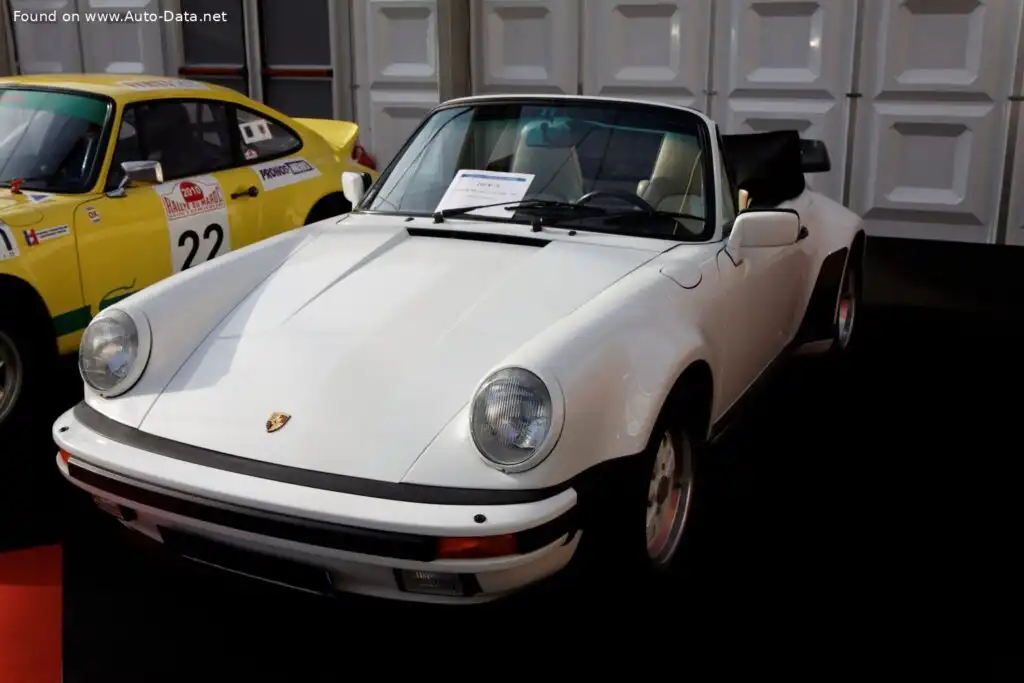
The Porsche 911 Cabriolet Type 930, specifically the 3.3 Turbo variant producing 300 horsepower, represents a pivotal moment in the evolution of Porsche’s iconic sports car. Produced from 1987 through 1989, this model bridged the gap between the earlier, more raw 930 Turbos and the more refined 964 generation. It was the final iteration of the original 911 silhouette before significant modernization, offering a unique blend of classic Porsche feel and forced-induction performance. This variant sat at the top of the 911 Cabriolet range, offering the most potent engine option available in an open-top configuration during its production run.
Technical Specifications
| Brand | Porsche |
| Model | 911 |
| Generation | 911 Cabriolet (Type 930) |
| Type (Engine) | 3.3 Turbo (300 Hp) |
| Start of production | 1987 |
| End of production | 1989 |
| Powertrain Architecture | Internal Combustion engine |
| Body type | Cabriolet |
| Seats | 4 |
| Doors | 2 |
| Fuel consumption (urban) | 15.5 l/100 km (15.2 US mpg, 18.2 UK mpg, 6.5 km/l) |
| Fuel consumption (extra urban) | 9.7 l/100 km (24.2 US mpg, 29.1 UK mpg, 10.3 km/l) |
| Fuel Type | Petrol (Gasoline) |
| Acceleration 0 – 100 km/h | 5.4 sec |
| Acceleration 0 – 62 mph | 5.4 sec |
| Acceleration 0 – 60 mph | 5.1 sec |
| Maximum speed | 260 km/h (161.56 mph) |
| Power | 300 Hp @ 5500 rpm |
| Power per litre | 90.9 Hp/l |
| Torque | 430 Nm @ 4000 rpm (317.15 lb.-ft. @ 4000 rpm) |
| Maximum engine speed | 6000 rpm |
| Engine layout | Rear, Longitudinal |
| Engine Model/Code | 930.66 |
| Engine displacement | 3299 cm3 (201.32 cu. in.) |
| Number of cylinders | 6 |
| Engine configuration | Boxer |
| Cylinder Bore | 97 mm (3.82 in.) |
| Piston Stroke | 74.4 mm (2.93 in.) |
| Compression ratio | 7:1 |
| Number of valves per cylinder | 2 |
| Fuel injection system | Multi-port manifold injection |
| Engine aspiration | Turbocharger, Intercooler |
| Valvetrain | SOHC |
| Engine oil capacity | 13 l (13.74 US qt, 11.44 UK qt) |
| Fuel tank capacity | 80.5 l (21.27 US gal, 17.71 UK gal) |
| Length | 4291 mm (168.94 in.) |
| Width | 1775 mm (69.88 in.) |
| Height | 1310 mm (51.57 in.) |
| Wheelbase | 2272 mm (89.45 in.) |
| Front track | 1432 mm (56.38 in.) |
| Rear track | 1492 mm (58.74 in.) |
| Ride height (ground clearance) | 130 mm (5.12 in.) |
| Minimum turning circle | 10.95 m (35.93 ft.) |
| Drivetrain Architecture | Rear wheel drive |
| Number of gears | 5 gears, manual transmission |
| Front suspension | Spring Strut, Wishbone |
| Rear suspension | Trailing arm |
| Front brakes | Ventilated discs, 304 mm |
| Rear brakes | Ventilated discs, 309 mm |
| Steering type | Steering rack and pinion |
| Front tires | 205/55 R16 |
| Rear tires | 245/45 R16 |
| Front wheel rims | 7J x 16 |
| Rear wheel rims | 9J x 16 |
Introduction
The 1987-1989 Porsche 911 Cabriolet 3.3 Turbo (Type 930) represents the culmination of years of development for the original 911. Building upon the foundation laid by earlier 930 Turbo models, Porsche addressed concerns regarding drivability and heat management while retaining the exhilarating performance that defined the Turbo moniker. This final iteration of the 930 Cabriolet offered a unique open-air experience combined with the potent turbocharged flat-six engine, making it a highly sought-after vehicle among collectors and enthusiasts. It was a significant offering in the US market, where the 911 had established a strong following, and in Europe, where it represented the pinnacle of 911 performance in a convertible form.
Powertrain & Engine Architecture
At the heart of the 930 Turbo Cabriolet lies the 930.66 engine, a 3.3-liter air-cooled flat-six. This engine featured a single KKK turbocharger with an intercooler to mitigate turbo lag and increase power output. The engine utilized Bosch K-Jetronic fuel injection, a mechanical system known for its reliability and precise fuel delivery. The valvetrain employed a single overhead camshaft (SOHC) design, operating two valves per cylinder. The engine’s 7:1 compression ratio was a compromise necessary to accommodate the turbocharging system. The 300 horsepower and 317 lb-ft of torque were delivered to the rear wheels through a robust 5-speed manual transmission. This transmission was specifically tuned to handle the substantial torque output of the turbocharged engine. The engine’s longitudinal rear-engine layout contributed to the 911’s distinctive handling characteristics.
Driving Characteristics
The 930 Turbo Cabriolet offered a driving experience that was both exhilarating and demanding. The turbocharger provided a significant surge of power, but also introduced a degree of turbo lag. Once the turbo spooled up, however, the acceleration was dramatic. The 5-speed manual transmission allowed drivers to precisely control the engine’s power delivery. Compared to the naturally aspirated 911s, the Turbo Cabriolet offered significantly higher performance, but it also required more skill and attention to drive effectively. The open-top configuration enhanced the sensory experience, allowing drivers to fully appreciate the engine’s sound and the rush of air. While not as nimble as some contemporary sports cars, the 930 Turbo Cabriolet provided a unique and rewarding driving experience that was characteristic of Porsche’s engineering philosophy.
Equipment & Trim Levels
The 930 Turbo Cabriolet was relatively well-equipped for its time, though options were plentiful. Standard features included leather upholstery, power windows, and a basic sound system. The interior design was functional and focused on the driving experience. Optional extras included upgraded sound systems, sport seats, and limited-slip differentials. The exterior featured a distinctive whale-tail spoiler, which provided aerodynamic stability at high speeds. The Cabriolet top was manually operated, adding to the car’s classic feel. The interior trim was typically finished in black or dark blue leather, with options for other colors available through the Porsche Exclusive program.
Chassis & Braking
The 930 Turbo Cabriolet utilized a modified version of the 911’s chassis, strengthened to handle the increased power output. The suspension featured independent torsion bar springs and shock absorbers at all four corners. The front suspension employed a MacPherson strut design, while the rear suspension utilized trailing arms. The braking system consisted of ventilated disc brakes at all four wheels, providing ample stopping power. The Cabriolet version featured a reinforced chassis to compensate for the lack of a fixed roof, ensuring structural rigidity. The steering was a rack-and-pinion system, providing precise and responsive handling.
Market Reception & Comparison
The 930 Turbo Cabriolet was generally well-received by automotive critics, who praised its performance and distinctive styling. However, some critics noted the car’s challenging handling characteristics and relatively high price. Compared to the standard 911 Cabriolet, the Turbo offered a significant performance upgrade, but it also came with a substantial price premium. Compared to the earlier 930 Turbo coupes, the Cabriolet offered a more open-air driving experience, but it also suffered from a slight weight penalty. Fuel economy was predictably poor, reflecting the car’s high-performance nature. Reliability was generally good, but maintenance costs could be high due to the complexity of the turbocharged engine.
Legacy
The Porsche 911 Cabriolet 3.3 Turbo (Type 930) remains a highly collectible and sought-after vehicle today. Its combination of classic Porsche styling, potent performance, and open-top driving experience makes it a unique and desirable sports car. The 930.66 engine is known for its durability and tunability, though regular maintenance is essential. In the used car market, prices for well-maintained examples have steadily increased in recent years, reflecting the car’s growing popularity among collectors. The 930 Turbo Cabriolet represents a significant chapter in the history of the Porsche 911, and it continues to be appreciated by enthusiasts around the world.