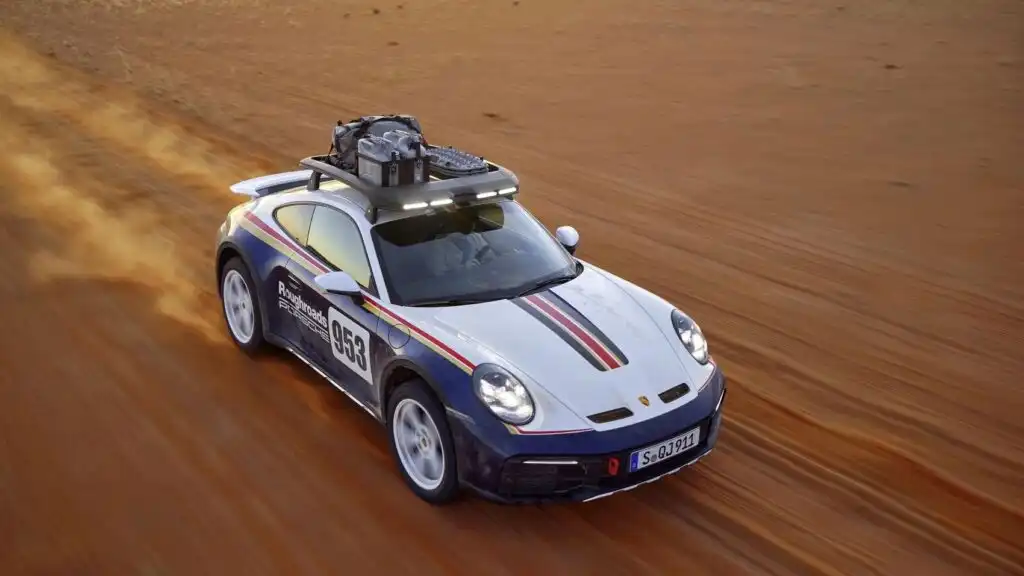
The Porsche 911 Dakar (992) 3.0, a limited-production variant of the iconic 911, debuted in November 2022 and concluded production in May 2024. This model represents a unique blend of Porsche’s legendary sports car performance with enhanced off-road capability, harking back to the original 911 Dakar rally cars of the 1980s. Built on the 992 generation 911 platform, the Dakar is distinguished by its increased ground clearance, all-wheel drive system, and specialized tires, making it the first 911 since the 953 rally car to be intentionally designed for off-pavement use. The 3.0 designation refers to its 3.0-liter twin-turbocharged flat-six engine, producing 480 horsepower and paired exclusively with Porsche’s 8-speed PDK dual-clutch transmission.
Technical Specifications
| Brand | Porsche |
| Model | 911 |
| Generation | 911 Dakar (992) |
| Type (Engine) | 3.0 (480 Hp) AWD PDK |
| Start of production | November, 2022 |
| End of production | May, 2024 |
| Powertrain Architecture | Internal Combustion engine |
| Body type | Off-road vehicle, Coupe |
| Seats | 2 |
| Doors | 2 |
| Fuel consumption at Low speed (WLTP) | 19.4 l/100 km (12.1 US mpg, 14.6 UK mpg, 5.2 km/l) |
| Fuel consumption at Medium speed (WLTP) | 10.7 l/100 km (22 US mpg, 26.4 UK mpg, 9.3 km/l) |
| Fuel consumption at high speed (WLTP) | 9.5 l/100 km (24.8 US mpg, 29.7 UK mpg, 10.5 km/l) |
| Fuel consumption at very high speed (WLTP) | 10.1 l/100 km (23.3 US mpg, 28 UK mpg, 9.9 km/l) |
| Combined fuel consumption (WLTP) | 11.3 l/100 km (20.8 US mpg, 25 UK mpg, 8.8 km/l) |
| CO2 emissions (WLTP) | 256 g/km |
| Fuel consumption (economy) – urban (NEDC) | 15.1 l/100 km (15.6 US mpg, 18.7 UK mpg, 6.6 km/l) |
| Fuel consumption (economy) – extra urban (NEDC) | 7.8 l/100 km (30.2 US mpg, 36.2 UK mpg, 12.8 km/l) |
| Fuel consumption (economy) – combined (NEDC) | 10.5 l/100 km (22.4 US mpg, 26.9 UK mpg, 9.5 km/l) |
| CO2 emissions (NEDC) | 239 g/km |
| Fuel Type | Petrol (Gasoline) |
| Acceleration 0 – 100 km/h | 3.4 sec |
| Acceleration 0 – 62 mph | 3.4 sec |
| Acceleration 0 – 60 mph | 3.2 sec |
| Acceleration 0 – 200 km/h | 12 sec |
| Maximum speed | 240 km/h (149.13 mph), Electronically limited |
| Emission standard | Euro 6d-ISC-FCM |
| Weight-to-power ratio | 3.3 kg/Hp, 299.1 Hp/tonne |
| Weight-to-torque ratio | 2.8 kg/Nm, 355.1 Nm/tonne |
| Power | 480 Hp @ 6500 rpm |
| Power per litre | 161 Hp/l |
| Torque | 570 Nm @ 2300-5000 rpm (420.41 lb.-ft. @ 2300-5000 rpm) |
| Maximum engine speed | 7500 rpm |
| Engine layout | Rear, Longitudinal |
| Engine displacement | 2981 cm3 (181.91 cu. in.) |
| Number of cylinders | 6 |
| Engine configuration | Boxer |
| Cylinder Bore | 91 mm (3.58 in.) |
| Piston Stroke | 76.4 mm (3.01 in.) |
| Compression ratio | 10.2:1 |
| Number of valves per cylinder | 4 |
| Fuel injection system | Direct injection |
| Engine aspiration | BiTurbo, Intercooler |
| Valvetrain | VarioCam Plus |
| Engine systems | Start & Stop System, Particulate filter |
| Kerb Weight | 1605 kg (3538.42 lbs.) |
| Max. weight | 1960 kg (4321.06 lbs.) |
| Max load | 355 kg (782.64 lbs.) |
| Trunk (boot) space – minimum | 132 l (4.66 cu. ft.) |
| Fuel tank capacity | 67 l (17.7 US gal | 14.74 UK gal) |
| Max. roof load | 75 kg (165.35 lbs.) |
| Length | 4530 mm (178.35 in.) |
| Width | 1864 mm (73.39 in.) |
| Width including mirrors | 2033 mm (80.04 in.) |
| Height | 1338 mm (52.68 in.) |
| Wheelbase | 2450 mm (96.46 in.) |
| Front track | 1617 mm (63.66 in.) |
| Rear (Back) track | 1572 mm (61.89 in.) |
| Ride height (ground clearance) | 161 mm (6.34 in.) |
| Drag coefficient (Cd) | 0.35 |
| Minimum turning circle (turning diameter) | 10.7 m (35.1 ft.) |
| Approach angle | 14.2° |
| Departure angle | 16.4° |
| Ramp-over (brakeover) angle | 16.2° |
| Drivetrain Architecture | The Internal combustion engine (ICE) drives permanently the four wheels of the vehicle. |
| Drive wheel | All wheel drive (4×4) |
| Number of gears and type of gearbox | 8 gears, automatic transmission PDK |
| Front suspension | Independent type McPherson |
| Rear suspension | Independent multi-link suspension |
| Front brakes | Ventilated discs, 350×34 mm |
| Rear brakes | Ventilated discs, 350×28 mm |
| Assisting systems | ABS (Anti-lock braking system), 4-wheel steering (4WS, active rear steering) |
| Steering type | Steering rack and pinion |
| Power steering | Electric Steering |
| Tires size | Front wheel tires: 245/45 R19, Rear wheel tires: 295/40 R20 |
| Wheel rims size | Front wheel rims: 8J x 19, Rear wheel rims: 11.5J x 20 |
Powertrain & Engine Architecture
The heart of the 911 Dakar is Porsche’s 3.0-liter twin-turbocharged flat-six engine, internally designated as the 9A2. This engine utilizes direct fuel injection and variable turbine geometry (VTG) turbochargers to deliver 480 horsepower at 6,500 rpm and 420 lb-ft of torque between 2,300 and 5,000 rpm. The ‘VarioCam Plus’ system manages valve timing and lift on both intake and exhaust valves for optimized performance and efficiency. The engine is paired exclusively with Porsche’s 8-speed PDK (Porsche Doppelkupplung) dual-clutch transmission. The PDK is calibrated for quicker shifts and a lower final drive ratio to enhance off-road traction. A mechanical rear differential lock further aids in distributing power during challenging terrain. The engine also incorporates a gasoline particulate filter (GPF) to meet stringent emissions standards.
Driving Characteristics
The 911 Dakar’s driving experience is markedly different from standard 911 models. The increased ride height (approximately 50mm higher than a standard 911 Carrera) and specialized all-terrain tires (Pirelli Scorpion All Terrain Plus) provide significantly improved capability on loose surfaces. While the 480 hp output and PDK transmission deliver brisk acceleration – 0 to 60 mph in 3.2 seconds – the focus is less on outright speed and more on controlled traction and stability. The lower final drive ratio means the engine operates at slightly higher revs at highway speeds. The rear differential lock is crucial for maintaining momentum in low-grip situations. Compared to a 911 Carrera with the same engine, the Dakar feels more planted and forgiving on uneven surfaces, but slightly less agile on smooth pavement.
Equipment & Trim Levels
The 911 Dakar came exceptionally well-equipped as standard. Interior features included full bucket seats, a carbon fiber roof, and extensive use of Race-Tex (a microfiber material) throughout the cabin. A unique interior trim package was specific to the Dakar, featuring red accents and embossed Porsche crests. Standard equipment also included Porsche Active Suspension Management (PASM), Porsche Torque Vectoring Plus (PTV Plus), and a sports exhaust system. Optional extras included a roll cage, six-point racing harnesses, and a roof rack for carrying additional equipment. The exterior was characterized by its rugged styling cues, including wider wheel arches, protective underbody panels, and a distinctive rear spoiler.
Chassis & Braking
The 911 Dakar utilizes a modified version of the standard 911 chassis, with significant changes to accommodate its off-road intentions. The suspension features increased travel and revised damping characteristics. The front suspension employs a McPherson strut design, while the rear utilizes a multi-link setup. Braking duties are handled by ventilated discs at all four corners, measuring 350x34mm at the front and 350x28mm at the rear. The anti-lock braking system (ABS) is calibrated to work effectively on a variety of surfaces. The inclusion of four-wheel steering (4WS) enhances agility and maneuverability, particularly at lower speeds.
Market Reception & Comparison
The Porsche 911 Dakar received overwhelmingly positive reviews from automotive critics. It was praised for its unique blend of performance and off-road capability, as well as its distinctive styling. Compared to other 911 variants, the Dakar occupies a niche position, appealing to enthusiasts seeking a more adventurous and versatile sports car. While fuel economy is not a primary concern for this model, the combined WLTP figure of 11.3 l/100 km (20.8 US mpg) is comparable to other high-performance 911s. Reliability is expected to be on par with other 992-generation 911s, benefiting from Porsche’s reputation for engineering excellence.
Legacy
The 911 Dakar is poised to become a highly collectible Porsche model. Its limited production run and unique character are likely to drive up values in the used car market. The powertrain, based on the proven 3.0-liter twin-turbo flat-six and PDK transmission, is expected to be durable and reliable with proper maintenance. The Dakar represents a bold and innovative step for Porsche, demonstrating the brand’s willingness to push the boundaries of what a 911 can be. It successfully bridges the gap between on-road performance and off-road adventure, creating a truly special and memorable driving experience.