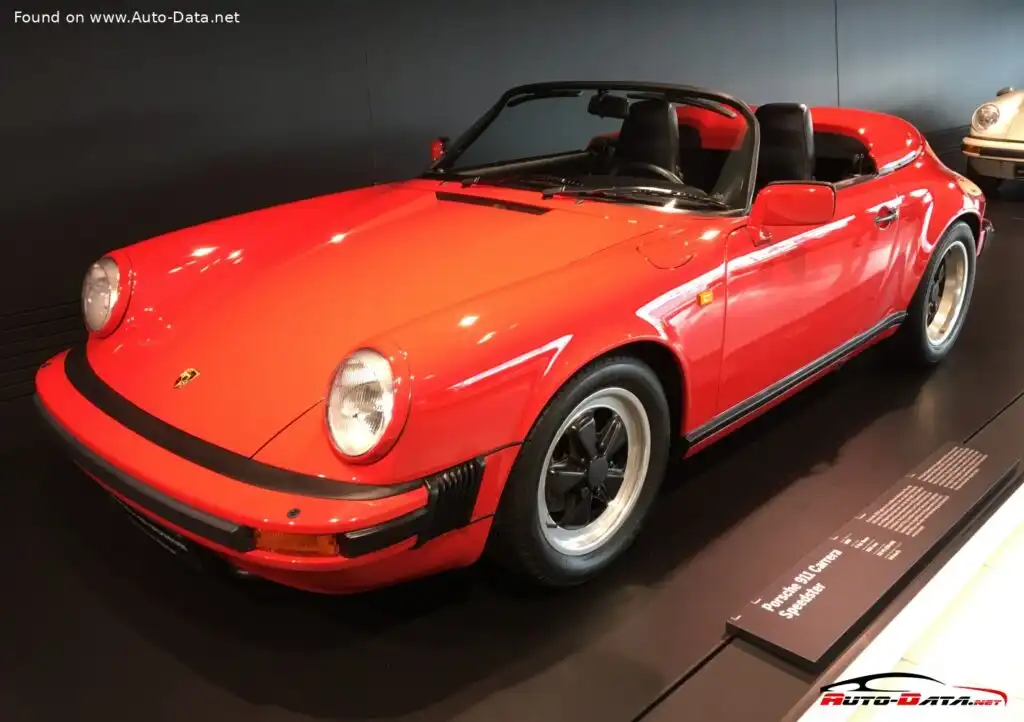
The Porsche 911 Speedster 3.6, produced for the 1989 model year, represents a final flourish for the G-Series (911) platform. It was a limited-production, open-top variant designed to evoke the spirit of Porsche’s early sports cars, specifically the 356 Speedster. Built on the 911 Carrera 3.2 chassis, the 3.6 Speedster offered a more potent engine and a distinctive, low-slung profile. It served as a bridge between the classic 911 aesthetic and the more modern 964 generation that followed, and is highly sought after by collectors today. Production numbers were relatively small, adding to its exclusivity.
Technical Specifications
| Brand | Porsche |
| Model | 911 |
| Generation | 911 Speedster |
| Type (Engine) | 3.6 (250 Hp) |
| Start of production | 1989 |
| End of production | 1989 |
| Powertrain Architecture | Internal Combustion engine |
| Body type | Cabriolet |
| Seats | 2 |
| Doors | 2 |
| Fuel consumption (economy) – urban | 17.1 l/100 km (13.8 US mpg, 16.5 UK mpg, 5.8 km/l) |
| Fuel consumption (economy) – extra urban | 7.8 l/100 km (30.2 US mpg, 36.2 UK mpg, 12.8 km/l) |
| Fuel Type | Petrol (Gasoline) |
| Acceleration 0 – 100 km/h | 5.7 sec |
| Acceleration 0 – 62 mph | 5.7 sec |
| Acceleration 0 – 60 mph | 5.4 sec |
| Maximum speed | 260 km/h (161.56 mph) |
| Weight-to-power ratio | 5.4 kg/Hp, 185.2 Hp/tonne |
| Weight-to-torque ratio | 4.4 kg/Nm, 229.6 Nm/tonne |
| Power | 250 Hp @ 6100 rpm |
| Power per litre | 69.4 Hp/l |
| Torque | 310 Nm @ 4800 rpm (228.64 lb.-ft. @ 4800 rpm) |
| Engine layout | Rear, Longitudinal |
| Engine Model/Code | M64.01 |
| Engine displacement | 3600 cm3 (219.69 cu. in.) |
| Number of cylinders | 6 |
| Cylinder Bore | 100 mm (3.94 in.) |
| Piston Stroke | 76.4 mm (3.01 in.) |
| Compression ratio | 11.3:1 |
| Number of valves per cylinder | 2 |
| Fuel injection system | Multi-port manifold injection |
| Engine aspiration | Naturally aspirated engine |
| Valvetrain | SOHC |
| Engine oil capacity | 11.5 l (12.15 US qt | 10.12 UK qt) |
| Kerb Weight | 1350 kg (2976.24 lbs.) |
| Max. weight | 1600 kg (3527.4 lbs.) |
| Max load | 250 kg (551.16 lbs.) |
| Fuel tank capacity | 77 l (20.34 US gal | 16.94 UK gal) |
| Length | 4250 mm (167.32 in.) |
| Width | 1652 mm (65.04 in.) |
| Height | 1280 mm (50.39 in.) |
| Wheelbase | 2272 mm (89.45 in.) |
| Front track | 1374 mm (54.09 in.) |
| Rear (Back) track | 1374 mm (54.09 in.) |
| Ride height (ground clearance) | 115 mm (4.53 in.) |
| Minimum turning circle (turning diameter) | 12.35 m (40.52 ft.) |
| Drivetrain Architecture | Rear wheel drive |
| Number of gears and type of gearbox | 5 gears, manual transmission |
| Front suspension | Wishbone, Transverse stabilizer |
| Rear suspension | Trailing arm |
| Front brakes | Ventilated discs |
| Rear brakes | Disc |
| Assisting systems | ABS (Anti-lock braking system) |
| Steering type | Steering rack and pinion |
| Power steering | Hydraulic Steering |
| Tires size | Front wheel tires: 205/50 ZR17 Rear wheel tires: 255/40 ZR17 |
| Wheel rims size | Front wheel rims: 7J x 17 Rear wheel rims: 7J x 17 |
Powertrain & Engine Architecture
The heart of the 911 Speedster 3.6 is the M64.01, a 3.6-liter naturally aspirated flat-six engine. This engine was a significant upgrade over the 3.2-liter found in earlier Carrera models. It featured a larger displacement achieved through an increased bore, resulting in a substantial power increase. The engine utilized Bosch Motronic fuel injection and a single overhead camshaft (SOHC) design per cylinder bank. The M64.01 produced 250 horsepower at 6100 rpm and 228.64 lb-ft of torque at 4800 rpm. This power was delivered to the rear wheels through a robust, five-speed manual transmission – an automatic transmission was not offered. The engine’s longitudinal rear-engine layout contributed to the 911’s unique handling characteristics.
Driving Characteristics
The 911 Speedster 3.6 offered a thrilling driving experience. The increased power of the 3.6-liter engine, combined with the relatively lightweight construction, resulted in brisk acceleration – 0 to 60 mph in approximately 5.4 seconds and a top speed of 161.56 mph. Compared to the standard 911 Carrera 3.2, the Speedster felt noticeably more responsive. The manual transmission provided precise control, and the rear-engine layout demanded respect and skill from the driver. While not as forgiving as front-engined sports cars, the 911 Speedster rewarded experienced drivers with exceptional handling and a unique connection to the road. The gear ratios were optimized for acceleration, making it a potent performer on both winding roads and open highways.
Equipment & Trim Levels
The 911 Speedster 3.6 was relatively sparsely equipped compared to some contemporary luxury cars, reflecting its focus on driving purity. Standard features included leather upholstery, a basic sound system, and power windows. However, the Speedster’s defining feature was its low-slung, chopped-top design, which included a manually operated soft top. Optional extras included upgraded sound systems, sport seats, and limited-slip differentials. The interior was functional and driver-focused, with analog gauges providing essential information. The Speedster’s interior trim was generally more subdued than other 911 variants, emphasizing its sporting intentions.
Chassis & Braking
The 911 Speedster 3.6 utilized the chassis and suspension components of the 911 Carrera 3.2. This included a torsion bar suspension system, providing a relatively firm ride. The front suspension featured wishbones and a transverse stabilizer bar, while the rear suspension employed trailing arms. Braking duties were handled by ventilated discs at the front and solid discs at the rear, assisted by an ABS anti-lock braking system. The Speedster’s relatively low weight (approximately 2976 lbs) contributed to its agile handling and effective braking performance. The suspension setup was tuned for performance, prioritizing handling over outright comfort.
Market Reception & Comparison
The 911 Speedster 3.6 was well-received by automotive critics, who praised its performance, handling, and classic styling. It was seen as a fitting send-off to the G-Series 911. Compared to the standard Carrera 3.2, the Speedster offered a more engaging driving experience thanks to its increased power and more focused character. It was also more expensive, reflecting its limited production and exclusive appeal. Compared to the later 964 generation, the Speedster retained a more raw and visceral feel, appealing to purists. Fuel economy, while not a primary concern for buyers of this vehicle, was reasonable for a sports car of its era.
Legacy
The Porsche 911 Speedster 3.6 has become a highly collectible car. Its limited production numbers, iconic design, and engaging driving experience have made it a favorite among Porsche enthusiasts. The M64.01 engine is known for its durability and relatively straightforward maintenance, although parts can be expensive. Well-maintained examples command high prices in the used car market. The Speedster represents a significant chapter in the 911’s history, bridging the gap between the classic air-cooled era and the more modern water-cooled models. It remains a testament to Porsche’s commitment to building exceptional sports cars.