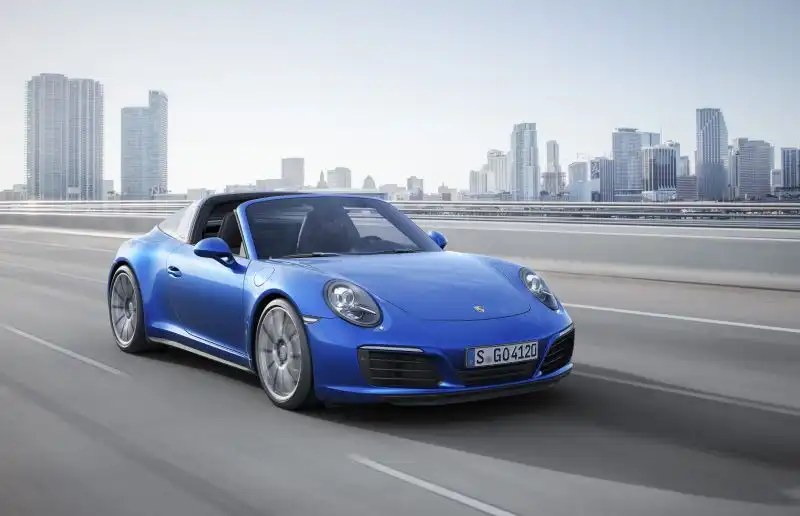
The Porsche 911 Targa 4 GTS 3.0 (450 hp) represents a compelling blend of performance, open-air driving enjoyment, and everyday usability within the esteemed 991.2 generation of the iconic 911. Produced from 2017 to 2020, this variant occupied a premium position in the Targa lineup, offering a significant step up in power and dynamic capability compared to the base Targa 4. It builds upon the foundation of the 991.2 platform, known for its refinement and technological advancements, while retaining the unique Targa top mechanism that distinguishes it from the coupe and cabriolet models.
Technical Specifications
| Brand | Porsche |
| Model | 911 |
| Generation | 911 Targa (991 II) |
| Type (Engine) | 4 GTS 3.0 (450 Hp) |
| Start of production | 2017 |
| End of production | 2020 |
| Powertrain Architecture | Internal Combustion engine |
| Body type | Targa |
| Seats | 4 |
| Doors | 2 |
| Fuel consumption (economy) – urban | 13.3 l/100 km (17.7 US mpg, 21.2 UK mpg, 7.5 km/l) |
| Fuel consumption (economy) – extra urban | 7.6 l/100 km (30.9 US mpg, 37.2 UK mpg, 13.2 km/l) |
| Fuel consumption (economy) – combined | 9.7 l/100 km (24.2 US mpg, 29.1 UK mpg, 10.3 km/l) |
| CO2 emissions | 220 g/km |
| Fuel Type | Petrol (Gasoline) |
| Acceleration 0 – 100 km/h | 4.1 sec |
| Acceleration 0 – 62 mph | 4.1 sec |
| Acceleration 0 – 60 mph | 3.9 sec |
| Acceleration 0 – 200 km/h | 14.1 sec |
| Maximum speed | 308 km/h (191.38 mph) |
| Emission standard | Euro 6 |
| Weight-to-power ratio | 3.5 kg/Hp, 283.9 Hp/tonne |
| Weight-to-torque ratio | 2.9 kg/Nm, 347 Nm/tonne |
| Power | 450 Hp @ 6500 rpm |
| Power per litre | 151 Hp/l |
| Torque | 550 Nm @ 2150-5000 rpm (405.66 lb.-ft. @ 2150-5000 rpm) |
| Maximum engine speed | 7500 rpm |
| Engine layout | Rear, Longitudinal |
| Engine Model/Code | MDC.JA |
| Engine displacement | 2981 cm3 (181.91 cu. in.) |
| Number of cylinders | 6 |
| Engine configuration | Boxer |
| Cylinder Bore | 91 mm (3.58 in.) |
| Piston Stroke | 76.4 mm (3.01 in.) |
| Compression ratio | 10:1 |
| Number of valves per cylinder | 4 |
| Fuel injection system | Direct injection |
| Engine aspiration | BiTurbo, Intercooler |
| Engine oil capacity | 8 l (8.45 US qt | 7.04 UK qt) |
| Kerb Weight | 1585 kg (3494.33 lbs.) |
| Max. weight | 2025 kg (4464.36 lbs.) |
| Max load | 440 kg (970.03 lbs.) |
| Trunk (boot) space – maximum | 285 l (10.06 cu. ft.) |
| Fuel tank capacity | 67 l (17.7 US gal | 14.74 UK gal) |
| Length | 4528 mm (178.27 in.) |
| Width | 1852 mm (72.91 in.) |
| Width including mirrors | 1978 mm (77.87 in.) |
| Height | 1291 mm (50.83 in.) |
| Wheelbase | 2450 mm (96.46 in.) |
| Front track | 1539 mm (60.59 in.) |
| Rear (Back) track | 1544 mm (60.79 in.) |
| Drag coefficient (Cd) | 0.32 |
| Minimum turning circle | 11.1 m (36.42 ft.) |
| Drive wheel | All wheel drive (4×4) |
| Number of gears and type of gearbox | 7 gears, manual transmission |
| Front suspension | Independent type McPherson |
| Rear suspension | Independent multi-link suspension |
| Front brakes | Ventilated discs |
| Rear brakes | Ventilated discs |
| Assisting systems | ABS (Anti-lock braking system) |
| Steering type | Steering rack and pinion |
| Power steering | Electric Steering |
| Tires size | 245/35 ZR 20; 305/30 ZR 20 |
| Wheel rims size | 9J x 20; 12J x 20 |
Powertrain & Engine Architecture
At the heart of the 911 Targa 4 GTS lies the 3.0-liter twin-turbocharged flat-six engine, designated as the MDC.JA. This engine represents a significant upgrade over the standard 911 Carrera’s powerplant, delivering 450 horsepower at 6,500 rpm and 550 Nm (405.66 lb-ft) of torque between 2,150 and 5,000 rpm. The engine utilizes direct fuel injection and variable turbine geometry (VTG) turbochargers to optimize both power delivery and efficiency. The VTG technology allows the turbochargers to adjust their geometry based on engine speed and load, minimizing turbo lag and maximizing boost across the rev range. The engine’s boxer configuration contributes to a low center of gravity, enhancing handling and stability. The standard transmission for this model is a seven-speed manual, although Porsche’s PDK (Porsche Doppelkupplung) dual-clutch transmission was available as an option. The PDK offers lightning-fast shifts and enhanced control, particularly during spirited driving.
Driving Characteristics
The 911 Targa 4 GTS 3.0 delivers a thrilling driving experience characterized by its potent acceleration, precise handling, and engaging feedback. The twin-turbocharged engine provides a broad and accessible powerband, with strong torque available from low engine speeds. This makes the car remarkably responsive in everyday driving situations, while also providing ample power for overtaking and spirited runs. The all-wheel-drive system ensures excellent traction, particularly in challenging conditions, and contributes to the car’s overall stability. Compared to the standard Targa 4, the GTS benefits from a more aggressive suspension setup, including Porsche Active Suspension Management (PASM), which lowers the ride height and stiffens the dampers for improved handling. The steering is precise and communicative, providing the driver with a direct connection to the road. The Targa top mechanism, while adding some weight, does not significantly detract from the car’s dynamic capabilities.
Equipment & Trim Levels
The 911 Targa 4 GTS 3.0 came generously equipped as standard, reflecting its position as a premium model. Standard features included a leather interior, sport seats, a Porsche Communication Management (PCM) system with a touchscreen display, and a high-quality sound system. The GTS also featured unique styling cues, such as a sport exhaust system with black tailpipes, darkened exterior trim, and a distinctive interior trim package. Numerous options were available, allowing buyers to personalize their cars to their preferences. These included adaptive cruise control, lane keep assist, a sunroof, and a variety of interior trim materials and colors. The optional Sport Chrono Package added a Sport Response button, launch control, and a digital stopwatch.
Chassis & Braking
The 911 Targa 4 GTS utilizes a sophisticated chassis design optimized for performance and handling. The suspension features independent control arms and coil springs at all four corners, with PASM as standard. The braking system consists of ventilated discs on all four wheels, providing ample stopping power. Larger brake rotors and calipers were available as an option for even greater braking performance. The car’s all-wheel-drive system utilizes a multi-plate clutch to distribute torque between the front and rear axles, optimizing traction and stability. The steering system is a power-assisted rack-and-pinion design, providing precise and responsive steering feel.
Market Reception & Comparison
The 911 Targa 4 GTS 3.0 was widely praised by automotive critics for its performance, handling, and overall refinement. It was lauded as a compelling alternative to the 911 Carrera S, offering a similar level of performance with the added appeal of the Targa top. Compared to the standard Targa 4, the GTS provided a noticeable increase in power and a more engaging driving experience. It also offered a more exclusive and sporty image. Fuel economy was respectable for a high-performance sports car, with combined fuel consumption of around 24.2 US mpg. Reliability has generally been good, although maintenance costs can be high due to the car’s complex engineering.
Legacy
The 911 Targa 4 GTS 3.0 (991.2) has established itself as a desirable and collectible variant within the 991 generation. Its combination of performance, style, and open-air driving enjoyment has made it a favorite among Porsche enthusiasts. On the used car market, these models command a premium price compared to the standard Targa 4, reflecting their increased performance and exclusivity. The 3.0-liter twin-turbocharged engine has proven to be a robust and reliable powerplant, and with proper maintenance, these cars are expected to provide many years of driving pleasure.