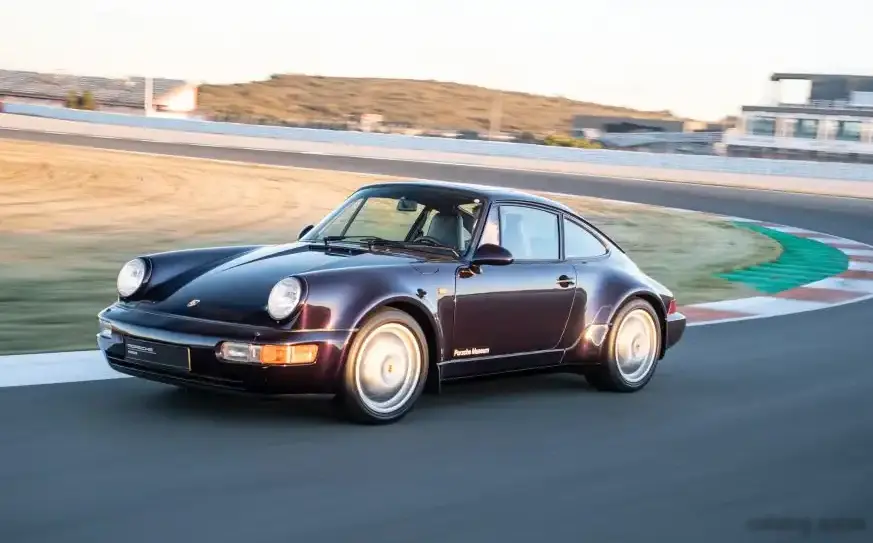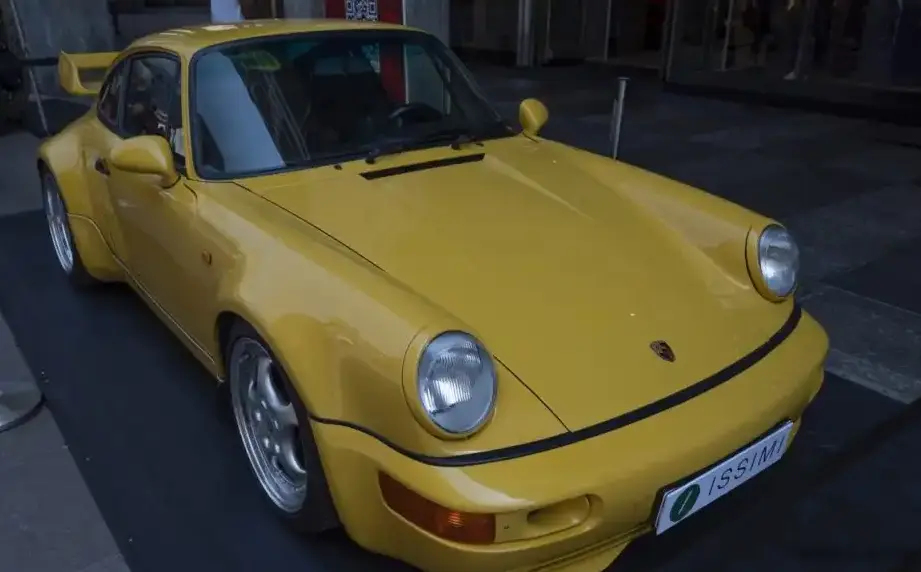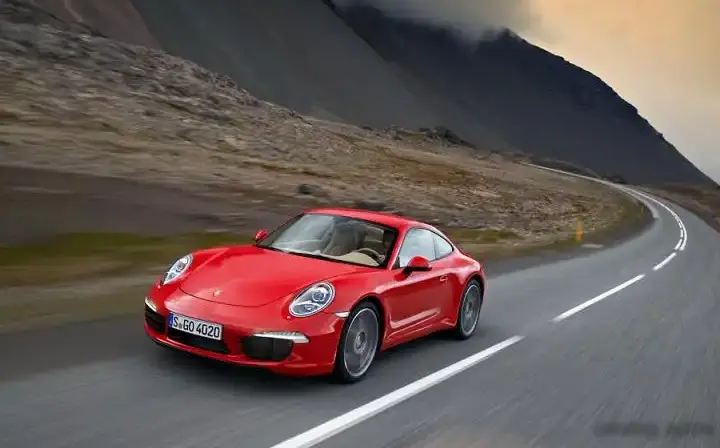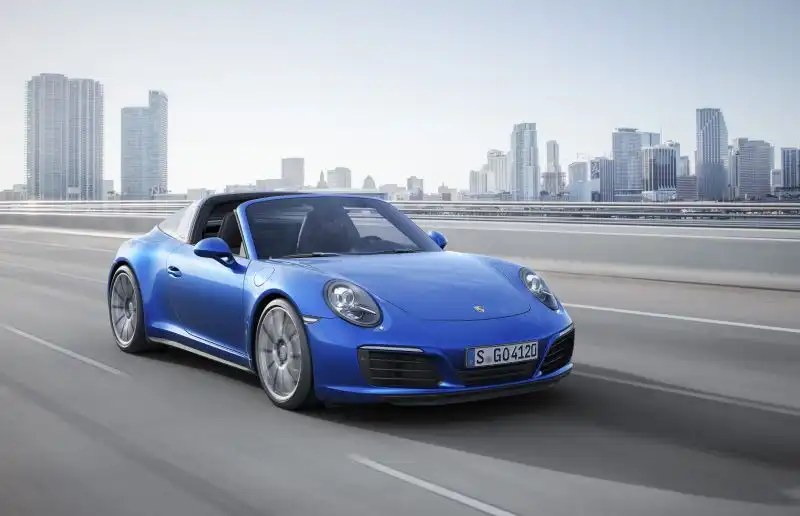
The Porsche 911 Targa 4S (991 II) 3.0, produced from 2015 to 2018, represents a compelling blend of open-air motoring and all-weather capability within the iconic 911 lineage. Part of the second generation (991.2) of the 991 series, this variant occupied a premium position in the Targa lineup, offering a significant step up in performance and refinement compared to the base Targa models. It distinguished itself with a twin-turbocharged engine and Porsche’s sophisticated PDK dual-clutch transmission, appealing to drivers seeking a more engaging and capable sports car experience. The 991.2 generation brought substantial updates over the original 991, including revised engines, updated interior technology, and subtle styling refinements.
Technical Specifications
| Brand | Porsche |
| Model | 911 |
| Generation | 911 Targa (991 II) |
| Type (Engine) | 4S 3.0 (420 Hp) PDK |
| Start of production | 2015 |
| End of production | 2018 |
| Powertrain Architecture | Internal Combustion engine |
| Body type | Targa |
| Seats | 4 |
| Doors | 2 |
| Fuel consumption (economy) – urban | 10.4 l/100 km (22.6 US mpg, 27.2 UK mpg, 9.6 km/l) |
| Fuel consumption (economy) – extra urban | 6.7 l/100 km (35.1 US mpg, 42.2 UK mpg, 14.9 km/l) |
| Fuel consumption (economy) – combined | 8 l/100 km (29.4 US mpg, 35.3 UK mpg, 12.5 km/l) |
| CO2 emissions | 184 g/km |
| Fuel Type | Petrol (Gasoline) |
| Acceleration 0 – 100 km/h | 4.2 sec |
| Acceleration 0 – 62 mph | 4.2 sec |
| Acceleration 0 – 60 mph | 4 sec |
| Maximum speed | 301 km/h (187.03 mph) |
| Emission standard | Euro 6 |
| Weight-to-power ratio | 3.8 kg/Hp, 262.5 Hp/tonne |
| Weight-to-torque ratio | 3.2 kg/Nm, 312.5 Nm/tonne |
| Power | 420 Hp @ 6500 rpm |
| Power per litre | 140.9 Hp/l |
| Torque | 500 Nm @ 1700-5000 rpm (368.78 lb.-ft. @ 1700-5000 rpm) |
| Engine layout | Rear, Longitudinal |
| Engine Model/Code | MA2.01, MA2.02 |
| Engine displacement | 2981 cm3 (181.91 cu. in.) |
| Number of cylinders | 6 |
| Engine configuration | Boxer |
| Cylinder Bore | 91 mm (3.58 in.) |
| Piston Stroke | 76.4 mm (3.01 in.) |
| Compression ratio | 10:1 |
| Number of valves per cylinder | 4 |
| Fuel injection system | Direct injection |
| Engine aspiration | BiTurbo, Intercooler |
| Valvetrain | DOHC |
| Engine oil capacity | 8 l (8.45 US qt | 7.04 UK qt) |
| Kerb Weight | 1600 kg (3527.4 lbs.) |
| Max. weight | 2040 kg (4497.43 lbs.) |
| Max load | 440 kg (970.03 lbs.) |
| Trunk (boot) space – minimum | 160 l (5.65 cu. ft.) |
| Fuel tank capacity | 67 l (17.7 US gal | 14.74 UK gal) |
| Length | 4499 mm (177.13 in.) |
| Width | 1852 mm (72.91 in.) |
| Width including mirrors | 1978 mm (77.87 in.) |
| Height | 1293 mm (50.91 in.) |
| Wheelbase | 2450 mm (96.46 in.) |
| Front track | 1543 mm (60.75 in.) |
| Rear (Back) track | 1558 mm (61.34 in.) |
| Drag coefficient (Cd) | 0.3 |
| Drive wheel | All wheel drive (4×4) |
| Number of gears and type of gearbox | 7 gears, automatic transmission PDK |
| Front suspension | Independent type McPherson |
| Rear suspension | Independent multi-link spring suspension with stabilizer |
| Front brakes | Ventilated discs |
| Rear brakes | Ventilated discs |
| Assisting systems | ABS (Anti-lock braking system) |
| Steering type | Steering rack and pinion |
| Power steering | Electric Steering |
| Tires size | 245/35 ZR 20; 305/30 ZR 20 |
| Wheel rims size | 8.5J x 20; 11.5J x 20 |
Powertrain & Engine Architecture
The heart of the 911 Targa 4S (991 II) is the 3.0-liter twin-turbocharged flat-six engine, designated as the MA2.01 or MA2.02. This engine represented a significant departure from the naturally aspirated engines of previous 911 generations. The introduction of turbocharging not only increased power output to 420 horsepower at 6500 rpm and 500 Nm (368.78 lb-ft) of torque between 1700-5000 rpm, but also broadened the torque curve, providing readily available power across a wider range of engine speeds. The engine utilizes direct fuel injection and a sophisticated engine management system to optimize combustion efficiency and reduce emissions. The boxer configuration, with its horizontally opposed cylinders, contributes to a lower center of gravity, enhancing handling stability. Paired with the engine is Porsche’s 7-speed PDK (Porsche Doppelkupplung) dual-clutch transmission. The PDK offers incredibly fast and smooth gear changes, both in automatic and manual modes, contributing to the car’s overall performance and responsiveness.
Driving Characteristics
The 911 Targa 4S with the PDK transmission delivers a remarkably refined yet exhilarating driving experience. Acceleration from 0 to 60 mph takes approximately 4 seconds, and the car can reach a top speed of 187 mph. The PDK transmission’s quick shifts and intelligent programming ensure minimal interruption of power delivery. Compared to the standard Targa models with less powerful engines, the 4S offers a substantial performance upgrade. While the manual transmission 911s are often praised for their driver engagement, the PDK provides a level of convenience and speed that many drivers appreciate, particularly in everyday driving situations. The all-wheel-drive system provides excellent traction, especially in inclement weather, making the Targa 4S a usable sports car year-round. The steering is precise and communicative, providing ample feedback to the driver.
Equipment & Trim Levels
The 911 Targa 4S came standard with a generous array of features, including leather upholstery, a power-adjustable driver’s seat, automatic climate control, a touchscreen infotainment system with navigation, and a premium sound system. The Targa roof, with its automatically retracting hardtop, was a defining feature of this model. Optional extras were plentiful, allowing buyers to personalize their vehicles. Popular options included sport seats, adaptive suspension (PASM), a sport exhaust system, and various interior trim packages. The interior design was typically Porsche – functional, elegant, and focused on the driver.
Chassis & Braking
The 911 Targa 4S utilizes a sophisticated chassis design featuring an independent McPherson strut suspension at the front and an independent multi-link suspension at the rear. The suspension is tuned to provide a balance between comfort and handling performance. Ventilated disc brakes are fitted on all four wheels, providing ample stopping power. Porsche’s ABS (Anti-lock Braking System) and stability control systems further enhance safety. The all-wheel-drive system distributes power between the front and rear axles as needed, optimizing traction and stability.
Market Reception & Comparison
The 911 Targa 4S (991 II) was generally well-received by automotive critics. It was praised for its performance, handling, and refinement. The twin-turbocharged engine was lauded for its power and responsiveness, while the PDK transmission was commended for its smoothness and speed. Compared to the base Targa models, the 4S offered a significant performance advantage. Compared to the 911 Carrera S, the Targa 4S offered a unique open-air experience, albeit with a slightly higher weight and a different aesthetic. Fuel economy was respectable for a high-performance sports car, averaging around 29.4 US mpg in combined driving.
Legacy
The 911 Targa 4S (991 II) represents a significant milestone in the evolution of the 911. The introduction of turbocharging marked a turning point for the model, and the 991.2 generation is widely regarded as one of the most refined and capable 911s ever produced. These cars have proven to be relatively reliable, with the twin-turbocharged engines generally holding up well over time. On the used car market, the 911 Targa 4S (991 II) commands a premium price, reflecting its performance, desirability, and iconic status. Maintenance costs, however, can be substantial, as with any high-performance Porsche. The combination of performance, luxury, and open-air driving enjoyment ensures that the 911 Targa 4S (991 II) will remain a sought-after sports car for years to come.