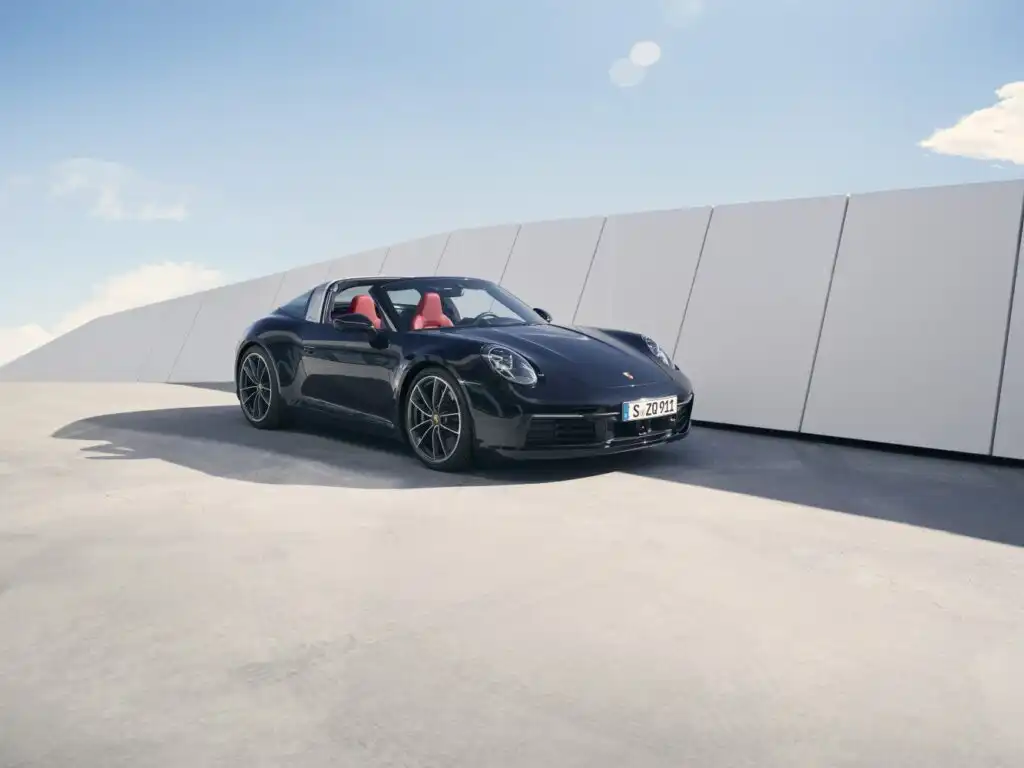
The Porsche 911 Targa 4S (992) 3.0, producing 450 horsepower, represents a compelling blend of open-air motoring and all-weather capability within the iconic 911 lineage. Introduced in August 2020 as part of the 992 generation, it continued in production through May 2024. This variant occupies a premium position in the Targa lineup, offering a significant step up in performance from the base Targa 4 while remaining more accessible than the even more potent Targa 4S Exclusive Design Edition. It builds upon the foundation of the 992 platform, known for its advancements in technology, refinement, and driving dynamics.
Technical Specifications
| Brand | Porsche |
| Model | 911 |
| Generation | 911 Targa (992) |
| Type (Engine) | 4S 3.0 (450 Hp) PDK |
| Start of production | August, 2020 |
| End of production | May, 2024 |
| Powertrain Architecture | Internal Combustion engine |
| Body type | Targa |
| Seats | 4 |
| Doors | 2 |
| Fuel consumption (economy) – urban | 13.3 l/100 km (17.7 US mpg, 21.2 UK mpg, 7.5 km/l) |
| Fuel consumption (economy) – extra urban | 8.0 l/100 km (29.4 US mpg, 35.3 UK mpg, 12.5 km/l) |
| Fuel consumption (economy) – combined | 9.9 l/100 km (23.8 US mpg, 28.5 UK mpg, 10.1 km/l) |
| CO2 emissions | 227 g/km |
| Fuel Type | Petrol (Gasoline) |
| Acceleration 0 – 100 km/h | 3.8 sec |
| Acceleration 0 – 62 mph | 3.8 sec |
| Acceleration 0 – 60 mph | 3.6 sec |
| Acceleration 0 – 200 km/h | 13.4 sec |
| Maximum speed | 304 km/h (188.9 mph) |
| Emission standard | EURO 6d – ISC – FCM |
| Weight-to-power ratio | 3.7 kg/Hp, 268.7 Hp/tonne |
| Weight-to-torque ratio | 3.2 kg/Nm, 316.4 Nm/tonne |
| Power | 450 Hp @ 6500 rpm |
| Power per litre | 151 Hp/l |
| Torque | 530 Nm @ 2300-5000 rpm (390.91 lb.-ft. @ 2300-5000 rpm) |
| Maximum engine speed | 7500 rpm |
| Engine layout | Rear, Longitudinal |
| Engine Model/Code | DKK |
| Engine displacement | 2981 cm3 (181.91 cu. in.) |
| Number of cylinders | 6 |
| Engine configuration | Boxer |
| Cylinder Bore | 91 mm (3.58 in.) |
| Piston Stroke | 76.4 mm (3.01 in.) |
| Compression ratio | 10.2:1 |
| Number of valves per cylinder | 4 |
| Fuel injection system | Direct injection |
| Engine aspiration | BiTurbo, Intercooler |
| Engine oil capacity | 8.3 l (8.77 US qt | 7.3 UK qt) |
| Kerb Weight | 1675 kg (3692.74 lbs.) |
| Max. weight | 2085 kg (4596.64 lbs.) |
| Max load | 410 kg (903.9 lbs.) |
| Trunk (boot) space – minimum | 132 l (4.66 cu. ft.) |
| Fuel tank capacity | 67 l (17.7 US gal | 14.74 UK gal) |
| Length | 4519 mm (177.91 in.) |
| Width | 1852 mm (72.91 in.) |
| Width including mirrors | 2024 mm (79.69 in.) |
| Height | 1299 mm (51.14 in.) |
| Wheelbase | 2450 mm (96.46 in.) |
| Front track | 1589 mm (62.56 in.) |
| Rear (Back) track | 1557 mm (61.3 in.) |
| Drag coefficient (Cd) | 0.30 |
| Minimum turning circle (turning diameter) | 11.2 m (36.75 ft.) |
| Drivetrain Architecture | The Internal combustion engine (ICE) drives permanently the four wheels of the vehicle. |
| Drive wheel | All wheel drive (4×4) |
| Number of gears and type of gearbox | 8 gears, automatic transmission PDK |
| Front suspension | Independent, type McPherson with coil spring and anti-roll bar |
| Rear suspension | Independent multi-link suspension |
| Front brakes | Ventilated discs, 350 mm |
| Rear brakes | Ventilated discs, 350 mm |
| Assisting systems | ABS (Anti-lock braking system), 4-wheel steering (4WS, active rear steering) |
| Steering type | Steering rack and pinion |
| Power steering | Electric Steering |
| Tires size | Front wheel tires: 245/35 ZR 20, Rear wheel tires: 305/30 ZR 21 |
| Wheel rims size | Front wheel rims: 8.5J x 20, Rear wheel rims: 11.5J x 21 |
INTRODUCTION
The 992-generation Porsche 911 Targa 4S 3.0, launched in 2020, represents a sophisticated evolution of the Targa concept. The Targa, historically significant for its unique retractable roof design, combines the open-air experience of a convertible with the structural rigidity and security of a coupe. The 992 Targa 4S specifically leverages a twin-turbocharged 3.0-liter flat-six engine paired with Porsche’s eight-speed PDK (Porsche Doppelkupplung) dual-clutch transmission and all-wheel drive. This configuration positions it as a performance-oriented Targa model, appealing to drivers seeking a blend of luxury, performance, and distinctive styling. It sits above the base Targa 4 in terms of power and performance, and below the more focused and expensive Targa 4S Exclusive Design Edition.
Powertrain & Engine Architecture
At the heart of the 911 Targa 4S lies the Porsche DKK engine, a 2.981-liter twin-turbocharged flat-six. This engine utilizes direct fuel injection and variable turbine geometry (VTG) turbochargers to deliver a broad torque curve and responsive power delivery. The engine produces 450 horsepower at 6,500 rpm and 530 Nm (390.91 lb-ft) of torque between 2,300 and 5,000 rpm. The PDK transmission, a seven-speed unit, is renowned for its incredibly fast and smooth shifts. It offers both fully automatic and manual shifting modes, allowing the driver to tailor the driving experience. The all-wheel-drive system is a sophisticated electronically controlled system that actively distributes torque between the front and rear axles, optimizing traction and stability in all conditions. The engine’s boxer configuration contributes to a low center of gravity, enhancing handling characteristics.
Driving Characteristics
The 911 Targa 4S 3.0 PDK delivers a remarkably refined yet exhilarating driving experience. The PDK transmission provides seamless gear changes, contributing to brisk acceleration – 0 to 60 mph in approximately 3.6 seconds. The all-wheel-drive system provides exceptional grip, particularly when exiting corners. Compared to a manual transmission equipped 911 Targa 4S, the PDK offers quicker acceleration and easier operation in everyday driving. While not as raw or visceral as a traditional manual, the PDK allows drivers to focus more on steering and braking. The Targa top mechanism, fully automatic and electrically operated, retracts smoothly into the rear parcel shelf, transforming the car from a coupe to an open-top vehicle in approximately 19 seconds.
Equipment & Trim Levels
The 911 Targa 4S 3.0 came standard with a comprehensive array of features, including Porsche Active Suspension Management (PASM), Porsche Communication Management (PCM) with a 10.9-inch touchscreen display, and a premium sound system. Interior appointments typically included leather upholstery, power-adjustable sports seats, and a leather-wrapped steering wheel. Optional extras were extensive, ranging from adaptive cruise control and a Burmester high-end surround sound system to carbon fiber interior trim and various customization options through Porsche’s “Personalization Plus” program. The Targa 4S also offered a wider range of exterior color options and wheel designs compared to the base Targa 4.
Chassis & Braking
The 992-generation 911 Targa 4S utilizes a sophisticated chassis design featuring independent suspension all around. The front suspension employs a McPherson strut design, while the rear utilizes a multi-link setup. Porsche Active Suspension Management (PASM) electronically adjusts the damping characteristics based on road conditions and driving style. Braking duties are handled by ventilated discs on all four wheels, measuring 350mm in diameter. The braking system is further enhanced by Porsche Stability Management (PSM) and Porsche Torque Vectoring Plus (PTV Plus), which help to maintain stability and optimize cornering performance. The car’s relatively low weight (1675 kg / 3692.74 lbs) contributes to its agile handling.
Market Reception & Comparison
The 911 Targa 4S 3.0 PDK was generally well-received by automotive critics, praised for its blend of performance, luxury, and open-air driving experience. Compared to the base Targa 4, the 4S offered a noticeable increase in power and performance, justifying its higher price tag for enthusiasts seeking a more engaging driving experience. Fuel economy, while not a primary concern for 911 buyers, was respectable for a high-performance sports car, averaging around 23.8 US mpg in combined driving. Reliability has been generally good, consistent with Porsche’s reputation for engineering excellence, although routine maintenance costs can be substantial.
Legacy
The 992-generation 911 Targa 4S 3.0 PDK continues to hold its value well in the used car market. Its combination of performance, style, and the unique Targa experience makes it a desirable collector’s item. The PDK transmission and twin-turbocharged engine have proven to be reliable, although regular maintenance, including oil changes and inspections, is crucial to ensure long-term durability. As a representative of the iconic 911 lineage, the Targa 4S 3.0 PDK remains a highly sought-after sports car for discerning drivers.