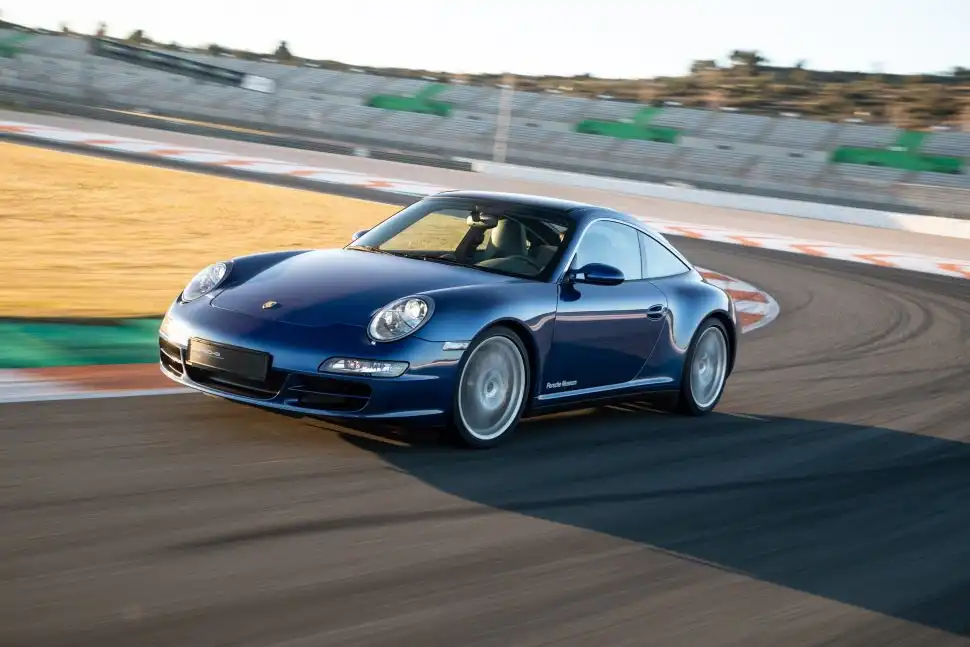
The Porsche 911 Targa 4 3.6, produced between 2006 and 2008, represents a compelling blend of open-air motoring and all-weather capability within the 997 generation of the iconic 911. Positioned as a premium offering within the Targa lineup, it combined the unique retractable roof mechanism of the Targa with Porsche’s renowned all-wheel-drive system and a naturally aspirated 3.6-liter flat-six engine. This variant aimed to deliver a more versatile and confident driving experience compared to the rear-wheel-drive Targa models, while still retaining the classic 911 feel. It sat above the base Targa models in terms of performance and price, but below the more focused Carrera S variants.
Technical Specifications
| Brand | Porsche |
| Model | 911 |
| Generation | 911 Targa (997) |
| Type (Engine) | Targa 4 3.6 (325 Hp) |
| Start of production | 2006 |
| End of production | 2008 |
| Powertrain Architecture | Internal Combustion engine |
| Body type | Targa |
| Seats | 4 |
| Doors | 2 |
| Fuel consumption (economy) – urban | 16.6 l/100 km (14.2 US mpg, 17 UK mpg, 6 km/l) |
| Fuel consumption (economy) – extra urban | 8.4 l/100 km (28 US mpg, 33.6 UK mpg, 11.9 km/l) |
| Fuel consumption (economy) – combined | 11.3 l/100 km (20.8 US mpg, 25 UK mpg, 8.8 km/l) |
| CO2 emissions | 272 g/km |
| Fuel Type | Petrol (Gasoline) |
| Acceleration 0 – 100 km/h | 5.3 sec |
| Acceleration 0 – 62 mph | 5.3 sec |
| Acceleration 0 – 60 mph | 5 sec |
| Maximum speed | 280 km/h (173.98 mph) |
| Weight-to-power ratio | 4.6 kg/Hp, 215.2 Hp/tonne |
| Weight-to-torque ratio | 4.1 kg/Nm, 245 Nm/tonne |
| Power | 325 Hp @ 6800 rpm |
| Power per litre | 90.4 Hp/l |
| Torque | 370 Nm @ 4250 rpm (272.9 lb.-ft. @ 4250 rpm) |
| Engine layout | Rear, Longitudinal |
| Engine Model/Code | M96.05 |
| Engine displacement | 3596 cm3 (219.44 cu. in.) |
| Number of cylinders | 6 |
| Engine configuration | Boxer |
| Compression ratio | 11.3:1 |
| Number of valves per cylinder | 4 |
| Fuel injection system | Multi-port manifold injection |
| Engine aspiration | Naturally aspirated engine |
| Engine oil capacity | 8.3 l (8.77 US qt | 7.3 UK qt) |
| Coolant | 31 l (32.76 US qt | 27.28 UK qt) |
| Kerb Weight | 1510 kg (3328.98 lbs) |
| Max. weight | 1900 kg (4188.78 lbs) |
| Max load | 390 kg (859.8 lbs) |
| Trunk (boot) space – maximum | 105 l (3.71 cu. ft.) |
| Fuel tank capacity | 67 l (17.7 US gal | 14.74 UK gal) |
| Length | 4427 mm (174.29 in) |
| Width | 1852 mm (72.91 in) |
| Height | 1310 mm (51.57 in) |
| Wheelbase | 2350 mm (92.52 in) |
| Drag coefficient (Cd) | 0.30 |
| Minimum turning circle | 10.9 m (35.76 ft) |
| Drive wheel | All wheel drive (4×4) |
| Number of gears and type of gearbox | 6 gears, manual transmission |
| Front suspension | Independent type McPherson |
| Rear suspension | Independent multi-link suspension |
| Front brakes | Ventilated discs |
| Rear brakes | Ventilated discs |
| Assisting systems | ABS (Anti-lock braking system) |
| Steering type | Steering rack and pinion |
| Power steering | Hydraulic Steering |
| Tires size | 235/40 ZR18; 295/35 ZR18 |
| Wheel rims size | 8J x 18; 11J x 18 |
Powertrain & Engine Architecture
At the heart of the 911 Targa 4 3.6 lies the M96.05 engine, a 3.6-liter naturally aspirated flat-six. This engine, a hallmark of Porsche engineering, features a dry-sump lubrication system, crucial for maintaining oil supply during the high G-forces experienced in spirited driving. The engine utilizes multi-port fuel injection, delivering precise fuel metering for optimal combustion. The valvetrain employs four valves per cylinder, enhancing breathing and contributing to the engine’s high-revving nature. The 325 horsepower and 370 Nm (272.9 lb-ft) of torque are delivered to all four wheels through a standard six-speed manual transmission. While a Tiptronic S automatic transmission was available as an option, the manual was favored by enthusiasts for its direct connection and control. The engine’s longitudinal rear-engine layout contributes to the 911’s unique handling characteristics.
Driving Characteristics
The 911 Targa 4 3.6 offered a refined and capable driving experience. The all-wheel-drive system provided excellent traction, particularly in inclement weather, making it a more practical choice than rear-wheel-drive 911s for year-round use. Acceleration from 0 to 60 mph took approximately 5 seconds, and the car could reach a top speed of 174 mph. Compared to the more powerful Carrera S models, the 3.6-liter engine felt less frantic, offering a broader, more accessible powerband. The manual transmission’s gear ratios were well-matched to the engine’s characteristics, providing strong acceleration in each gear. While not as brutally fast as some of its siblings, the Targa 4 3.6 delivered a satisfying and engaging driving experience, blending performance with everyday usability.
Equipment & Trim Levels
The Targa 4 3.6 came standard with a generous array of features, including leather upholstery, automatic climate control, a Bose sound system, and bi-xenon headlights. The interior featured a classic 911 dashboard layout with five circular gauges. Optional extras included navigation, sport seats, a sunroof, and various customization options through Porsche’s “Personalization” program. Interior trim could be specified in a variety of leather colors and materials. The Targa-specific retractable glass roof was electrically operated and provided an open-air experience while maintaining a degree of structural rigidity.
Chassis & Braking
The 997 generation 911 Targa 4 3.6 utilized an independent suspension system, with McPherson struts at the front and a multi-link setup at the rear. This configuration provided a comfortable ride while maintaining excellent handling precision. Braking duties were handled by ventilated discs on all four wheels, providing ample stopping power. An Anti-lock Braking System (ABS) was standard. The car’s chassis was designed to balance rigidity with weight reduction, contributing to its responsive handling. The all-wheel-drive system employed a viscous coupling to distribute power between the front and rear axles, optimizing traction in various conditions.
Market Reception & Comparison
The 911 Targa 4 3.6 was generally well-received by automotive critics. It was praised for its blend of performance, practicality, and open-air enjoyment. Compared to the base Targa models, the all-wheel-drive system and increased power were seen as significant upgrades. However, some critics noted that it didn’t offer the same level of visceral excitement as the rear-wheel-drive Carrera models. Fuel economy was reasonable for a sports car of its caliber, averaging around 20.8 US mpg in combined driving. Reliability was generally good, although the M96 engine has been known to exhibit issues with intermediate shaft bearing failure in some cases, requiring preventative maintenance.
Legacy
The 911 Targa 4 3.6 remains a desirable classic Porsche. Its combination of all-wheel-drive capability, open-air motoring, and the iconic 911 design has ensured its enduring appeal. The M96 engine, while requiring diligent maintenance, is a robust and rewarding powerplant. On the used car market, well-maintained examples command a premium, reflecting their rarity and desirability. The 997 generation 911, including the Targa 4 3.6, is widely regarded as a sweet spot in the 911 lineage, offering a blend of classic Porsche character and modern technology.