
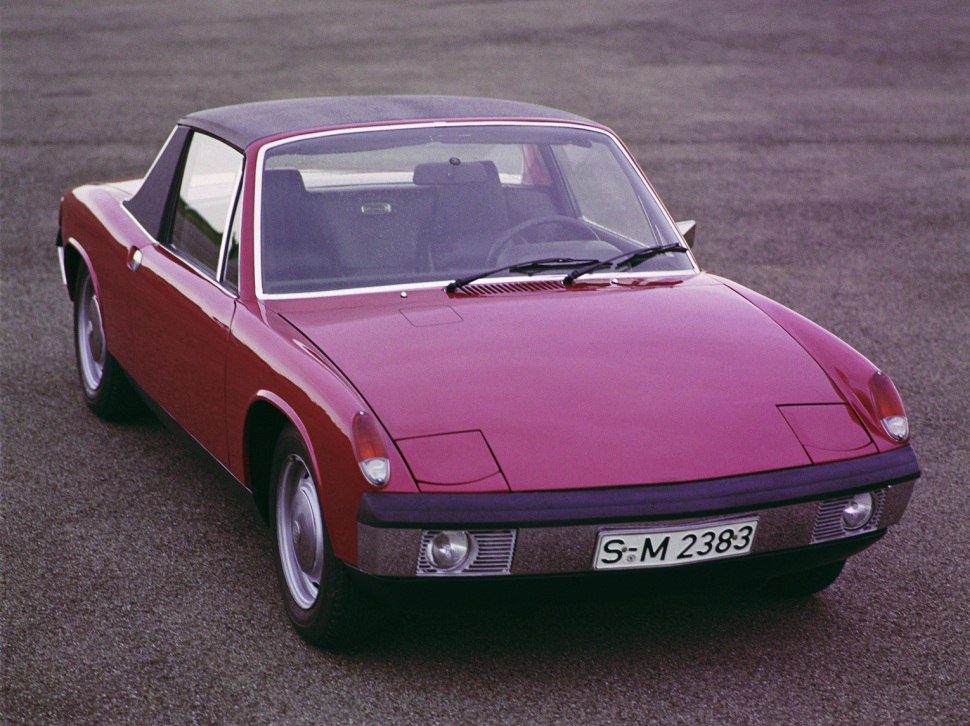
The Porsche 914, particularly the 2.0-liter variant producing 110 horsepower, represents a unique chapter in Porsche’s history. Introduced in 1969 and continuing through 1972, this model occupied an unusual space in the automotive market – a relatively affordable, mid-engined sports car intended to broaden Porsche’s appeal. While not initially embraced by Porsche purists, the 914 has since gained a dedicated following for its distinctive design, engaging driving experience, and historical significance as Porsche’s first mid-engine production vehicle.
The Porsche 914 2.0: A Mid-Engine Revolution
The 914 was born from a collaboration between Porsche and Volkswagen, initially conceived as a replacement for the Volkswagen Karmann Ghia. However, Porsche ultimately took the lead in development, resulting in a vehicle that, while sharing some components with the VW-Porsche 912, was distinctly a Porsche in its engineering and driving characteristics. The 2.0-liter version, introduced in 1970, offered a significant performance upgrade over the earlier 1.7-liter models, solidifying the 914’s position as a genuine sports car.
Engine & Performance
The heart of the 914 2.0 is its 1,991 cc (121.5 cu. in.) Type 901.38 engine. This naturally aspirated, 6-cylinder boxer engine, a hallmark of Porsche engineering, produced 110 horsepower at 5,800 rpm and 178 Nm (131.29 lb.-ft.) of torque at 4,200 rpm. The boxer configuration, with its horizontally opposed cylinders, contributes to a low center of gravity, enhancing handling and stability. Power per liter is rated at 55.2 hp/l. The engine is fed by a carburetor fuel injection system. This power is delivered to the rear wheels through a 5-speed manual transmission, providing a direct and engaging driving experience. The 914 2.0 achieves a maximum speed of 201 km/h (124.9 mph). The weight-to-power ratio of 8.5 kg/Hp and a weight-to-torque ratio of 5.3 kg/Nm contribute to its nimble handling.
Design & Features
The Porsche 914 is instantly recognizable by its distinctive Targa top – a removable roof panel that provides an open-air driving experience while maintaining structural rigidity. The body, designed by Butzi Porsche, is characterized by its flowing lines and relatively compact dimensions. The mid-engine layout necessitated a unique design, with separate trunk compartments front and rear, offering a surprising amount of luggage space for a sports car. Inside, the 914 features a minimalist interior focused on the driving experience. While lacking many of the luxury features found in contemporary Porsche models, the 914 prioritizes functionality and driver engagement. Safety features of the era, such as disc brakes on all four wheels, were standard, reflecting Porsche’s commitment to performance and control. The car’s dimensions are 3985 mm (156.89 in.) in length, 1650 mm (64.96 in.) in width, and 1230 mm (48.43 in.) in height, with a wheelbase of 2450 mm (96.46 in.).
Technical Specifications
| Brand | Porsche |
| Model | 914 |
| Generation | 914 |
| Type (Engine) | 2.0 (110 Hp) |
| Start of production | 1969 |
| End of production | 1972 |
| Powertrain Architecture | Internal Combustion engine |
| Body type | Targa |
| Seats | 2 |
| Doors | 2 |
| Fuel consumption (combined) | 9 l/100 km (26.1 US mpg, 31.4 UK mpg, 11.1 km/l) |
| Fuel Type | Petrol (Gasoline) |
| Maximum speed | 201 km/h (124.9 mph) |
| Weight-to-power ratio | 8.5 kg/Hp |
| Weight-to-torque ratio | 5.3 kg/Nm |
| Power | 110 Hp @ 5800 rpm |
| Power per litre | 55.2 Hp/l |
| Torque | 178 Nm @ 4200 rpm (131.29 lb.-ft. @ 4200 rpm) |
| Engine layout | Middle, Longitudinal |
| Engine Model/Code | 901.38 |
| Engine displacement | 1991 cm3 (121.5 cu. in.) |
| Number of cylinders | 6 |
| Engine configuration | Boxer |
| Cylinder Bore | 80 mm (3.15 in.) |
| Piston Stroke | 66 mm (2.6 in.) |
| Compression ratio | 8.6:1 |
| Number of valves per cylinder | 2 |
| Fuel injection system | Carburettor |
| Engine aspiration | Naturally aspirated engine |
| Valvetrain | SOHC |
| Engine oil capacity | 9 l (9.51 US qt | 7.92 UK qt) |
| Kerb Weight | 940 kg (2072.35 lbs.) |
| Max. weight | 1260 kg (2777.82 lbs.) |
| Max load | 320 kg (705.48 lbs.) |
| Length | 3985 mm (156.89 in.) |
| Width | 1650 mm (64.96 in.) |
| Height | 1230 mm (48.43 in.) |
| Wheelbase | 2450 mm (96.46 in.) |
| Front track | 1361 mm (53.58 in.) |
| Rear track | 1382 mm (54.41 in.) |
| Ride height (ground clearance) | 128 mm (5.04 in.) |
| Minimum turning circle | 11 m (36.09 ft.) |
| Drivetrain Architecture | Rear wheel drive |
| Number of gears and type of gearbox | 5 gears, manual transmission |
| Front suspension | Spring Strut, Wishbone |
| Rear suspension | Trailing arm, Coil spring |
| Front brakes | Disc, 282.5 mm |
| Rear brakes | Disc, 286 mm |
| Steering type | Steering rack and pinion |
| Wheel rims size | 5.5J x 15 |
The Porsche 914 2.0, despite its initial reception, has proven to be a lasting and influential model. Its mid-engine layout paved the way for future Porsche designs, and its affordability brought the Porsche experience to a wider audience. Today, the 914 is celebrated by enthusiasts for its unique character, engaging driving dynamics, and its place as a pivotal moment in Porsche’s evolution.
