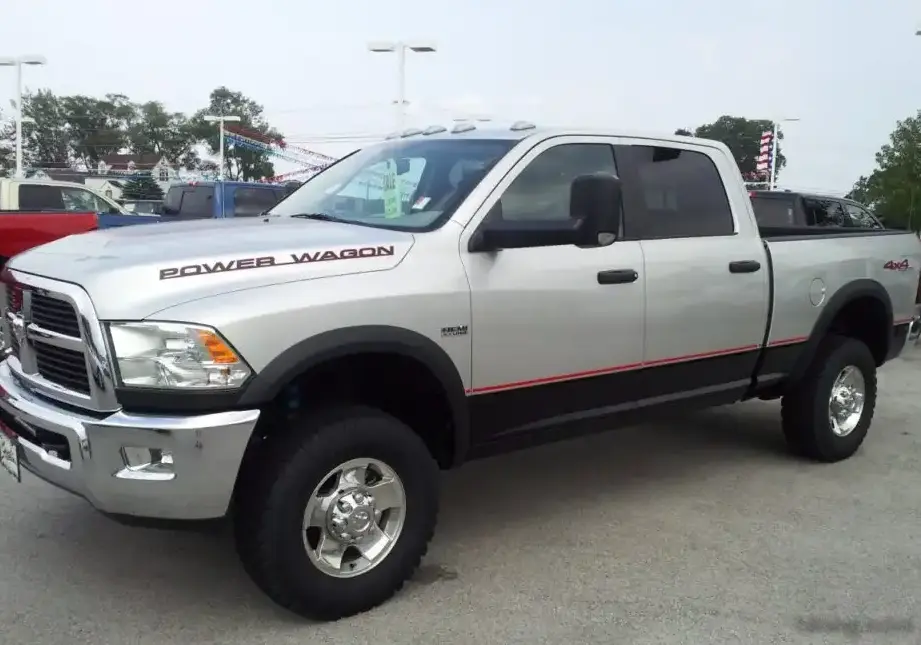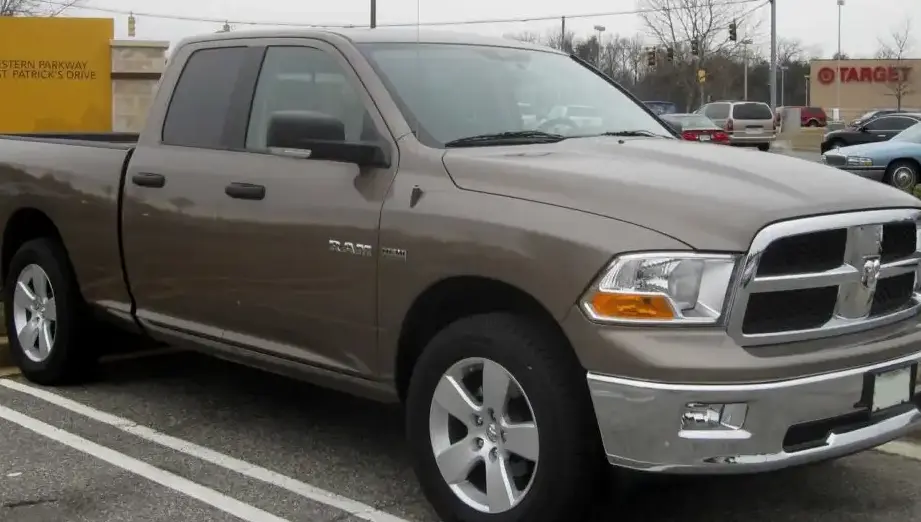
The RAM 1500 Quad Cab (DS) equipped with the 4.7-liter V8 engine and automatic transmission was a mainstay of the full-size pickup truck market in North America from 2010 to 2012. Representing the second generation of the redesigned Dodge Ram (later RAM) introduced in 1994, this variant occupied a middle ground in the 1500 lineup, offering a balance between capability, comfort, and affordability. It was positioned below the more powerful 5.7-liter HEMI V8 models and above the base V6 offerings, catering to buyers who needed substantial towing and hauling capacity without the premium price tag of the higher trims.
Technical Specifications
| Brand | RAM |
| Model | 1500 |
| Generation | 1500 Quad Cab (DS) |
| Type (Engine) | 4.7 V8 (310 Hp) Automatic |
| Start of production | 2010 |
| End of production | 2012 |
| Powertrain Architecture | Internal Combustion engine |
| Body type | Pick-up |
| Seats | 5-6 |
| Doors | 4 |
| Fuel consumption (economy) – urban | 15.6 l/100 km (15.1 US mpg, 18.1 UK mpg, 6.4 km/l) |
| Fuel consumption (economy) – extra urban | 10.8 l/100 km (21.8 US mpg, 26.2 UK mpg, 9.3 km/l) |
| Fuel Type | Petrol (Gasoline) |
| Weight-to-power ratio | 7.3 kg/Hp, 136.4 Hp/tonne |
| Weight-to-torque ratio | 5.1 kg/Nm, 196.7 Nm/tonne |
| Power | 310 Hp @ 5650 rpm |
| Power per litre | 65.9 Hp/l |
| Torque | 447 Nm @ 3950 rpm (329.69 lb.-ft. @ 3950 rpm) |
| Maximum engine speed | 6000 rpm |
| Engine layout | Front, Longitudinal |
| Engine Model/Code | EVE |
| Engine displacement | 4701 cm3 (286.87 cu. in.) |
| Number of cylinders | 8 |
| Engine configuration | V-engine |
| Cylinder Bore | 93 mm (3.66 in.) |
| Piston Stroke | 86.5 mm (3.41 in.) |
| Compression ratio | 9.8:1 |
| Number of valves per cylinder | 2 |
| Fuel injection system | Multi-port manifold injection |
| Engine aspiration | Naturally aspirated engine |
| Valvetrain | SOHC |
| Engine oil capacity | 5.7 l (6.02 US qt | 5.02 UK qt) |
| Coolant | 13 l (13.74 US qt | 11.44 UK qt) |
| Kerb Weight | 2272 kg (5008.9 lbs.) |
| Max. weight | 3039 kg (6699.85 lbs.) |
| Max load | 767 kg (1690.95 lbs.) |
| Trunk (boot) space – maximum | 1628 l (57.49 cu. ft.) |
| Fuel tank capacity | 98 l (25.89 US gal | 21.56 UK gal) |
| Permitted trailer load with brakes (12%) | 2858 kg (6300.81 lbs.) |
| Length | 5816 mm (228.98 in.) |
| Width including mirrors | 2016 mm (79.37 in.) |
| Height | 1906 mm (75.04 in.) |
| Wheelbase | 3569 mm (140.51 in.) |
| Front track | 1728 mm (68.03 in.) |
| Rear (Back) track | 1714 mm (67.48 in.) |
| Drag coefficient (Cd) | 0.36 |
| Minimum turning circle (turning diameter) | 13.7 m (44.95 ft.) |
| Approach angle | 18.8° |
| Departure angle | 25.1° |
| Ramp-over (brakeover) angle | 21.4° |
| Drivetrain Architecture | The Internal combustion engine (ICE) drives the rear wheels of the vehicle. |
| Drive wheel | Rear wheel drive |
| Number of gears and type of gearbox | 5 gears, automatic transmission |
| Front suspension | Double wishbone |
| Rear suspension | Independent multi-link suspension |
| Front brakes | Ventilated discs |
| Rear brakes | Disc |
| Assisting systems | ABS (Anti-lock braking system) |
| Tires size | 265/70 R17 |
| Wheel rims size | 7.0J x 17 |
Powertrain & Engine Architecture
The heart of this RAM 1500 variant was the 4.7-liter (286.87 cubic inch) V8 engine, internally designated as the EVE engine code. This engine was a member of Chrysler’s third-generation small-block V8 family. It featured a cast iron block with aluminum cylinder heads, a single overhead camshaft (SOHC) valvetrain operating two valves per cylinder, and multi-port fuel injection. The 9.8:1 compression ratio contributed to a respectable 310 horsepower at 5,650 rpm and 329.69 lb-ft of torque at 3,950 rpm. The engine’s longitudinal mounting and rear-wheel-drive configuration were standard for full-size American pickups. The 42RE four-speed automatic transmission was the sole transmission option for this configuration. While not as sophisticated as some newer automatic transmissions, the 42RE was known for its durability and relatively simple design.
Driving Characteristics
The 4.7-liter V8 and 42RE automatic combination provided adequate, but not exhilarating, performance. Acceleration was sufficient for everyday driving and moderate towing, but it lacked the punch of the 5.7-liter HEMI. The automatic transmission’s gear ratios were optimized for towing and hauling, resulting in a relatively conservative feel. The truck felt capable when loaded, with the engine providing enough torque to maintain speed on inclines. Fuel economy, however, was a notable drawback, averaging around 15.6 l/100 km (15.1 US mpg) in city driving and 10.8 l/100 km (21.8 US mpg) on the highway. Compared to the manual transmission equipped 4.7L, the automatic offered convenience at the expense of fuel efficiency and a slightly less engaging driving experience.
Equipment & Trim Levels
The Quad Cab (DS) trim level typically included standard features such as air conditioning, power windows and locks, a basic audio system, and cloth upholstery. The “DS” designation indicated a mid-range trim, offering more features than the base ST model but falling short of the luxury-oriented Laramie trim. Optional extras included upgraded audio systems, leather upholstery, power-adjustable seats, a sunroof, and various towing packages. The interior design was functional and durable, prioritizing practicality over luxury.
Chassis & Braking
The RAM 1500 Quad Cab (DS) utilized a body-on-frame construction, providing a robust and durable platform. The front suspension featured a double wishbone design, while the rear suspension employed an independent multi-link setup. This combination aimed to balance ride comfort with load-carrying capability. Braking duties were handled by ventilated discs at the front and solid discs at the rear. Anti-lock braking system (ABS) was standard. The truck’s relatively high curb weight of 2272 kg (5008.9 lbs) necessitated a capable braking system to ensure safe stopping distances.
Market Reception & Comparison
The RAM 1500 Quad Cab (DS) 4.7L Automatic was generally well-received by critics as a solid, dependable work truck. It offered a good value proposition for buyers who needed a capable pickup without the expense of the higher-trim models. However, its fuel economy was often criticized, especially compared to newer, more fuel-efficient trucks. Compared to the 5.7-liter HEMI V8 models, the 4.7L offered less power and towing capacity but was more affordable to purchase and maintain. The 4.7L also proved to be a more reliable engine than the early iterations of the HEMI, avoiding some of the initial issues associated with the variable valve timing system.
Legacy
The 4.7-liter V8 engine, while eventually superseded by the more modern 3.6-liter Pentastar V6 and 5.7-liter HEMI V8, proved to be a durable and reliable powertrain. Many examples of the RAM 1500 equipped with this engine are still on the road today. On the used car market, these trucks are often sought after for their affordability and capability. While maintenance costs can increase with age, the engine’s relatively simple design makes it relatively easy to repair. The 42RE automatic transmission, while not known for its refinement, is also considered to be a robust unit. Overall, the RAM 1500 Quad Cab (DS) 4.7L Automatic represents a capable and dependable full-size pickup truck that continues to serve many owners well.