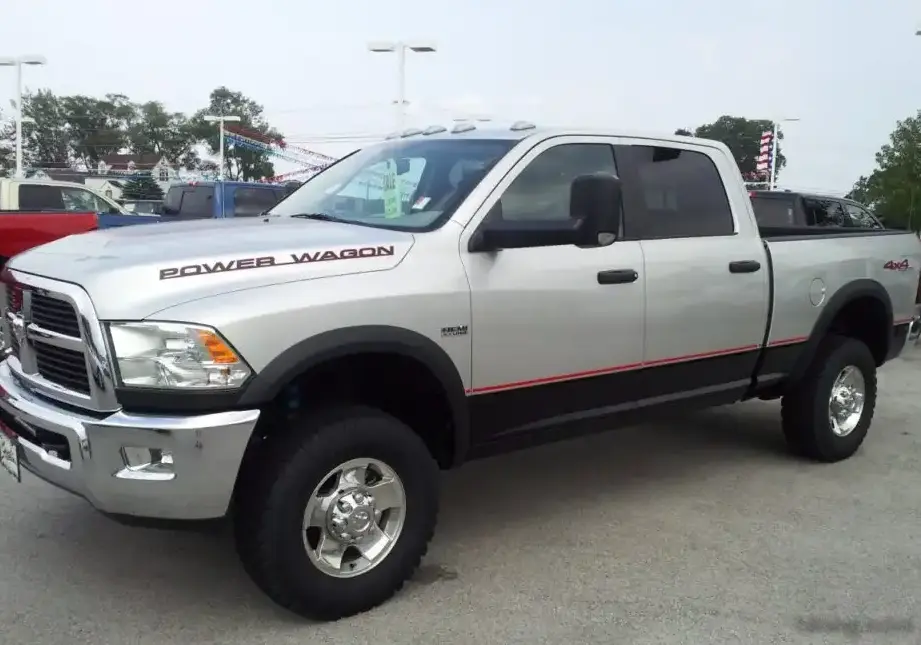
The RAM 1500 Regular Cab Long (DS) equipped with the 5.7 Hemi V8 engine and automatic transmission was a mainstay of the full-size pickup truck market in North America from 2010 to 2012. Representing the third generation of the Dodge Ram (later Ram) 1500, this configuration offered a balance of power, capability, and relative affordability within the broader 1500 lineup. The “DS” designation refers to the cab and bed configuration – a Regular Cab with a Long bed. This particular variant served as a workhorse for individuals and businesses needing a robust, no-frills pickup for hauling and towing.
Technical Specifications
| Brand | RAM |
| Model | 1500 |
| Generation | 1500 Regular Cab Long (DS) |
| Type (Engine) | 5.7 Hemi V8 (390 Hp) Automatic |
| Start of production | 2010 |
| End of production | 2012 |
| Powertrain Architecture | Internal Combustion engine |
| Body type | Pick-up |
| Seats | 2-3 |
| Doors | 2 |
| Fuel consumption (urban) | 15.4 l/100 km (15.3 US mpg, 18.3 UK mpg, 6.5 km/l) |
| Fuel consumption (extra urban) | 10.2 l/100 km (23.1 US mpg, 27.7 UK mpg, 9.8 km/l) |
| Fuel Type | Petrol (Gasoline) |
| Weight-to-power ratio | 5.7 kg/Hp, 175.8 Hp/tonne |
| Weight-to-torque ratio | 4 kg/Nm, 248.9 Nm/tonne |
| Power | 390 Hp @ 5600 rpm |
| Power per litre | 69 Hp/l |
| Torque | 552 Nm @ 4000 rpm (407.13 lb.-ft. @ 4000 rpm) |
| Maximum engine speed | 5800 rpm |
| Engine layout | Front, Longitudinal |
| Engine Model/Code | EZH |
| Engine displacement | 5654 cm3 (345.03 cu. in.) |
| Number of cylinders | 8 |
| Engine configuration | V-engine |
| Cylinder Bore | 99.5 mm (3.92 in.) |
| Piston Stroke | 90.9 mm (3.58 in.) |
| Compression ratio | 10.5:1 |
| Number of valves per cylinder | 2 |
| Fuel injection system | Multi-port manifold injection |
| Engine aspiration | Naturally aspirated engine |
| Valvetrain | OHV |
| Engine oil capacity | 6.6 l (6.97 US qt | 5.81 UK qt) |
| Coolant | 15 l (15.85 US qt | 13.2 UK qt) |
| Kerb Weight | 2218 kg (4889.85 lbs.) |
| Max. weight | 2994 kg (6600.64 lbs.) |
| Max load | 776 kg (1710.79 lbs.) |
| Trunk (boot) space – maximum | 2115 l (74.69 cu. ft.) |
| Fuel tank capacity | 121 l (31.96 US gal | 26.62 UK gal) |
| Permitted trailer load with brakes (12%) | 2699 kg (5950.28 lbs.) |
| Length | 5866 mm (230.94 in.) |
| Width including mirrors | 2016 mm (79.37 in.) |
| Height | 1889 mm (74.37 in.) |
| Wheelbase | 3569 mm (140.51 in.) |
| Front track | 1728 mm (68.03 in.) |
| Rear (Back) track | 1714 mm (67.48 in.) |
| Drag coefficient (Cd) | 0.36 |
| Minimum turning circle (turning diameter) | 13.7 m (44.95 ft.) |
| Approach angle | 18.8° |
| Departure angle | 24.1° |
| Ramp-over (brakeover) angle | 21.4° |
| Drivetrain Architecture | Rear wheel drive |
| Number of gears and type of gearbox | 5 gears, automatic transmission |
| Front suspension | Double wishbone |
| Rear suspension | Independent multi-link suspension |
| Front brakes | Ventilated discs |
| Rear brakes | Disc |
| Assisting systems | ABS (Anti-lock braking system) |
| Tires size | 265/70 R17 |
| Wheel rims size | 7.0J x 17 |
INTRODUCTION
The 2010-2012 RAM 1500 Regular Cab Long (DS) with the 5.7L Hemi V8 and automatic transmission occupied a significant position in the full-size pickup segment. It was part of the second generation of the redesigned Ram 1500, introduced in 2009 (platform code: DS). This generation marked a departure from the previous model, focusing on improved ride quality, interior refinement, and a more modern aesthetic. The Regular Cab Long configuration, with its extended bed, catered to customers prioritizing cargo space and utility over passenger comfort. This trim level was positioned as a step up from the base V6 models, offering substantially more power and towing capacity, but remained more accessible than the higher-trim level 1500s with four-wheel drive or luxury features.
Powertrain & Engine Architecture
At the heart of this RAM 1500 variant lies the 5.7-liter Hemi V8 engine, internally designated as the EZH. This engine is a naturally aspirated, overhead valve (OHV) design featuring multi-port fuel injection. The 5.7L Hemi benefits from Chrysler’s Multi-Displacement System (MDS), which seamlessly switches between eight and four cylinders under light load conditions to improve fuel economy. The engine produces 390 horsepower at 5600 rpm and 407 lb-ft of torque at 4000 rpm. The automatic transmission paired with this engine is a five-speed unit, known for its durability and smooth shifting. While not the most technologically advanced transmission available at the time, it was well-suited to the engine’s power characteristics and the truck’s intended use. The transmission’s gear ratios were optimized for both towing and everyday driving, providing adequate acceleration and maintaining reasonable engine speeds at highway speeds.
Driving Characteristics
The 5.7L Hemi-equipped RAM 1500 Regular Cab Long delivered a robust driving experience. While not as quick as some of the lighter, more performance-oriented pickups, it provided ample power for hauling heavy loads and towing trailers. The automatic transmission, while smooth, wasn’t particularly sporty, prioritizing functionality over aggressive shifting. Compared to the 3.7L V6 models, the Hemi offered a significant increase in acceleration and overall responsiveness. Against the higher-output 6.1L Hemi (available in some previous Ram models), the 5.7L offered a more balanced combination of power and fuel efficiency. The long wheelbase contributed to a comfortable ride, but also made the truck feel large and less nimble in tight spaces. The rear-wheel-drive configuration provided good traction in most conditions, but could struggle in slippery environments without the addition of weight in the bed or the use of appropriate tires.
Equipment & Trim Levels
The RAM 1500 Regular Cab Long (DS) with the 5.7 Hemi V8 typically came standard with features such as air conditioning, a basic audio system, and vinyl upholstery. Higher trim levels, such as the SLT, added features like power windows and locks, keyless entry, and upgraded interior materials. Optional extras included a premium sound system, a navigation system, and various towing packages. The interior design was functional and durable, prioritizing practicality over luxury. The dashboard layout was straightforward and easy to use, with large, clearly marked controls. The bench seat offered seating for up to three passengers, although the Regular Cab configuration was best suited for two adults.
Chassis & Braking
The RAM 1500’s chassis featured a robust frame-on-body construction, providing a solid foundation for hauling and towing. The front suspension utilized a double wishbone design, while the rear suspension employed an independent multi-link setup. This combination delivered a comfortable ride and good handling characteristics. Braking duties were handled by ventilated discs at the front and discs at the rear, providing adequate stopping power for the truck’s weight. An Anti-lock Braking System (ABS) was standard, enhancing safety and control during emergency braking situations. The standard tire size was 265/70 R17, mounted on 7.0J x 17 inch wheels.
Market Reception & Comparison
The 2010-2012 RAM 1500 with the 5.7 Hemi V8 and automatic transmission was generally well-received by critics and consumers alike. It was praised for its comfortable ride, spacious interior, and powerful engine. Fuel economy, however, was a common criticism, as the 5.7L Hemi was not particularly fuel-efficient. Compared to the V6 models, the Hemi offered a significant performance advantage, but at the cost of increased fuel consumption. Against competitors like the Ford F-150 and Chevrolet Silverado, the RAM 1500 offered a compelling combination of features and value. The RAM’s unique coil-spring rear suspension was often cited as a key advantage, providing a smoother ride than the leaf-spring setups found in some competitors.
Legacy
The 5.7L Hemi V8 and five-speed automatic transmission pairing proved to be a reliable and durable powertrain combination. These engines are known for their longevity and relatively low maintenance costs. In the used car market, these RAM 1500s remain popular choices for buyers seeking a capable and affordable pickup truck. While newer trucks offer more advanced technology and features, the 2010-2012 RAM 1500 continues to provide a solid and dependable workhorse for a variety of tasks. Common issues reported with these trucks include occasional sensor failures and minor electrical glitches, but overall, they are considered to be relatively trouble-free vehicles.