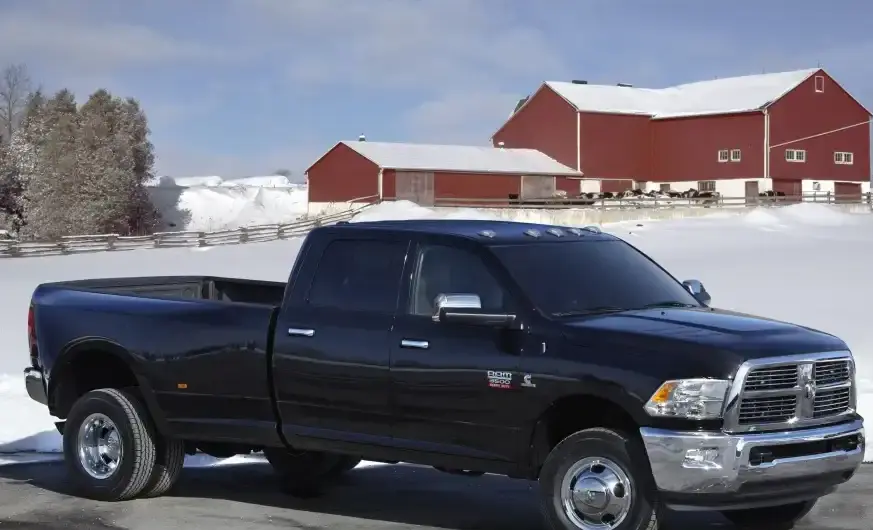
The RAM 2500/3500 Crew Cab Long I, specifically the 2500 model equipped with the 6.7-liter Cummins turbocharged diesel engine producing 350 horsepower and paired with a six-speed automatic transmission, was a prominent offering in the heavy-duty pickup truck segment from 2010 to 2012. This configuration represented a sweet spot in the lineup, balancing substantial towing and hauling capability with a degree of everyday usability. Positioned between the base gasoline engine options and the higher-output Cummins variants, it catered to buyers needing serious truck performance without the added cost or fuel consumption of the most powerful models. This generation (often referred to as the second generation of the new RAM trucks) built upon the foundation laid by its predecessors, offering improved refinement and features while maintaining the rugged durability expected of a heavy-duty pickup.
Technical Specifications
| Brand | RAM |
| Model | 2500/3500 |
| Generation | 2500/3500 Crew Cab Long I |
| Type (Engine) | 2500 6.7 Cummins TD (350 Hp) 4×4 Automatic |
| Start of production | 2010 |
| End of production | 2012 |
| Powertrain Architecture | Internal Combustion engine |
| Body type | Pick-up |
| Seats | 5-6 |
| Doors | 4 |
| Fuel Type | Diesel |
| Weight-to-power ratio | 9.3 kg/Hp, 107.3 Hp/tonne |
| Weight-to-torque ratio | 3.9 kg/Nm, 253.6 Nm/tonne |
| Power | 350 Hp @ 3013 rpm |
| Power per litre | 52.3 Hp/l |
| Torque | 827 Nm @ 1400 rpm (609.96 lb.-ft. @ 1400 rpm) |
| Engine Model/Code | ETJ |
| Engine displacement | 6690 cm3 (408.25 cu. in.) |
| Number of cylinders | 6 |
| Engine configuration | Inline |
| Cylinder Bore | 107 mm (4.21 in.) |
| Piston Stroke | 124 mm (4.88 in.) |
| Fuel injection system | Diesel Commonrail |
| Engine aspiration | Turbocharger, Intercooler |
| Engine oil capacity | 11.4 l (12.05 US qt | 10.03 UK qt) |
| Coolant | 21.4 l (22.61 US qt | 18.83 UK qt) |
| Kerb Weight | 3261 kg (7189.27 lbs.) |
| Max. weight | 4354 kg (9598.93 lbs.) |
| Max load | 1093 kg (2409.65 lbs.) |
| Trunk (boot) space – maximum | 2115 l (74.69 cu. ft.) |
| Fuel tank capacity | 132 l (34.87 US gal | 29.04 UK gal) |
| Permitted trailer load with brakes (12%) | 3856 kg (8501.02 lbs.) |
| Length | 6589 mm (259.41 in.) |
| Width including mirrors | 2009 mm (79.09 in.) |
| Height | 1971 mm (77.6 in.) |
| Wheelbase | 4290 mm (168.9 in.) |
| Front track | 1735 mm (68.31 in.) |
| Rear (Back) track | 1732 mm (68.19 in.) |
| Minimum turning circle (turning diameter) | 14.9 m (48.88 ft.) |
| Approach angle | 21.8° |
| Departure angle | 25.9° |
| Ramp-over (brakeover) angle | 16.5° |
| Drive wheel | All wheel drive (4×4) |
| Number of gears and type of gearbox | 6 gears, automatic transmission |
| Front suspension | Independent multi-link suspension |
| Rear suspension | Leaf spring |
| Front brakes | Disc |
| Rear brakes | Disc |
| Assisting systems | ABS (Anti-lock braking system) |
| Tires size | 245/70 R17; 265/70 R17; 275/70 R18 |
| Wheel rims size | 7.5J x 17; 8J x 17; 8J x 18 |
Powertrain & Engine Architecture
The heart of this RAM 2500 was the 6.7-liter Cummins inline-six diesel engine, designated with the ETJ code. This engine represented a significant evolution of Cummins’ proven diesel technology. It featured a cast iron block, a 24-valve cylinder head, and a variable geometry turbocharger with an intercooler. The common-rail fuel injection system, delivering fuel at extremely high pressures, was crucial to the engine’s efficiency and power output. The 350 horsepower and 827 lb-ft of torque were achieved through precise fuel metering and optimized combustion. The six-speed automatic transmission, sourced from Allison, was specifically designed to handle the substantial torque output of the Cummins engine. It featured electronically controlled shifting and a tow/haul mode for improved performance when towing heavy loads.
Driving Characteristics
The 350 hp Cummins with the automatic transmission provided a robust and capable driving experience. While not as overtly powerful as the higher-output Cummins variants (which could exceed 400 hp), this configuration offered a more relaxed and manageable power delivery. The automatic transmission, while smooth, wasn’t particularly quick to downshift, meaning drivers needed to anticipate acceleration needs. The gear ratios were optimized for towing and hauling, prioritizing low-end torque over outright acceleration. Compared to the manual transmission versions, the automatic offered greater convenience, especially in stop-and-go traffic, but at the expense of some driver control and fuel efficiency. The truck felt planted and stable, even when carrying heavy loads, thanks to its robust chassis and suspension.
Equipment & Trim Levels
The 2500/3500 Crew Cab Long I with the 6.7L Cummins and automatic transmission typically came standard with features like air conditioning, power windows and locks, a basic audio system, and vinyl upholstery. The Crew Cab configuration offered spacious seating for up to six passengers. Popular optional extras included leather upholstery, a premium sound system, navigation, a sunroof, and various towing packages. Trim levels, such as STX, SLT, and Laramie, offered progressively more luxurious appointments and features. The SLT trim was a popular choice, offering a good balance of features and value.
Chassis & Braking
The RAM 2500/3500 featured a heavy-duty chassis designed to withstand the stresses of demanding work. The front suspension utilized an independent multi-link setup for improved ride quality and handling, while the rear suspension employed leaf springs to provide robust load-carrying capacity. Brakes were disc brakes on all four wheels, providing ample stopping power even when heavily loaded. An Anti-lock Braking System (ABS) was standard. The rear axle ratios varied depending on the specific configuration and intended use, with lower ratios (numerically higher) providing better towing performance and higher ratios offering improved fuel economy at highway speeds.
Market Reception & Comparison
The 2500/3500 with the 350 hp Cummins and automatic transmission was generally well-received by critics and buyers alike. It was praised for its strong towing capacity, comfortable ride (for a heavy-duty truck), and relatively refined interior. Compared to the gasoline-powered RAM 2500/3500 models, the Cummins diesel offered significantly more torque and better fuel economy, especially when towing. Compared to the higher-output Cummins variants, this configuration offered a lower price point and slightly better fuel economy, making it an attractive option for buyers who didn’t need the absolute maximum towing capacity. Reliability was generally good, although diesel engines require more diligent maintenance than gasoline engines.
Legacy
The 6.7-liter Cummins engine has become legendary for its durability and longevity. The 2010-2012 RAM 2500/3500 with this powertrain continues to be a popular choice in the used truck market. These trucks are known for their ability to accumulate high mileage while remaining reliable. However, potential buyers should be aware of the need for regular maintenance, including oil changes, fuel filter replacements, and inspections of the cooling system. The automatic transmission, while generally reliable, should also be inspected for any signs of wear or slippage. Overall, this RAM 2500/3500 configuration represents a solid and capable heavy-duty truck that continues to provide value to its owners today.