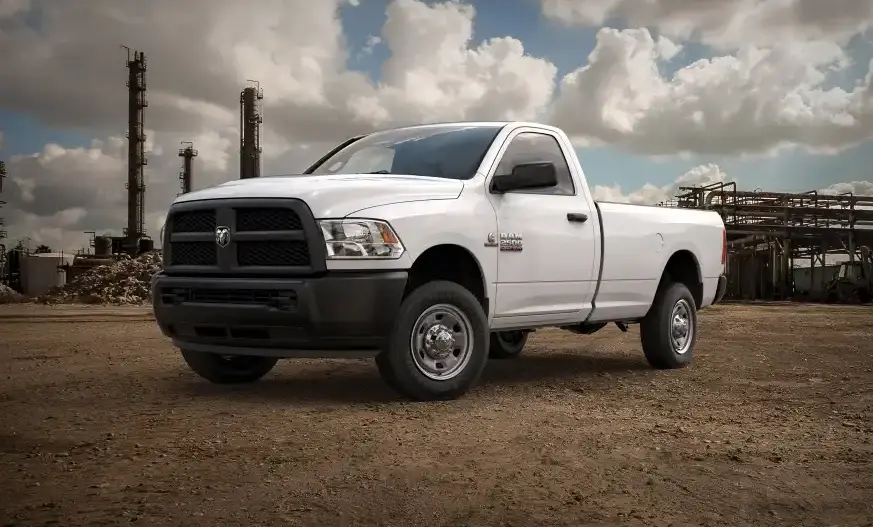
The RAM 2500/3500 Regular Cab I (facelift 2013) with the 5.7 Hemi V8 engine and automatic transmission represents a significant iteration in the evolution of Ram’s heavy-duty pickup truck lineup. Produced from 2013 to 2018, this configuration occupied a crucial middle ground within the 2500/3500 series, offering a balance between capability, comfort, and affordability. It was positioned as a workhorse for those needing substantial towing and payload capacity, but without the higher price tag and complexity of the Cummins diesel options. This model year saw a substantial refresh of the previous generation, bringing updated styling, interior refinements, and improved technology.
Technical Specifications
| Brand | RAM |
| Model | 2500/3500 |
| Generation | 2500/3500 Regular Cab I (facelift 2013) |
| Type (Engine) | 2500 5.7 Hemi V8 (383 Hp) Automatic |
| Start of production | 2013 |
| End of production | 2018 |
| Powertrain Architecture | Internal Combustion engine |
| Body type | Pick-up |
| Seats | 2-3 |
| Doors | 2 |
| Fuel Type | Petrol (Gasoline) |
| Weight-to-power ratio | 6.5 kg/Hp, 154.1 Hp/tonne |
| Weight-to-torque ratio | 4.6 kg/Nm, 218 Nm/tonne |
| Power | 383 Hp @ 5600 rpm |
| Power per litre | 67.7 Hp/l |
| Torque | 542 Nm @ 4000 rpm, 399.76 lb.-ft. @ 4000 rpm |
| Maximum engine speed | 5800 rpm |
| Engine layout | Front, Longitudinal |
| Engine Model/Code | EZC |
| Engine displacement | 5654 cm3, 345.03 cu. in. |
| Number of cylinders | 8 |
| Engine configuration | V-engine |
| Cylinder Bore | 99.5 mm, 3.92 in. |
| Piston Stroke | 90.9 mm, 3.58 in. |
| Compression ratio | 10.5:1 |
| Number of valves per cylinder | 2 |
| Fuel injection system | Multi-port manifold injection |
| Engine aspiration | Naturally aspirated engine |
| Engine oil capacity | 6.6 l, 6.97 US qt | 5.81 UK qt |
| Coolant | 17.3 l, 18.28 US qt | 15.22 UK qt |
| Kerb Weight | 2486 kg, 5480.69 lbs |
| Max. weight | 3924 kg, 8650.94 lbs |
| Max load | 1438 kg, 3170.25 lbs |
| Trunk (boot) space – maximum | 2115 l, 74.69 cu. ft |
| Fuel tank capacity | 121 l, 31.96 US gal | 26.62 UK gal |
| Permitted trailer load with brakes (12%) | 5602 kg, 12350.3 lbs |
| Length | 5867 mm, 230.98 in |
| Width including mirrors | 2004 mm, 78.9 in |
| Height | 1862 mm, 73.31 in |
| Wheelbase | 3569 mm, 140.51 in |
| Front track | 1742 mm, 68.58 in |
| Rear (Back) track | 1732 mm, 68.19 in |
| Minimum turning circle (turning diameter) | 13.3 m, 43.64 ft |
| Approach angle | 13.2° |
| Departure angle | 18.1° |
| Ramp-over (brakeover) angle | 16.5° |
| Drivetrain Architecture | The Internal combustion engine (ICE) drives the rear wheels of the vehicle. |
| Drive wheel | Rear wheel drive |
| Number of gears and type of gearbox | 6 gears, automatic transmission |
| Front suspension | Independent multi-link suspension |
| Rear suspension | Independent multi-link suspension |
| Front brakes | Disc |
| Rear brakes | Disc |
| Assisting systems | ABS (Anti-lock braking system) |
| Power steering | Hydraulic Steering |
| Tires size | 245/70 R17; 265/70 R17; 275/70 R18 |
| Wheel rims size | 7.5J x 17; 8J x 17; 8J x 18 |
INTRODUCTION
The 2013-2018 RAM 2500/3500 Regular Cab I, equipped with the 5.7-liter Hemi V8 and automatic transmission, was a mainstay of the Ram heavy-duty lineup. This configuration was built on the 2500/3500 platform, offering a robust chassis and suspension designed for demanding tasks. The facelift introduced in 2013 brought a more refined interior, updated exterior styling, and improvements to the truck’s overall functionality. It served as a popular choice for individuals and businesses requiring a capable pickup without the added cost and complexity of a diesel engine.
Powertrain & Engine Architecture
At the heart of this variant lies the 5.7-liter Hemi V8 engine, designated with the code EZC. This engine is a naturally aspirated, 90-degree V8 featuring multi-port fuel injection. The engine utilizes a cast iron block with aluminum cylinder heads, contributing to its durability and relatively lightweight construction. The valvetrain employs two valves per cylinder, operated by hydraulic lifters and a single overhead camshaft. The 5.7L Hemi produces 383 horsepower at 5,600 rpm and 400 lb-ft of torque at 4,000 rpm.
The engine is paired with a six-speed automatic transmission. This transmission was designed to handle the substantial torque output of the Hemi V8 and provide smooth, reliable shifting. The transmission features electronic range selection and tow/haul mode, optimizing shift points for towing and hauling heavy loads. The automatic transmission’s gear ratios are tuned for a balance of acceleration and fuel efficiency, though prioritizing capability over outright economy.
Driving Characteristics
The 5.7 Hemi V8-powered 2500/3500 offers a distinct driving experience compared to its diesel counterparts. While lacking the low-end grunt of the Cummins diesel, the Hemi provides ample power for everyday driving and most towing applications. Acceleration is brisk, and the engine is responsive, particularly when utilizing the throttle fully. The six-speed automatic transmission generally shifts smoothly, although it can sometimes hunt for the right gear when under heavy load or climbing steep inclines. The weight-to-power ratio of 6.5 kg/Hp translates to a noticeable, but manageable, feel of substantial mass. Compared to the manual transmission option, the automatic provides greater convenience, especially in stop-and-go traffic, but sacrifices some driver control and potentially fuel efficiency.
Equipment & Trim Levels
The 2500/3500 Regular Cab I with the 5.7 Hemi typically came standard with a relatively basic level of equipment, reflecting its positioning as a work-oriented truck. Standard features generally included air conditioning, a basic audio system, vinyl upholstery, and manual windows and locks. Higher trim levels, such as the SLT and Laramie, added features like cloth or leather upholstery, power windows and locks, a more advanced audio system, and chrome exterior trim. Optional extras included a navigation system, a rearview camera, and various towing packages. The Regular Cab configuration offered a bench seat capable of seating up to three passengers, though it prioritized functionality over passenger comfort.
Chassis & Braking
The RAM 2500/3500 chassis is built around a robust frame designed to withstand heavy loads and demanding conditions. The suspension system utilizes independent multi-link suspension at both the front and rear, providing a relatively comfortable ride for a heavy-duty truck. The braking system features disc brakes on all four wheels, providing adequate stopping power. An Anti-lock Braking System (ABS) was standard equipment. The rear axle ratios varied depending on the specific configuration and intended use, impacting both towing capacity and fuel economy. Steering is hydraulic, providing a firm and direct feel.
Market Reception & Comparison
The 5.7 Hemi-equipped RAM 2500/3500 received generally positive reviews, particularly from buyers who prioritized affordability and ease of use over the ultimate towing capacity offered by the diesel models. Critics praised the engine’s power and responsiveness, as well as the comfortable ride quality. However, fuel economy was often cited as a drawback, especially compared to the diesel options. Compared to the Cummins diesel variants, the 5.7 Hemi offered a lower initial purchase price and simpler maintenance requirements, but at the cost of reduced towing capacity and fuel efficiency. The 5.7L was often favored by those who didn’t require the extreme towing capabilities of the diesel, making it a popular choice for personal use and lighter commercial applications.
Legacy
The 5.7 Hemi V8 in the 2013-2018 RAM 2500/3500 has proven to be a relatively reliable powertrain. While not immune to typical maintenance needs, the engine is generally known for its durability and longevity. On the used car market, these trucks remain popular choices for buyers seeking a capable and affordable heavy-duty pickup. The combination of the Hemi V8 and automatic transmission provides a good balance of power, convenience, and reliability, making it a viable option for a wide range of applications. Proper maintenance, including regular oil changes and fluid checks, is crucial for ensuring the long-term health of this powertrain.