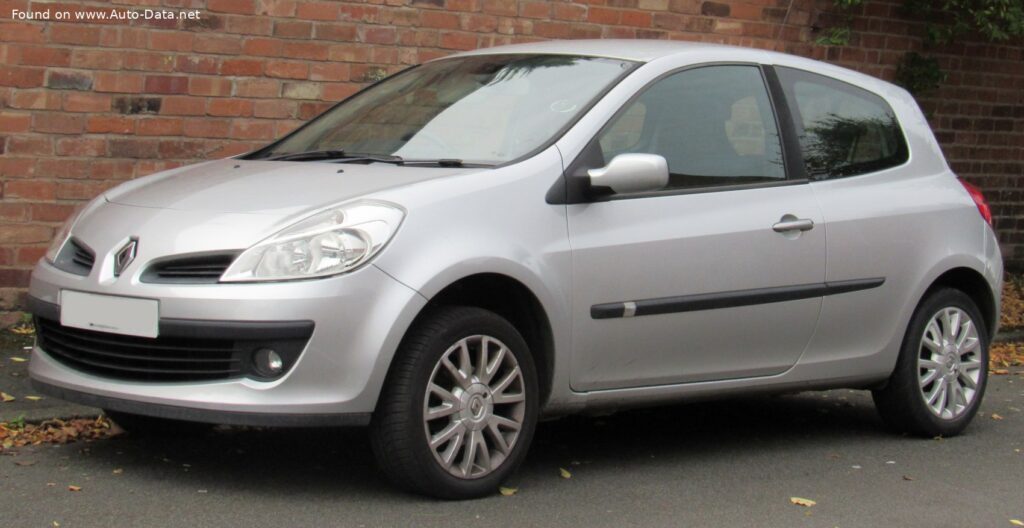
The Renault Clio III (Phase I) 3-door 2.0 16V (139 Hp) Automatic: A European Supermini with a Potent Heart
The Renault Clio III (Phase I), produced from 2006 to 2009, represented a significant evolution in Renault’s highly successful supermini lineage. Introduced as the third generation of the Clio, this model aimed to elevate the segment’s benchmarks in terms of safety, refinement, and interior quality. While the Clio nameplate has enjoyed immense popularity across Europe and other international markets, it was never officially sold in the United States, making it a distinctive example of European automotive engineering and market focus. The specific variant under examination, the 3-door 2.0 16V (139 Hp) Automatic, offered a compelling blend of spirited performance and convenience, positioning itself as a more premium and dynamic option within the Clio III range, aimed at buyers seeking more power than the typical smaller-displacement engines in its class.
Launched in 2005, the Clio III quickly garnered critical acclaim, including being crowned European Car of the Year in 2006. Its design philosophy moved away from the more rounded aesthetic of its predecessor, adopting a more mature, robust, and sophisticated appearance. The “Phase I” designation refers to the initial production run before a mid-cycle refresh. This particular 3-door hatchback configuration, paired with a relatively large 2.0-liter engine and an automatic transmission, was a less common but noteworthy offering, providing a smoother, more relaxed driving experience compared to its manual counterparts, while still delivering respectable acceleration and top speed for its segment.
Engine & Performance of the Renault Clio III (Phase I)
At the heart of this particular Renault Clio III (Phase I) variant was the M4R 701 engine, a 2.0-liter (1997 cubic inches) naturally aspirated inline four-cylinder powerplant. This sophisticated engine featured a Double Overhead Camshaft (DOHC) valvetrain with 16 valves (four per cylinder), optimized for efficiency and power delivery. It produced a robust 139 horsepower at 6000 rpm, a substantial output for a car of its size and class at the time. Torque figures were equally impressive, reaching 143.09 lb.-ft. at 3750 rpm, providing ample pulling power across a usable rev range.
Power was delivered to the front wheels via a 4-speed automatic transmission. While a 4-speed automatic might seem somewhat dated by today’s standards, even for 2006, it offered a smooth and convenient driving experience, particularly in urban environments where the Clio was expected to spend much of its time. This powertrain combination allowed the Clio III to accelerate from 0 to 60 mph in a respectable 8.6 seconds (calculated), with a top speed of 124.27 mph. These figures placed it firmly among the more potent options in the supermini segment, bridging the gap between standard models and the high-performance Clio Renault Sport variants.
Despite its performance orientation, the 2.0-liter engine maintained reasonable fuel economy for its class, especially on longer journeys. According to NEDC (New European Driving Cycle) figures, the combined fuel consumption was 29.8 US mpg. Urban driving saw consumption at 21.6 US mpg, while extra-urban figures reached an impressive 37.9 US mpg. Emissions stood at 187 g/km of CO2, meeting the Euro 4 emission standard, which was current for its production period and reflected Renault’s commitment to environmental compliance.
Design & Features
The Renault Clio III represented a significant departure in design from its predecessors, adopting a more substantial and sophisticated aesthetic. The 3-door hatchback body type, measuring 156.93 inches in length, 67.68 inches in width (excluding mirrors), and 58.86 inches in height, provided a compact footprint ideal for European city driving, yet offered surprising interior space. The styling was characterized by smooth lines, prominent headlights, and a more pronounced shoulder line, giving it a solid and planted appearance. The design aimed for a perception of higher quality and greater safety, moving the Clio further upmarket within the supermini segment.
Inside, the Clio III continued this theme of enhanced quality. The cabin offered seating for five, though the rear seats in the 3-door model were naturally more suited for occasional use or children. Materials and fit-and-finish were notably improved over previous generations, with soft-touch plastics and well-integrated controls creating a more premium feel. Practicality was a strong suit, with a minimum trunk space of 10.17 cubic feet, expanding to a generous 36.3 cubic feet with the rear seats folded, making it versatile for daily errands or weekend trips.
Safety was a paramount concern for the Clio III, and it was one of the first cars in its class to achieve a full 5-star Euro NCAP safety rating for adult occupant protection, a major selling point in its primary markets. Standard safety features included an Anti-lock Braking System (ABS), and depending on the trim level, multiple airbags. The suspension system comprised an independent McPherson strut setup with coil springs and an anti-roll bar at the front, paired with a coil spring and torsion beam arrangement at the rear. This setup provided a comfortable ride while maintaining competent handling characteristics. Braking was handled by ventilated discs measuring 280 mm at the front and solid discs of 240 mm at the rear. The vehicle also featured electric power steering, contributing to ease of maneuverability in tight urban spaces.
Technical Specifications
| Category | Specification |
|---|---|
| Brand | Renault |
| Model | Clio |
| Generation | Clio III (Phase I) 3-door |
| Type (Engine) | 2.0 16V (139 Hp) Automatic |
| Production Years | 2006 – 2009 |
| Body Type | Hatchback |
| Doors / Seats | 3 / 5 |
| Powertrain Architecture | Internal Combustion Engine, Front-wheel drive |
| Performance | |
| Fuel Consumption (Urban) | 21.6 US mpg (10.9 l/100 km) |
| Fuel Consumption (Extra Urban) | 37.9 US mpg (6.2 l/100 km) |
| Fuel Consumption (Combined) | 29.8 US mpg (7.9 l/100 km) |
| CO2 Emissions (NEDC) | 187 g/km |
| Fuel Type | Petrol (Gasoline) |
| Acceleration 0-60 mph | 8.6 seconds |
| Maximum Speed | 124.27 mph (200 km/h) |
| Emission Standard | Euro 4 |
| Weight-to-Power Ratio | 8.7 kg/Hp (114.4 Hp/tonne) |
| Engine Specs | |
| Power | 139 Hp @ 6000 rpm |
| Torque | 143.09 lb.-ft. (194 Nm) @ 3750 rpm |
| Engine Layout | Front, Transverse |
| Engine Model/Code | M4R 701 |
| Engine Displacement | 2.0 liters (1997 cm3, 121.86 cu. in.) |
| Number of Cylinders | 4, Inline |
| Valves per Cylinder | 4 |
| Compression Ratio | 10:1 |
| Fuel Injection System | Multi-port manifold injection |
| Engine Aspiration | Naturally Aspirated |
| Valvetrain | DOHC |
| Engine Oil Capacity | 4.65 US qt (4.4 l) |
| Coolant Capacity | 6.23 US qt (5.9 l) |
| Dimensions & Weights | |
| Length | 156.93 in (3986 mm) |
| Width | 67.68 in (1719 mm) |
| Width (incl. mirrors) | 79.72 in (2025 mm) |
| Height | 58.86 in (1495 mm) |
| Wheelbase | 101.38 in (2575 mm) |
| Kerb Weight | 2678.62 lbs (1215 kg) |
| Max. Weight | 3758.88 lbs (1705 kg) |
| Trunk Space (Min/Max) | 10.17 – 36.3 cu. ft. (288 – 1028 l) |
| Fuel Tank Capacity | 14.53 US gal (55 l) |
| Ground Clearance | 4.72 in (120 mm) |
| Minimum Turning Circle | 37.07 ft (11.3 m) |
| Drivetrain, Brakes & Suspension | |
| Drive Wheel | Front Wheel Drive |
| Gearbox Type | 4-speed automatic transmission |
| Front Suspension | Independent, McPherson with coil spring and anti-roll bar |
| Rear Suspension | Coil spring, Torsion beam |
| Front Brakes | Ventilated discs, 280 mm |
| Rear Brakes | Disc, 240 mm |
| Assisting Systems | ABS (Anti-lock braking system) |
| Steering Type | Steering rack and pinion, Electric Power Steering |
| Tires Size | 195/50 R16 |
| Wheel Rims Size | 6.5J x 16 |
Legacy & Market Impact
The Renault Clio III, and particularly its Phase I iteration, left an indelible mark on the European supermini segment. It solidified the Clio’s reputation as a leader in its class, known for its strong emphasis on safety, comfort, and interior refinement—qualities not always prioritized in smaller vehicles. The 2.0 16V (139 Hp) Automatic variant, while not the highest-volume seller, played a crucial role in showcasing the Clio’s versatility and ability to cater to a broader spectrum of buyers, including those who desired more power and the convenience of an automatic transmission without stepping up to a larger vehicle class.
In its primary markets, the Clio III competed fiercely with formidable rivals such as the Peugeot 207, Ford Fiesta, Volkswagen Polo, Opel Corsa, and Fiat Grande Punto. Against these competitors, the Clio III often stood out for its mature styling, superior ride comfort, and its pioneering 5-star Euro NCAP safety rating. The availability of a potent 2.0-liter engine, coupled with an automatic gearbox, allowed it to carve out a niche for itself, appealing to drivers looking for a more relaxed yet capable urban commuter or a comfortable car for longer journeys without the need for constant gear changes.
Historically, the Clio III represented a pivotal moment for Renault, demonstrating their capability to produce a small car that felt like a larger, more expensive vehicle. Its success contributed significantly to Renault’s overall market share in Europe and helped to maintain the Clio’s status as one of the continent’s best-selling cars. The mechanical underpinnings, particularly the chassis, were praised for their robustness and dynamic capabilities, which also formed the basis for later performance-oriented models. While the 4-speed automatic transmission might be viewed as a slight drawback by modern standards, for its time, it offered a user-friendly and reliable solution for many drivers. The Renault Clio III (Phase I) 3-door 2.0 16V (139 Hp) Automatic ultimately contributed to the Clio’s enduring legacy as a benchmark in the supermini class, known for its blend of practicality, safety, and a touch of performance flair.