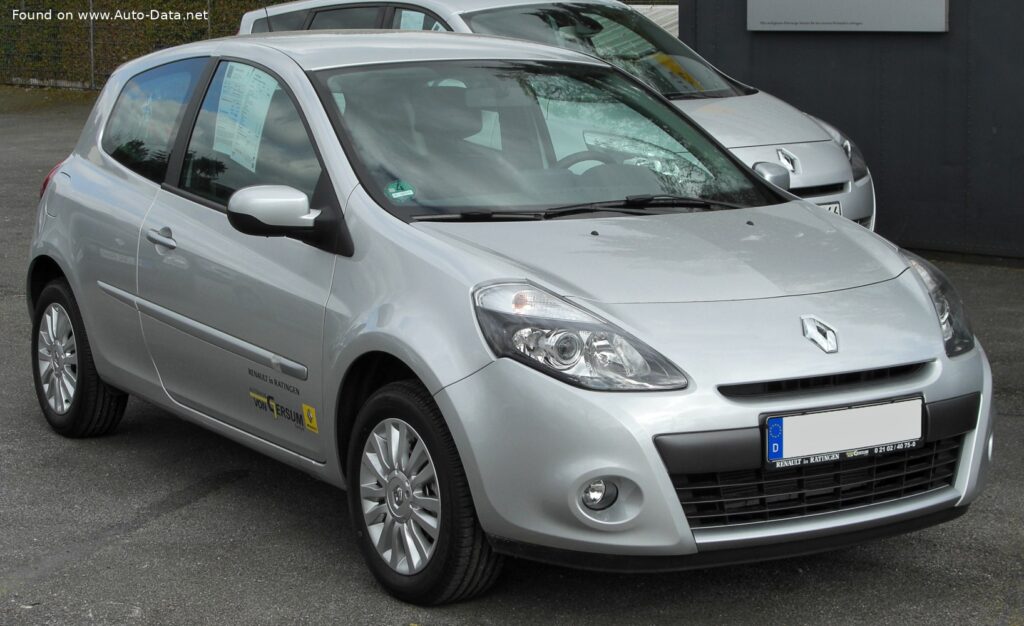
Introduction to the Renault Clio III (Phase II, 2009) 3-door
The Renault Clio III (Phase II, 2009) 3-door represents a significant iteration within the third generation of Renault’s highly successful Clio supermini. Launched in 2009 as a mid-cycle refresh (Phase II), this model continued to build on the Clio III’s reputation for safety, practicality, and driving dynamics in the fiercely competitive European B-segment. While never officially sold in the United States, the Clio has been a cornerstone of Renault’s global strategy, particularly in Europe, since its inception in 1990. The Phase II refresh brought subtle styling updates, improved interior materials, and minor mechanical refinements to keep the model fresh against rivals. This particular variant, equipped with the 1.2-liter 16-valve engine producing 65 horsepower, was positioned as an economical and accessible entry point into the Clio lineup, ideally suited for urban driving and first-time car buyers in its primary markets. Its 3-door configuration emphasized a sportier, more compact aesthetic, while still offering reasonable interior space for its class.
Engine and Performance of the Renault Clio III (Phase II, 2009) 3-door
At the heart of this particular Renault Clio III (Phase II, 2009) 3-door model is the venerable D4F 740 1.2-liter (1149 cubic centimeters or 70.12 cubic inches) naturally aspirated inline-four engine. This powertrain, a staple in Renault’s smaller vehicles, is known for its reliability and efficiency. Featuring a 16-valve cylinder head, it delivers 65 horsepower at 5500 rpm and a modest but adequate 77.44 lb.-ft. of torque at 4250 rpm. For a vehicle weighing in at 2403 pounds (curb weight), these figures translate to a performance profile squarely aimed at economical urban commuting rather than outright speed.
Power is sent to the front wheels via a 5-speed manual transmission, a common and robust setup for vehicles in this class. The acceleration from 0 to 60 mph is achieved in a respectable 13.3 seconds, with a top speed of 97.56 mph. While these numbers might not impress on a drag strip, they are perfectly suitable for navigating city traffic and maintaining highway speeds on European roads. The engine’s design, with a bore of 2.72 inches and a piston stroke of 3.02 inches, along with a compression ratio of 9.8:1, contributes to its smooth operation and fuel-efficient characteristics. The multi-port manifold injection system ensures precise fuel delivery, optimizing combustion and minimizing emissions.
Fuel economy was a key selling point for this variant. The combined cycle consumption is rated at an impressive 39.9 US mpg (5.9 liters per 100 km), showcasing its efficiency. Urban driving sees consumption at 30.9 US mpg (7.6 liters per 100 km), while extra-urban (highway) driving can achieve up to 48 US mpg (4.9 liters per 100 km). These figures highlight the Clio’s suitability as an affordable daily driver, especially in regions with high fuel prices.
Design and Features
Exterior and Dimensions
The Renault Clio III (Phase II, 2009) 3-door maintains the attractive and well-proportioned design of the third-generation Clio, with the Phase II refresh introducing subtle enhancements. The 3-door hatchback body type gives it a sportier, more compact appearance compared to its 5-door sibling, appealing to younger buyers or those prioritizing style. Its dimensions are well-suited for European cityscapes: a length of 158.74 inches, a width of 67.72 inches (79.72 inches including mirrors), and a height of 58.94 inches. The wheelbase of 101.38 inches provides a stable ride for its size, while the tight minimum turning circle of 33.79 feet makes it exceptionally maneuverable in tight urban environments. The front and rear tracks are 57.95 inches and 57.87 inches, respectively, contributing to its planted stance.
Interior and Practicality
Despite its compact exterior, the Clio III offers a surprisingly spacious and practical interior for a supermini. It is designed to comfortably seat five occupants, though the rear seats are best suited for two adults on longer journeys or three children. The 3-door configuration necessitates some compromise in rear-seat access, but the front seats provide ample room. Cargo capacity is a strong point for its class, with a minimum trunk space of 10.17 cubic feet (288 liters), which can expand significantly to 36.66 cubic feet (1038 liters) with the rear seats folded down, making it versatile for shopping trips or weekend getaways. The fuel tank capacity of 14.53 US gallons (55 liters) ensures a decent cruising range between fill-ups, particularly given its excellent fuel economy.
Chassis and Safety Features
The Clio III’s chassis benefits from a well-engineered suspension setup, featuring spring struts at the front and coil springs at the rear, providing a comfortable yet composed ride. The braking system comprises ventilated discs at the front for effective stopping power, complemented by drum brakes at the rear. Standard safety equipment for the 2009 model included an Anti-lock Braking System (ABS), a crucial feature for maintaining control during emergency braking. The steering system utilizes an electric power steering rack and pinion setup, offering light and precise control, which further aids in city driving and parking. The vehicle rides on 165/65 R15 tires mounted on 5.5J x 15 wheel rims, balancing grip, comfort, and efficiency.
Technical Specifications
| Category | Specification | US/Imperial Equivalent |
|---|---|---|
| General Information | ||
| Brand | Renault | |
| Model | Clio | |
| Generation | Clio III (Phase II, 2009) 3-door | |
| Engine Type | 1.2 16V (65 Hp) | |
| Production Start | 2009 | |
| Production End | 2012 | |
| Powertrain Architecture | Internal Combustion Engine | |
| Body Type | Hatchback | |
| Seats | 5 | |
| Doors | 3 | |
| Performance Specifications | ||
| Fuel Consumption (Urban) | 7.6 l/100 km | 30.9 US mpg |
| Fuel Consumption (Extra Urban) | 4.9 l/100 km | 48 US mpg |
| Fuel Consumption (Combined) | 5.9 l/100 km | 39.9 US mpg |
| Fuel Type | Petrol (Gasoline) | |
| Acceleration 0-60 mph | 13.3 sec | |
| Maximum Speed | 157 km/h | 97.56 mph |
| Weight-to-Power Ratio | 16.8 kg/Hp | 59.6 Hp/tonne |
| Weight-to-Torque Ratio | 10.4 kg/Nm | 96.3 Nm/tonne |
| Engine Specifications | ||
| Power | 65 Hp @ 5500 rpm | |
| Power per Liter | 56.6 Hp/l | |
| Torque | 105 Nm @ 4250 rpm | 77.44 lb.-ft. @ 4250 rpm |
| Engine Layout | Front, Transverse | |
| Engine Model/Code | D4F 740 | |
| Engine Displacement | 1149 cm3 | 70.12 cu. in. (1.1 liters) |
| Number of Cylinders | 4 | |
| Engine Configuration | Inline | |
| Cylinder Bore | 69 mm | 2.72 in. |
| Piston Stroke | 76.8 mm | 3.02 in. |
| Compression Ratio | 9.8:1 | |
| Valves per Cylinder | 4 | |
| Fuel Injection System | Multi-port manifold injection | |
| Engine Aspiration | Naturally aspirated | |
| Engine Oil Capacity | 4 l | 4.23 US qt |
| Coolant Capacity | 5 l | 5.28 US qt |
| Space, Volume, and Weights | ||
| Kerb Weight | 1090 kg | 2403.04 lbs. |
| Max. Weight | 1580 kg | 3483.3 lbs. |
| Max Load | 490 kg | 1080.27 lbs. |
| Trunk Space (Minimum) | 288 l | 10.17 cu. ft. |
| Trunk Space (Maximum) | 1038 l | 36.66 cu. ft. |
| Fuel Tank Capacity | 55 l | 14.53 US gal |
| Dimensions | ||
| Length | 4032 mm | 158.74 in. |
| Width | 1720 mm | 67.72 in. |
| Width (incl. mirrors) | 2025 mm | 79.72 in. |
| Height | 1497 mm | 58.94 in. |
| Wheelbase | 2575 mm | 101.38 in. |
| Front Track | 1472 mm | 57.95 in. |
| Rear Track | 1470 mm | 57.87 in. |
| Front Overhang | 830 mm | 32.68 in. |
| Rear Overhang | 626 mm | 24.65 in. |
| Minimum Turning Circle | 10.3 m | 33.79 ft. |
| Drivetrain, Brakes, and Suspension | ||
| Drivetrain Architecture | Front-wheel drive, Internal Combustion Engine | |
| Drive Wheel | Front wheel drive | |
| Gearbox | 5-speed manual transmission | |
| Front Suspension | Spring Strut | |
| Rear Suspension | Coil spring | |
| Front Brakes | Ventilated discs | |
| Rear Brakes | Drum | |
| Assisting Systems | ABS (Anti-lock braking system) | |
| Steering Type | Steering rack and pinion | |
| Power Steering | Electric Steering | |
| Tire Size | 165/65 R15 | |
| Wheel Rims Size | 5.5J x 15 | |
Legacy and Market Impact
The Renault Clio III (Phase II, 2009) 3-door, particularly in its economical 1.2-liter guise, played a crucial role in maintaining Renault’s strong presence in the European supermini segment. This segment is one of the most competitive in Europe, with a plethora of established rivals. The Clio III faced direct competition from perennial best-sellers such as the Ford Fiesta, Volkswagen Polo, Peugeot 207, Opel Corsa (Vauxhall Corsa in the UK), and the Fiat Punto. Against these formidable opponents, the Clio distinguished itself with its emphasis on safety (it was one of the first cars in its class to achieve a 5-star Euro NCAP rating), comfortable ride quality, and a generally perceived higher-quality interior than some of its predecessors.
The 2009 Phase II refresh helped to keep the Clio III competitive during the latter part of its production run (2009-2012). While the 65-horsepower 1.2-liter engine was not the most powerful option available, it was arguably one of the most sensible for many European buyers. Its excellent fuel economy, low running costs, and manageable insurance premiums made it an ideal choice for young drivers, urban dwellers, and families looking for a reliable second car. The 3-door body style, while less practical for family duties than the 5-door, appealed to those who prioritized a more dynamic and stylish aesthetic, often resonating with younger demographics.
Historically, the Clio series has been a consistent sales success for Renault, frequently appearing among Europe’s top-selling cars. The Clio III, and its Phase II evolution, contributed significantly to this legacy by offering a compelling blend of design, safety, and efficiency. Its impact was primarily felt in European markets, where the supermini class is a dominant force, shaping the landscape of personal transportation. The Clio’s success underscored Renault’s ability to produce compact cars that were not only affordable but also offered a sophisticated driving experience and advanced safety features for their time. Even today, used examples of the Clio III are highly regarded for their reliability and continued practicality, cementing its place as an important chapter in the history of the European supermini.