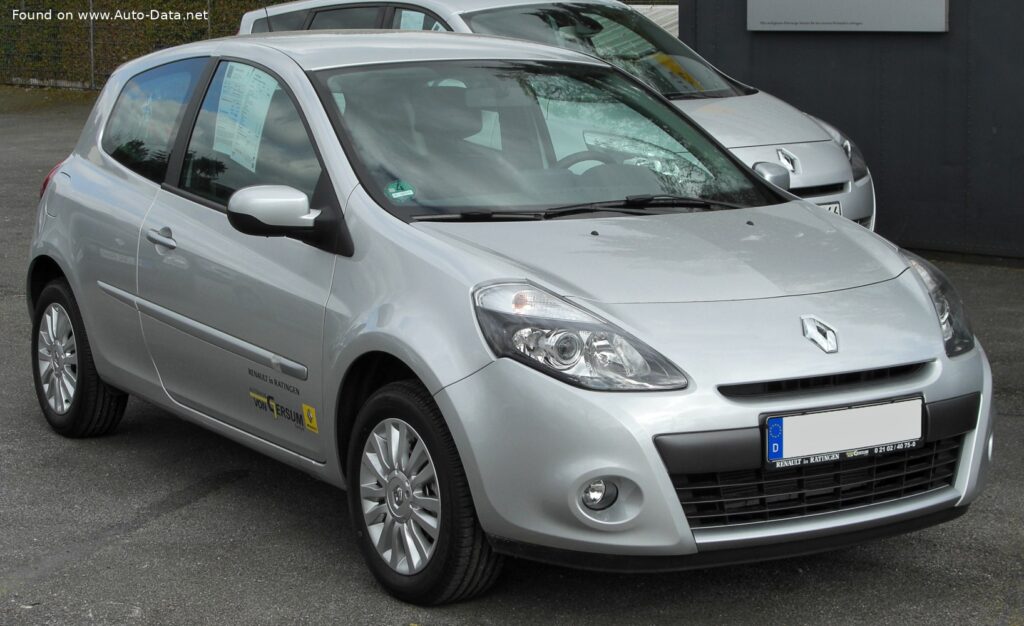
Introduction to the Renault Clio III (Phase II, 2009) 3-door 1.2 16V (75 Hp)
The Renault Clio, a cornerstone of the European supermini segment, has long been celebrated for its blend of style, practicality, and driving dynamics. The third generation, known internally as the Clio III, continued this legacy, and its mid-cycle refresh, or Phase II, introduced in 2009, brought a series of enhancements to maintain its competitive edge. This article specifically delves into the Renault Clio III (Phase II, 2009) 3-door 1.2 16V (75 Hp), a popular variant produced from October 2010 to November 2012. Positioned as an accessible and efficient option within the Clio lineup, this 3-door hatchback catered primarily to urban drivers, young families, and those seeking a compact yet capable daily driver in markets across Europe and beyond. While never officially sold in the United States, the Clio III represents a significant chapter in the global automotive landscape, embodying the design and engineering philosophies prevalent in European compact cars of its era.
The Clio III Phase II built upon the solid foundation of its predecessor, which had already earned the prestigious European Car of the Year award in 2006. The facelift aimed to modernize its aesthetic, improve interior quality, and refine its powertrain options. The 1.2 16V (75 Hp) model, a staple of the Clio range, offered a compelling balance of fuel economy and sufficient performance for its intended purpose, making it a volume seller and a familiar sight on European roads. Its front-wheel-drive architecture and compact dimensions underscored its design as an agile and maneuverable vehicle, perfect for navigating congested city streets and tight parking spaces.
Engine and Performance of the Renault Clio III (Phase II, 2009) 3-door 1.2 16V (75 Hp)
At the heart of this particular Renault Clio III (Phase II, 2009) 3-door 1.2 16V (75 Hp) model is a compact yet robust 1.2-liter (1149 cm³ or 70.12 cu. in.) naturally aspirated inline-four gasoline engine. Coded as D4F 706 or D4F 740, this engine is configured with a Double Overhead Camshaft (DOHC) valvetrain and 16 valves (four per cylinder), which is quite sophisticated for a small displacement engine of its time. It employs a multi-port manifold injection fuel system, ensuring efficient fuel delivery and combustion.
This powerplant generates a peak output of 75 horsepower (Hp) at 5500 rpm, translating to a power-per-liter rating of 65.3 Hp/l. Torque stands at 107 Newton-meters (78.92 lb.-ft.) delivered at a relatively accessible 4250 rpm. These figures, while not designed for blistering acceleration, are perfectly adequate for the Clio’s role as an urban commuter and light highway cruiser. The vehicle achieves a 0 to 60 mph acceleration in a respectable 12.7 seconds (0-100 km/h in 13.4 seconds), with a maximum speed of 103.77 mph (167 km/h).
Power is sent to the front wheels via a smooth-shifting 5-speed manual transmission, optimizing driver engagement and control. The engine’s transverse layout and front-wheel-drive architecture contribute to a well-balanced and predictable driving experience. In terms of efficiency, the Clio III 1.2 16V achieved a combined NEDC fuel consumption rating of 5.8 liters per 100 kilometers, which translates to an impressive 40.6 US miles per gallon. Urban consumption was rated at 7.6 l/100 km (30.9 US mpg), while extra-urban driving saw figures as low as 4.9 l/100 km (48 US mpg). With CO2 emissions of 135 g/km, this model met the stringent Euro 5 emission standard, reflecting Renault’s commitment to environmental responsibility even in its entry-level offerings. The engine oil capacity is 4 liters (4.23 US quarts), and the coolant system holds 5 liters (5.28 US quarts).
Design and Features
The Renault Clio III (Phase II) retained the fundamental design language of the third generation but introduced several key aesthetic and functional updates. As a 3-door hatchback, it presented a sportier, more compact profile compared to its 5-door sibling, appealing to a younger demographic or those prioritizing style over rear-door access. The Phase II facelift saw a redesigned front bumper, a larger Renault badge, and updated headlamps, giving the car a fresher, more contemporary look. The rear also received minor tweaks to the taillights and bumper design.
Measuring 158.74 inches (4032 mm) in length, 67.72 inches (1720 mm) in width (79.72 inches or 2025 mm including mirrors), and 58.94 inches (1497 mm) in height, the Clio III maintained its compact footprint. A wheelbase of 101.38 inches (2575 mm) contributed to a stable ride and maximized interior space within its class. The kerb weight ranged from 2325.88 to 2330.29 lbs (1055-1057 kg), making it a light and agile vehicle.
Inside, the Clio III Phase II offered seating for five, though the rear bench was more comfortable for two adults on longer journeys. The interior design emphasized ergonomics and practicality, with logically arranged controls and good outward visibility. Material quality was improved over the pre-facelift model, featuring soft-touch plastics in key areas. Standard features included electric power steering, making low-speed maneuvers exceptionally easy, and an Anti-lock Braking System (ABS) for enhanced safety. The car’s front suspension utilized an independent McPherson strut setup with coil springs and an anti-roll bar, while the rear featured a torsion beam with coil springs, a common and effective setup for compact cars, providing a comfortable ride and predictable handling.
Braking was handled by 260×22 mm ventilated discs at the front and 203 mm drums at the rear. The car rode on a choice of tire sizes, including 165/65 R15, 185/60 R15, or 195/50 R16, mounted on wheel rims sized 5.5J x 15, 6J x 15, or 6.5J x 16 respectively. Storage solutions included a minimum trunk space of 10.17 cubic feet (288 liters), expandable to a generous 36.66 cubic feet (1038 liters) with the rear seats folded, making it surprisingly versatile for its size. The fuel tank capacity of 14.53 US gallons (55 liters) provided a good cruising range for its class.
Technical Specifications
| Category | Specification | US/Imperial Conversion |
|---|---|---|
General Information |
||
| Brand | Renault | |
| Model | Clio | |
| Generation | Clio III (Phase II, 2009) 3-door | |
| Engine Type | 1.2 16V (75 Hp) | |
| Production Start | October, 2010 | |
| Production End | November, 2012 | |
| Powertrain Architecture | Internal Combustion Engine | |
| Body Type | Hatchback | |
| Seats | 5 | |
| Doors | 3 | |
Performance Specifications |
||
| Fuel Consumption (Urban, NEDC) | 7.6 l/100 km | 30.9 US mpg |
| Fuel Consumption (Extra Urban, NEDC) | 4.9 l/100 km | 48 US mpg |
| Fuel Consumption (Combined, NEDC) | 5.8 l/100 km | 40.6 US mpg |
| CO2 Emissions (NEDC) | 135 g/km | |
| Fuel Type | Petrol (Gasoline) | |
| Acceleration 0 – 60 mph | 12.7 sec | |
| Acceleration 0 – 100 km/h | 13.4 sec | |
| Maximum Speed | 167 km/h | 103.77 mph |
| Emission Standard | Euro 5 | |
| Weight-to-Power Ratio | 14.1 kg/Hp | 71.1 Hp/tonne |
| Weight-to-Torque Ratio | 9.9 kg/Nm | 101.4 Nm/tonne |
Engine Specifications |
||
| Power | 75 Hp @ 5500 rpm | |
| Power per liter | 65.3 Hp/l | |
| Torque | 107 Nm @ 4250 rpm | 78.92 lb.-ft. @ 4250 rpm |
| Engine Layout | Front, Transverse | |
| Engine Model/Code | D4F 706, D4F 740 | |
| Engine Displacement | 1149 cm³ | 70.12 cu. in. |
| Number of Cylinders | 4 | |
| Engine Configuration | Inline | |
| Cylinder Bore | 69 mm | 2.72 in. |
| Piston Stroke | 76.8 mm | 3.02 in. |
| Compression Ratio | 9.8:1 | |
| Valves per Cylinder | 4 | |
| Fuel Injection System | Multi-port manifold injection | |
| Engine Aspiration | Naturally aspirated | |
| Valvetrain | DOHC | |
| Engine Oil Capacity | 4 l | 4.23 US qt |
| Coolant Capacity | 5 l | 5.28 US qt |
Space, Volume and Weights |
||
| Kerb Weight | 1055-1057 kg | 2325.88 – 2330.29 lbs |
| Max. Weight | 1570 kg | 3461.26 lbs |
| Max Load | 513-515 kg | 1130.97 – 1135.38 lbs |
| Trunk (Boot) Space – Minimum | 288 l | 10.17 cu. ft. |
| Trunk (Boot) Space – Maximum | 1038 l | 36.66 cu. ft. |
| Fuel Tank Capacity | 55 l | 14.53 US gal |
| Max. Roof Load | 80 kg | 176.37 lbs |
| Permitted Trailer Load with Brakes (12%) | 1200 kg | 2645.55 lbs |
| Permitted Trailer Load without Brakes | 535 kg | 1179.47 lbs |
| Permitted Towbar Download | 75 kg | 165.35 lbs |
Dimensions |
||
| Length | 4032 mm | 158.74 in. |
| Width | 1720 mm | 67.72 in. |
| Width including Mirrors | 2025 mm | 79.72 in. |
| Height | 1497 mm | 58.94 in. |
| Wheelbase | 2575 mm | 101.38 in. |
| Front Track | 1458-1472 mm | 57.4 – 57.95 in. |
| Rear Track | 1450-1471 mm | 57.09 – 57.91 in. |
| Front Overhang | 830 mm | 32.68 in. |
| Rear Overhang | 626 mm | 24.65 in. |
| Ride Height (Ground Clearance) | 120 mm | 4.72 in. |
| Minimum Turning Circle | 10.3-11.3 m | 33.79 – 37.07 ft. |
Drivetrain, Brakes and Suspension |
||
| Drivetrain Architecture | Front-wheel drive, Internal Combustion Engine | |
| Drive Wheel | Front wheel drive | |
| Gearbox | 5 gears, manual transmission | |
| Front Suspension | Independent, McPherson with coil spring and anti-roll bar | |
| Rear Suspension | Coil spring, Torsion beam | |
| Front Brakes | Ventilated discs, 260×22 mm | |
| Rear Brakes | Drum, 203 mm | |
| Assisting Systems | ABS (Anti-lock braking system) | |
| Steering Type | Steering rack and pinion | |
| Power Steering | Electric Steering | |
| Tires Size | 165/65 R15; 185/60 R15; 195/50 R16 | |
| Wheel Rims Size | 5.5J x 15; 6J x 15; 6.5J x 16 | |
Legacy and Market Impact
The Renault Clio III (Phase II) 3-door, particularly in its 1.2 16V (75 Hp) guise, played a crucial role in maintaining Renault’s strong presence in the highly competitive European supermini segment. While specific sales figures for this exact variant are often aggregated, the Clio as a whole consistently ranked among Europe’s best-selling cars during its production run, underscoring its broad appeal. Its reputation was built on a foundation of attractive styling, a comfortable ride, good safety features (it achieved a 5-star Euro NCAP rating for occupant protection), and excellent fuel efficiency, especially with the smaller engines.
In its primary markets, the Clio III Phase II faced fierce competition from established rivals such as the Volkswagen Polo, Ford Fiesta, Peugeot 207, Opel/Vauxhall Corsa, and Fiat Punto. Each offered its own blend of attributes, but the Clio often stood out for its distinctive French design flair, comfortable suspension tuning, and a perception of good value. The 1.2 16V engine, while not a performance powerhouse, was a volume seller due to its low running costs, favorable insurance premiums, and sufficient capability for the typical urban and suburban driving cycles of European consumers.
The Clio III represented a significant step forward in terms of perceived quality and refinement compared to its predecessors, helping to elevate Renault’s brand image in the compact car segment. Its legacy is one of a highly successful supermini that continued the Clio lineage with distinction, reinforcing its status as a benchmark for practical, stylish, and efficient small cars in Europe. Even after its discontinuation in favor of the fourth-generation Clio, the Clio III remains a common sight on European roads, a testament to its durability and enduring appeal as a reliable and economical used car. Its influence on future Renault designs, particularly in terms of interior ergonomics and safety integration, is also notable, solidifying its historical significance within Renault’s extensive portfolio.