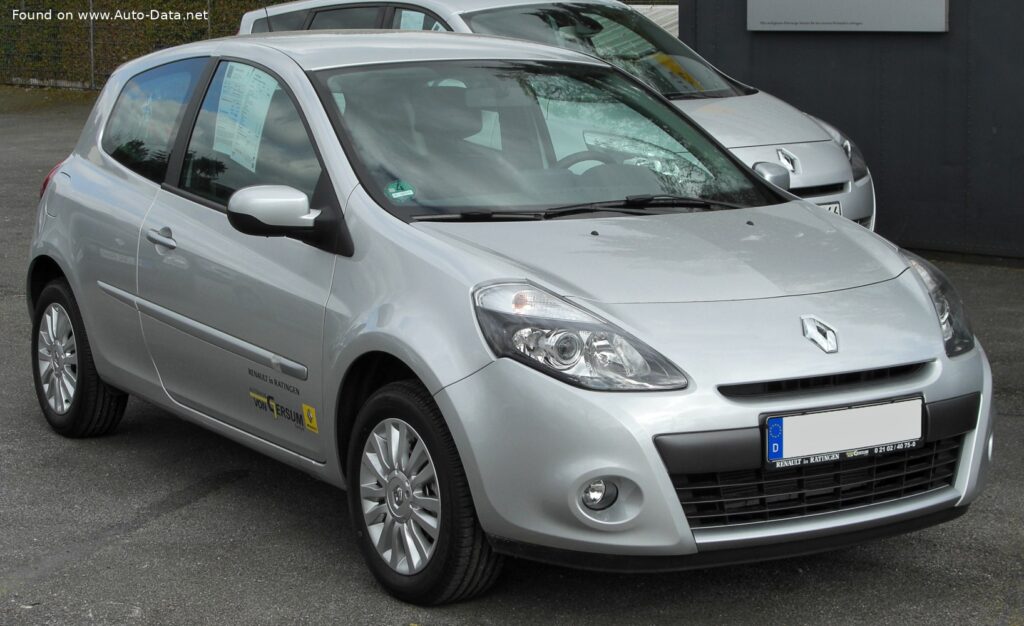
The Renault Clio III (Phase II, 2009) 3-door 1.2 16V (75 Hp) Quickshift: A European Urban Stalwart
The Renault Clio III (Phase II, 2009) 3-door 1.2 16V (75 Hp) Quickshift represents a significant iteration of one of Europe’s most enduring and successful subcompact cars. Produced from 2009 to 2012, this specific model is part of the third generation of the Clio, which itself garnered the prestigious European Car of the Year award in 2006. The “Phase II” designation indicates a mid-cycle refresh, bringing updated styling, enhanced features, and subtle mechanical refinements to maintain its competitive edge in the fiercely contested B-segment market. While never officially sold in the United States, the Clio line has been a cornerstone of Renault’s global strategy, particularly in its home continent of Europe, where its blend of compact dimensions, practical design, and efficient powertrains made it a popular choice for urban drivers and small families alike. This particular variant, with its 1.2-liter 16-valve engine and Quickshift automated manual transmission, was designed to offer an accessible and economical driving experience, emphasizing ease of use in congested city environments.
Engine and Performance: The Heart of the Renault Clio III (Phase II, 2009) 3-door 1.2 16V (75 Hp) Quickshift
Under the hood of the 2009 Renault Clio III (Phase II) 3-door lies a naturally aspirated 1.2-liter (1149 cm3 or 70.12 cu. in.) inline-four engine, designated by the code D4F. This powerplant features a double overhead camshaft (DOHC) valvetrain with 16 valves (four per cylinder), optimized for efficiency and smooth power delivery. It generates a modest but entirely adequate 75 horsepower at 5500 rpm, with a peak torque of 105 Newton-meters (77.44 lb.-ft.) available at 4250 rpm. This power output, combined with the car’s relatively low curb weight of 2403.04 lbs (1090 kg), results in a weight-to-power ratio of 14.5 kg/Hp, or 68.8 Hp per tonne.
Power is sent to the front wheels via a 5-speed Quickshift automatic transmission. The Quickshift system is an automated manual transmission, which, while not as smooth or refined as modern torque-converter automatics or dual-clutch units, provided the convenience of two-pedal driving at a lower cost and with better fuel economy than traditional automatics of its era. This transmission type, common in European budget cars, offers manual gear selection without a clutch pedal or can operate in a fully automatic mode, albeit with noticeable shifts. Performance figures for this setup include an acceleration time from 0 to 60 mph in 12.4 seconds (0-100 km/h in 13 seconds) and a top speed of 103.77 mph (167 km/h). While not a performance car, these figures are perfectly acceptable for urban and suburban commuting.
Fuel efficiency was a key selling point for this Clio variant. With a combined fuel consumption rating of 5.9 l/100 km, it translates to an impressive 39.9 US mpg. Urban consumption is rated at 7.6 l/100 km (30.9 US mpg), while extra-urban driving achieves 4.9 l/100 km (48 US mpg). The 55-liter (14.53 US gallon) fuel tank provided a commendable range, reducing the frequency of fill-ups, a significant benefit for cost-conscious European drivers. The engine’s multi-port manifold injection system ensures precise fuel delivery, contributing to its overall efficiency and low emissions for the time.
Design and Features: Practicality Meets European Style
The Clio III (Phase II) 3-door hatchback embodies the typical European subcompact design philosophy: compact, functional, and stylish. With a length of 158.74 inches (4032 mm), a width of 67.72 inches (1720 mm), and a height of 58.94 inches (1497 mm), the Clio is ideally sized for navigating narrow city streets and fitting into tight parking spaces. The 101.38-inch (2575 mm) wheelbase contributes to a stable ride for its class, while a minimum turning circle of 33.79 feet (10.3 meters) enhances its maneuverability.
The “Phase II” update brought a refreshed front fascia with new headlights, a redesigned grille, and updated bumper styling, giving the Clio a more contemporary and assertive look. The 3-door configuration emphasized a sportier profile compared to its 5-door sibling, appealing to younger buyers or those without frequent rear passenger needs. Despite its compact exterior, the Clio offers a surprisingly spacious interior for five occupants. The trunk space is practical, ranging from 10.17 cu. ft. (288 liters) with all seats in place, expanding to a generous 36.66 cu. ft. (1038 liters) when the rear seats are folded down, making it versatile for grocery runs or weekend trips.
In terms of features, the Clio III (Phase II) included standard amenities expected in its segment for the era. The electric power steering system offered light and responsive handling, particularly beneficial for urban driving. Safety was addressed with the inclusion of an Anti-lock Braking System (ABS), which was becoming standard across Europe. The car featured ventilated disc brakes at the front for effective stopping power, complemented by drum brakes at the rear, a common setup for economical vehicles. The suspension system utilized a spring strut design at the front and coil springs at the rear, providing a comfortable ride quality that absorbed typical road imperfections well, a hallmark of Renault’s chassis tuning. The car rode on 165/65 R15 tires mounted on 5.5J x 15 wheel rims, balancing grip, ride comfort, and rolling resistance for optimal fuel economy.
Technical Specifications
| Specification | Value |
|---|---|
| Brand | Renault |
| Model | Clio III (Phase II, 2009) 3-door |
| Type (Engine) | 1.2 16V (75 Hp) Quickshift |
| Start of Production | 2009 |
| End of Production | 2012 |
| Powertrain Architecture | Internal Combustion Engine |
| Body Type | Hatchback |
| Seats | 5 |
| Doors | 3 |
| Fuel Consumption (Urban) | 7.6 l/100 km (30.9 US mpg) |
| Fuel Consumption (Extra Urban) | 4.9 l/100 km (48 US mpg) |
| Fuel Consumption (Combined) | 5.9 l/100 km (39.9 US mpg) |
| Fuel Type | Petrol (Gasoline) |
| Acceleration 0 – 60 mph | 12.4 sec |
| Acceleration 0 – 100 km/h | 13 sec |
| Maximum Speed | 103.77 mph (167 km/h) |
| Weight-to-Power Ratio | 14.5 kg/Hp (68.8 Hp/tonne) |
| Weight-to-Torque Ratio | 10.4 kg/Nm (96.3 Nm/tonne) |
| Power | 75 Hp @ 5500 rpm |
| Power per Liter | 65.3 Hp/l |
| Torque | 105 Nm (77.44 lb.-ft.) @ 4250 rpm |
| Engine Layout | Front, Transverse |
| Engine Model/Code | D4F |
| Engine Displacement | 1149 cm3 (70.12 cu. in.) |
| Number of Cylinders | 4 |
| Engine Configuration | Inline |
| Cylinder Bore | 69 mm (2.72 in.) |
| Piston Stroke | 76.8 mm (3.02 in.) |
| Compression Ratio | 9.8:1 |
| Number of Valves per Cylinder | 4 |
| Fuel Injection System | Multi-port manifold injection |
| Engine Aspiration | Naturally aspirated |
| Valvetrain | DOHC |
| Engine Oil Capacity | 4 l (4.23 US qt) |
| Coolant Capacity | 5 l (5.28 US qt) |
| Kerb Weight | 1090 kg (2403.04 lbs) |
| Max. Weight | 1580 kg (3483.3 lbs) |
| Max Load | 490 kg (1080.27 lbs) |
| Trunk (Boot) Space – Minimum | 288 l (10.17 cu. ft.) |
| Trunk (Boot) Space – Maximum | 1038 l (36.66 cu. ft.) |
| Fuel Tank Capacity | 55 l (14.53 US gal) |
| Length | 4032 mm (158.74 in.) |
| Width | 1720 mm (67.72 in.) |
| Width Including Mirrors | 2025 mm (79.72 in.) |
| Height | 1497 mm (58.94 in.) |
| Wheelbase | 2575 mm (101.38 in.) |
| Front Track | 1472 mm (57.95 in.) |
| Rear (Back) Track | 1470 mm (57.87 in.) |
| Front Overhang | 830 mm (32.68 in.) |
| Rear Overhang | 626 mm (24.65 in.) |
| Minimum Turning Circle | 10.3 m (33.79 ft.) |
| Drivetrain Architecture | Front-wheel drive, Internal Combustion Engine |
| Drive Wheel | Front-wheel drive |
| Number of Gears and Type of Gearbox | 5 gears, automatic transmission Quickshift |
| Front Suspension | Spring Strut |
| Rear Suspension | Coil Spring |
| Front Brakes | Ventilated discs |
| Rear Brakes | Drum |
| Assisting Systems | ABS (Anti-lock braking system) |
| Steering Type | Steering rack and pinion |
| Power Steering | Electric Steering |
| Tires Size | 165/65 R15 |
| Wheel Rims Size | 5.5J x 15 |
Legacy and Market Impact
The Renault Clio III (Phase II), and the Clio line in general, holds a significant place in the European automotive landscape. The third generation, having been crowned European Car of the Year, built a strong reputation for its mature styling, improved build quality, and refined driving dynamics compared to its predecessors. The 2009 Phase II facelift ensured the Clio remained competitive against a strong field of rivals, including the Ford Fiesta, Volkswagen Polo, Peugeot 207, and Opel Corsa.
This particular 1.2 16V (75 Hp) Quickshift variant underscored Renault’s commitment to offering practical and affordable mobility. It appealed to a broad demographic, from young drivers seeking their first car to urban dwellers prioritizing ease of parking and fuel efficiency, and even older drivers desiring an automatic transmission in a compact, easy-to-manage package. The Quickshift transmission, while a point of contention for some due to its inherent shift characteristics, nonetheless provided an automatic option in a segment where manual gearboxes were, and still are, dominant. This made the Clio accessible to a wider audience, particularly those who preferred or required an automatic.
The Clio III’s legacy is defined by its role as a consistent volume seller for Renault, contributing significantly to the brand’s market share in Europe. It demonstrated that a subcompact car could offer a compelling blend of style, comfort, safety, and economy without compromising on practicality. Its enduring popularity ensured that the Clio nameplate remained a household name, setting the stage for future generations to continue its success as a benchmark in the highly competitive supermini segment. The 2009 Phase II model, with its subtle enhancements and efficient powertrain, was a testament to Renault’s continuous effort to refine and adapt its popular models to the evolving demands of the European car buyer.