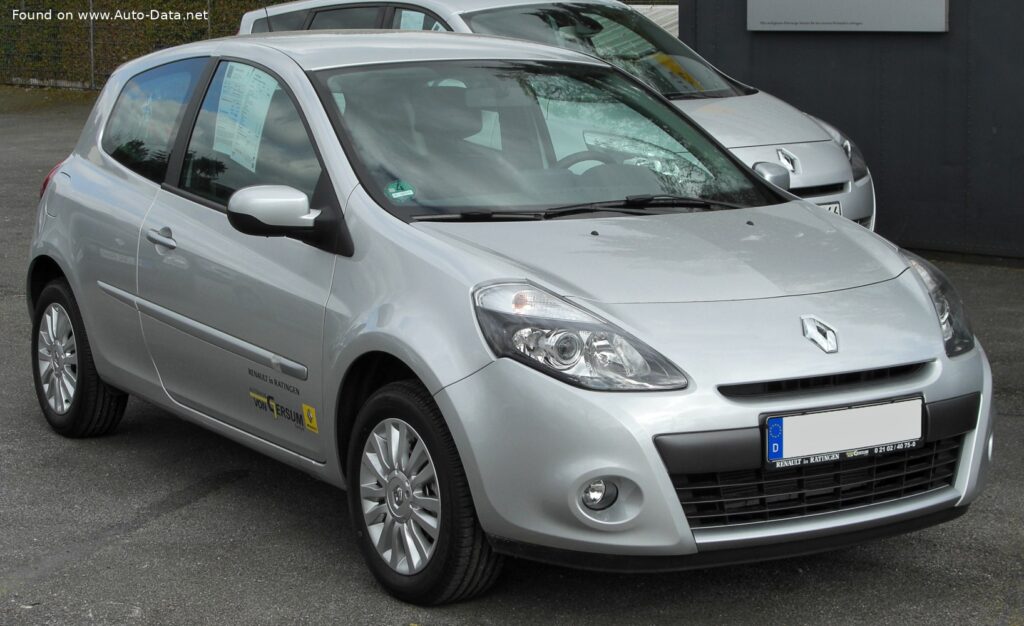
The Renault Clio III (Phase II, 2009) 3-door 1.2 16V TCe (100 Hp)
The Renault Clio III, specifically the Phase II variant introduced in 2009, represents a significant evolution in the highly competitive European B-segment, often referred to as the supermini class. As a cornerstone of Renault’s lineup, the Clio has consistently been one of Europe’s best-selling cars, celebrated for its blend of style, practicality, and driving dynamics. The particular model under examination, the Renault Clio III (Phase II, 2009) 3-door 1.2 16V TCe (100 Hp), was produced from May 2009 to April 2010. This iteration brought a refreshed design and powertrain refinements, enhancing its appeal to urban dwellers and young families across the continent. While never officially sold in the United States, the Clio’s success in its primary markets underscores its global impact as a benchmark for compact car design and engineering.
The Clio III generation, launched in 2005, marked a substantial step up in terms of perceived quality, safety, and sophistication compared to its predecessors. The Phase II facelift further honed these attributes, integrating subtle exterior updates and technological advancements. The 3-door hatchback body style, a popular choice in Europe, offered a sporty aesthetic while maintaining the practicality expected of a compact vehicle. The 1.2-liter TCe engine variant was particularly noteworthy for its early adoption of turbocharging in a small displacement engine, foreshadowing a trend that would become ubiquitous in the automotive industry for balancing performance with fuel efficiency.
Engine and Performance: The Heart of the Renault Clio III (Phase II, 2009) 3-door 1.2 16V TCe (100 Hp)
At the core of this particular Clio III variant is a sophisticated 1.2-liter (1149 cm3 or 70.12 cu. in.) 16-valve TCe (Turbo Control efficiency) inline-four engine, designated with the code D4F 784. This powertrain was a prime example of Renault’s commitment to “rightsizing,” providing performance typically associated with larger naturally aspirated engines while delivering the fuel economy and lower emissions of a smaller unit. The engine’s key feature is its turbocharger, coupled with an intercooler, which boosts power output and torque across a broad RPM range.
The 1.2 TCe engine generates a commendable 100 horsepower at 5500 rpm and 106.95 lb.-ft. of torque at 3000 rpm. For a vehicle with a curb weight ranging from 2347.92 to 2403.04 pounds, these figures translate into sprightly performance. The Clio III 1.2 TCe can accelerate from 0 to 60 mph in a respectable 10.5 seconds, with a top speed of 114.33 mph. These performance metrics made it perfectly suited for both city driving and comfortable cruising on European highways.
Power is delivered to the front wheels via a smooth-shifting 5-speed manual transmission, offering an engaging driving experience. Fuel efficiency was a strong selling point for this model. According to NEDC (New European Driving Cycle) standards, the combined fuel consumption was rated at an impressive 40.6 US mpg (5.8 l/100 km). Urban consumption stood at 31.8 US mpg (7.4 l/100 km), while extra-urban driving could achieve up to 49 US mpg (4.8 l/100 km). This efficiency, coupled with CO2 emissions of 137 g/km, allowed the vehicle to meet stringent Euro 4 emission standards, a crucial factor in the European market.
Design and Features of the 2009 Renault Clio III Phase II
The Renault Clio III (Phase II, 2009) retained the robust and mature design language of the third-generation Clio but introduced subtle enhancements to keep it fresh and competitive. The 3-door hatchback body type emphasized a sportier profile, appealing to a younger demographic or those seeking a more dynamic aesthetic. Measuring 158.74 inches in length, 67.72 inches in width (79.72 inches including mirrors), and 58.94 inches in height, the Clio III struck an excellent balance between compact dimensions for urban maneuverability and sufficient interior space.
Inside, the Clio III offered a comfortable and well-appointed cabin for its segment. It provided seating for five occupants, although the rear seats were best suited for two adults on longer journeys or three children. The interior design was ergonomic and functional, with an emphasis on quality materials for the class. Practicality was further enhanced by a minimum trunk space of 10.17 cubic feet (288 liters), which could expand significantly to 36.66 cubic feet (1038 liters) with the rear seats folded, making it versatile for various cargo needs.
In terms of features and safety, the 2009 Clio III Phase II was well-equipped for its time. Standard safety features included an Anti-lock Braking System (ABS), which was crucial for maintaining control during emergency braking. The braking system comprised ventilated discs measuring 260×22 mm at the front and reliable 203 mm drums at the rear. The car’s robust chassis, featuring an independent McPherson strut front suspension with coil springs and an anti-roll bar, combined with a torsion beam rear suspension, provided a comfortable ride and predictable handling. Electric power steering made parking and low-speed maneuvers effortless, a significant advantage in crowded European cities. Depending on the trim, the Clio was fitted with 185/60 R15 or 195/50 R16 tires on 6J x 15 or 6.5J x 16 wheel rims, respectively.
Technical Specifications
| General Information | |
|---|---|
| Brand | Renault |
| Model | Clio |
| Generation | Clio III (Phase II, 2009) 3-door |
| Type (Engine) | 1.2 16V TCe (100 Hp) |
| Start of Production | May, 2009 year |
| End of Production | April, 2010 year |
| Powertrain Architecture | Internal Combustion engine |
| Body type | Hatchback |
| Seats | 5 |
| Doors | 3 |
| Performance Specifications | |
| Fuel Consumption (Urban, NEDC) | 7.4 l/100 km (31.8 US mpg) |
| Fuel Consumption (Extra Urban, NEDC) | 4.8 l/100 km (49 US mpg) |
| Fuel Consumption (Combined, NEDC) | 5.8 l/100 km (40.6 US mpg) |
| CO2 Emissions (NEDC) | 137 g/km |
| Fuel Type | Petrol (Gasoline) |
| Acceleration 0 – 60 mph | 10.5 sec |
| Maximum Speed | 184 km/h (114.33 mph) |
| Emission Standard | Euro 4 |
| Weight-to-Power Ratio | 10.7 kg/Hp, 93.9 Hp/tonne |
| Weight-to-Torque Ratio | 7.3 kg/Nm, 136.2 Nm/tonne |
| Engine Specifications | |
| Power | 100 Hp @ 5500 rpm |
| Power per liter | 87 Hp/l |
| Torque | 145 Nm @ 3000 rpm (106.95 lb.-ft. @ 3000 rpm) |
| Engine Layout | Front, Transverse |
| Engine Model/Code | D4F 784 |
| Engine Displacement | 1149 cm3 (70.12 cu. in.) |
| Number of Cylinders | 4 |
| Engine Configuration | Inline |
| Cylinder Bore | 69 mm (2.72 in.) |
| Piston Stroke | 76.8 mm (3.02 in.) |
| Compression Ratio | 9.8:1 |
| Number of Valves per Cylinder | 4 |
| Fuel Injection System | Multi-port manifold injection |
| Engine Aspiration | Turbocharger, Intercooler |
| Valvetrain | DOHC |
| Engine Oil Capacity | 4 l (4.23 US qt) |
| Coolant Capacity | 5 l (5.28 US qt) |
| Space, Volume, and Weights | |
| Kerb Weight | 1065-1090 kg (2347.92 – 2403.04 lbs.) |
| Maximum Weight | 1580 kg (3483.3 lbs.) |
| Maximum Load | 490-515 kg (1080.27 – 1135.38 lbs.) |
| Trunk (Boot) Space – Minimum | 288 l (10.17 cu. ft.) |
| Trunk (Boot) Space – Maximum | 1038 l (36.66 cu. ft.) |
| Fuel Tank Capacity | 55 l (14.53 US gal) |
| Maximum Roof Load | 80 kg (176.37 lbs.) |
| Permitted Trailer Load with Brakes (12%) | 1200 kg (2645.55 lbs.) |
| Permitted Trailer Load without Brakes | 535 kg (1179.47 lbs.) |
| Permitted Towbar Download | 75 kg (165.35 lbs.) |
| Dimensions | |
| Length | 4032 mm (158.74 in.) |
| Width | 1720 mm (67.72 in.) |
| Width including mirrors | 2025 mm (79.72 in.) |
| Height | 1497 mm (58.94 in.) |
| Wheelbase | 2575 mm (101.38 in.) |
| Front Track | 1458-1472 mm (57.4 – 57.95 in.) |
| Rear (Back) Track | 1450-1471 mm (57.09 – 57.91 in.) |
| Front Overhang | 830 mm (32.68 in.) |
| Rear Overhang | 626 mm (24.65 in.) |
| Ride Height (Ground Clearance) | 120 mm (4.72 in.) |
| Minimum Turning Circle (Turning Diameter) | 10.7-11.3 m (35.1 – 37.07 ft.) |
| Drivetrain, Brakes, and Suspension Specifications | |
| Drivetrain Architecture | Front-wheel drive, Internal Combustion engine |
| Drive Wheel | Front-wheel drive |
| Number of Gears and Type of Gearbox | 5 gears, manual transmission |
| Front Suspension | Independent, McPherson type with coil spring and anti-roll bar |
| Rear Suspension | Coil spring, Torsion |
| Front Brakes | Ventilated discs, 260×22 mm |
| Rear Brakes | Drum, 203 mm |
| Assisting Systems | ABS (Anti-lock braking system) |
| Steering Type | Steering rack and pinion |
| Power Steering | Electric Steering |
| Tires Size | 185/60 R15; 195/50 R16 |
| Wheel Rims Size | 6J x 15; 6.5J x 16 |
Legacy and Market Impact
The Renault Clio III, and particularly its Phase II update with engines like the 1.2 16V TCe, left a significant mark on the European automotive landscape. Its reputation was built on a foundation of reliability, strong safety ratings (often achieving a full 5 stars in Euro NCAP crash tests), and a driving experience that blended comfort with agility. It was consistently praised for its refined ride quality, even on less-than-perfect roads, and its quiet cabin, which contributed to its appeal for longer journeys despite its compact size.
In its primary market, the Clio III faced fierce competition from a host of well-established rivals in the B-segment. Key competitors during its production run included the Ford Fiesta (especially the popular Mk6 and Mk7 generations), the Peugeot 207, Volkswagen Polo, Opel/Vauxhall Corsa, and Fiat Punto. Against these formidable adversaries, the Clio maintained its strong sales performance through a combination of attractive design, competitive pricing, and a reputation for solid engineering. The introduction of downsized, turbocharged engines like the 1.2 TCe was a strategic move that allowed Renault to stay ahead of the curve in terms of efficiency and emissions, a growing concern for European consumers and regulators.
The historical significance of this specific Clio variant lies in its embodiment of several key trends in the automotive industry of the late 2000s. It showcased the viability of small-capacity turbocharged engines as a path to improved fuel economy and lower CO2 emissions without compromising too much on performance. This “downsizing” trend, pioneered by models like the Clio TCe, would eventually become a standard industry practice globally. Furthermore, the Clio III’s emphasis on safety and refinement helped elevate the supermini segment, proving that small cars could offer much of the comfort and technology previously found only in larger vehicles.
While the Renault Clio never made its way to the North American market, primarily due to differing market preferences for larger vehicles, stringent import regulations, and the high cost of adapting European models for U.S. homologation, its influence was undeniable. It represented a class of vehicle that perfectly catered to the needs of European drivers: economical, practical, safe, and enjoyable to drive. The Renault Clio III (Phase II, 2009) 3-door 1.2 16V TCe (100 Hp) stands as a testament to Renault’s engineering prowess and its understanding of the demanding European compact car market, solidifying the Clio’s legacy as one of the continent’s most beloved and enduring automobiles.