The Renault Clio III (Phase II, 2009) 3-door 1.5 dCi (86 Hp): A European Supermini Standard-Bearer
The Renault Clio has long been a foundational pillar of the European automotive landscape, consistently ranking among the continent’s best-selling superminis. The
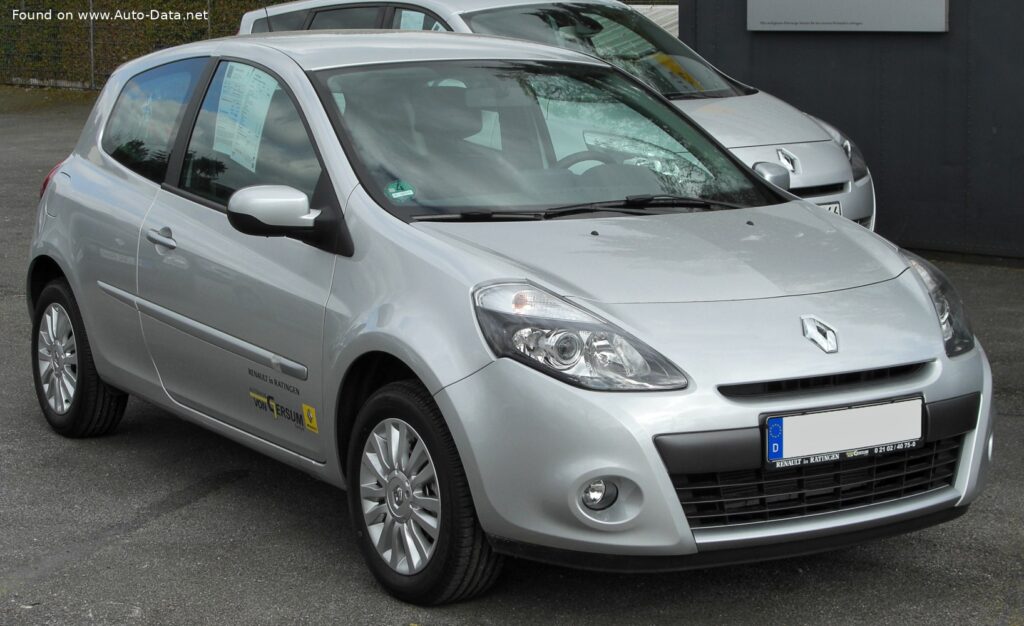
Renault Clio III (Phase II, 2009) 3-door 1.5 dCi (86 Hp)
represents a crucial evolutionary step for the model, embodying Renault’s commitment to efficiency, practicality, and accessible technology in the highly competitive B-segment. Launched in May 2009 as an updated version of the third-generation Clio, this particular variant, with its efficient 1.5-liter dCi diesel engine, was tailored specifically for the discerning European market, where fuel economy and low emissions are paramount. While never officially sold in the United States, the Clio III’s influence on global automotive design and its role in defining the modern compact car segment in Europe are undeniable.
The Clio III, first introduced in 2005, garnered significant acclaim, including the prestigious European Car of the Year award in 2006. The Phase II refresh, which began production in 2009, aimed to keep the model competitive against a new wave of rivals. This update brought subtle but impactful styling revisions, interior enhancements, and powertrain refinements, further cementing its appeal as a versatile and economical urban commuter. The 3-door hatchback configuration emphasized a sporty aesthetic and a compact footprint, making it particularly adept at navigating congested city streets while still offering comfortable seating for five and a respectable cargo capacity.
Engine & Performance: The Efficient Heart of the Renault Clio III (Phase II, 2009) 3-door 1.5 dCi (86 Hp)
At the core of this particular Clio III variant is the highly regarded 1.5-liter (1461 cm³) K9K 766 dCi engine, a testament to Renault’s expertise in diesel powertrain development. This inline four-cylinder, common-rail diesel unit, equipped with a turbocharger and an intercooler, was engineered for an optimal balance of performance and exceptional fuel efficiency. It delivers a modest yet highly effective 86 horsepower at 3750 rpm, providing ample power for daily driving in urban and suburban environments.
More significant than its horsepower figure is the engine’s torque output. With 200 Nm (147.51 lb.-ft.) available from a low 1900 rpm, the 1.5 dCi offers robust low-end grunt, which translates into effortless acceleration from a standstill and strong in-gear flexibility. This characteristic is particularly beneficial in city driving, reducing the need for frequent gear changes and enhancing the overall driving experience. Power is sent to the front wheels via a smooth-shifting 5-speed manual transmission, a common and reliable setup for vehicles in this class.
Performance figures for the Clio III 1.5 dCi (86 Hp) reflect its practical orientation. The car accelerates from 0 to 60 mph in a respectable 12.1 seconds, with a top speed of 108.12 mph (174 km/h). These numbers underscore its capability as a competent all-rounder, capable of comfortably handling highway speeds while remaining agile in traffic. However, the true highlight of this powertrain is its outstanding fuel economy. The combined NEDC cycle rating shows an impressive 4.3 liters per 100 km, which translates to approximately 54.7 US mpg. Urban consumption is rated at 45.2 US mpg, and extra-urban driving can yield up to 58.8 US mpg, making it an exceptionally economical choice for long commutes or road trips across Europe. Furthermore, with CO2 emissions of just 115 g/km and compliance with Euro 4 emission standards, the Clio 1.5 dCi was an environmentally conscious option for its era, contributing to lower running costs and reduced ecological impact.
Design & Features: Practicality Meets Refinement
The Clio III (Phase II) retained the fundamental design language of its predecessor but incorporated several refinements to keep it fresh and appealing. The 3-door hatchback body style presented a dynamic and youthful profile, characterized by its compact dimensions and flowing lines. Measuring 158.74 inches (4032 mm) in length, 67.72 inches (1720 mm) in width (79.72 inches including mirrors), and 58.94 inches (1497 mm) in height, the Clio was perfectly sized for urban environments, offering excellent maneuverability with a minimum turning circle of 35.1 to 37.07 feet.
Inside, the Clio III offered a surprisingly spacious and well-appointed cabin for a vehicle in its class. Despite its compact exterior, it comfortably seats five occupants, making it a practical choice for small families or groups. The trunk space was versatile, offering a minimum of 10.17 cubic feet (288 liters) with the rear seats up, expandable to a generous 36.66 cubic feet (1038 liters) when the rear seats were folded down. This flexibility allowed for the transport of larger items, enhancing its utility.
In terms of features, the 2009 Clio III (Phase II) came equipped with modern essentials for safety and convenience. Standard safety equipment included an Anti-lock Braking System (ABS), a crucial feature for maintaining control during emergency braking. The braking system itself comprised ventilated discs at the front (260×22 mm) and solid discs at the rear (240×8 mm), providing confident stopping power. The steering system was a rack and pinion type with electric power steering, offering light and precise control, particularly beneficial for parking and low-speed maneuvers. The suspension setup featured an independent McPherson strut system with coil springs and an anti-roll bar at the front, paired with a coil spring torsion beam at the rear, a common and effective combination for achieving a comfortable ride and stable handling in this segment. Various tire and wheel options were available, including 185/60 R15 or 195/50 R16 tires on 6J x 15 or 6.5J x 16 rims, respectively.
Technical Specifications
| Category | Specification | US Equivalent |
|---|---|---|
| General Information | ||
| Brand | Renault | |
| Model | Clio | |
| Generation | Clio III (Phase II, 2009) 3-door | |
| Type (Engine) | 1.5 dCi (86 Hp) | |
| Start of Production | May, 2009 | |
| End of Production | October, 2010 | |
| Powertrain Architecture | Internal Combustion engine | |
| Body type | Hatchback | |
| Seats | 5 | |
| Doors | 3 | |
| Performance Specs | ||
| Fuel consumption (economy) – urban (NEDC) | 5.2 l/100 km | 45.2 US mpg |
| Fuel consumption (economy) – extra urban (NEDC) | 4 l/100 km | 58.8 US mpg |
| Fuel consumption (economy) – combined (NEDC) | 4.3 l/100 km | 54.7 US mpg |
| CO2 emissions (NEDC) | 115 g/km | |
| Fuel Type | Diesel | |
| Acceleration 0 – 60 mph | 12.1 sec | |
| Maximum speed | 174 km/h | 108.12 mph |
| Emission standard | Euro 4 | |
| Weight-to-power ratio | 13.5 kg/Hp | 73.8 Hp/tonne |
| Weight-to-torque ratio | 5.8 kg/Nm | 171.7 Nm/tonne |
| Engine Specs | ||
| Power | 86 Hp @ 3750 rpm | |
| Power per liter | 58.9 Hp/l | |
| Torque | 200 Nm @ 1900 rpm | 147.51 lb.-ft. @ 1900 rpm |
| Engine layout | Front, Transverse | |
| Engine Model/Code | K9K 766 | |
| Engine displacement | 1461 cm³ | 89.16 cu. in. |
| Number of cylinders | 4 | |
| Engine configuration | Inline | |
| Cylinder Bore | 76 mm | 2.99 in. |
| Piston Stroke | 80.5 mm | 3.17 in. |
| Compression ratio | 17.9:1 | |
| Number of valves per cylinder | 2 | |
| Fuel injection system | Diesel Commonrail | |
| Engine aspiration | Turbocharger, Intercooler | |
| Valvetrain | SOHC | |
| Engine oil capacity | 4.5 l | 4.76 US qt |
| Coolant | 6.5 l | 6.87 US qt |
| Space, Volume and Weights | ||
| Kerb Weight | 1165 kg | 2568.39 lbs. |
| Max. weight | 1655 kg | 3648.65 lbs. |
| Max load | 490 kg | 1080.27 lbs. |
| Trunk (boot) space – minimum | 288 l | 10.17 cu. ft. |
| Trunk (boot) space – maximum | 1038 l | 36.66 cu. ft. |
| Fuel tank capacity | 55 l | 14.53 US gal |
| Max. roof load | 80 kg | 176.37 lbs. |
| Permitted trailer load with brakes (12%) | 1200 kg | 2645.55 lbs. |
| Permitted trailer load without brakes | 535 kg | 1179.47 lbs. |
| Permitted towbar download | 75 kg | 165.35 lbs. |
| Dimensions | ||
| Length | 4032 mm | 158.74 in. |
| Width | 1720 mm | 67.72 in. |
| Width including mirrors | 2025 mm | 79.72 in. |
| Height | 1497 mm | 58.94 in. |
| Wheelbase | 2575 mm | 101.38 in. |
| Front track | 1458-1472 mm | 57.4 – 57.95 in. |
| Rear (Back) track | 1450-1471 mm | 57.09 – 57.91 in. |
| Front overhang | 830 mm | 32.68 in. |
| Rear overhang | 626 mm | 24.65 in. |
| Ride height (ground clearance) | 120 mm | 4.72 in. |
| Minimum turning circle (turning diameter) | 10.7-11.3 m | 35.1 – 37.07 ft. |
| Drivetrain, Brakes and Suspension Specs | ||
| Drivetrain Architecture | The Internal combustion engine (ICE) drives the front wheels of the vehicle. | |
| Drive wheel | Front wheel drive | |
| Number of gears and type of gearbox | 5 gears, manual transmission | |
| Front suspension | Independent, type McPherson with coil spring and anti-roll bar | |
| Rear suspension | Coil spring, Torsion | |
| Front brakes | Ventilated discs, 260×22 mm | |
| Rear brakes | Disc, 240×8 mm | |
| Assisting systems | ABS (Anti-lock braking system) | |
| Steering type | Steering rack and pinion | |
| Power steering | Electric Steering | |
| Tires size | 185/60 R15; 195/50 R16 | |
| Wheel rims size | 6J x 15; 6.5J x 16 | |
Legacy & Market Impact
The Renault Clio III (Phase II) 1.5 dCi (86 Hp) played a significant role in solidifying the Clio’s reputation as a leader in the European supermini segment. Its combination of stylish design, practical interior, respectable performance, and, crucially, outstanding fuel economy made it a compelling proposition for a wide array of buyers, from first-time car owners to families seeking a second, economical vehicle. This model was a direct competitor to other European stalwarts such as the Volkswagen Polo, Ford Fiesta, Peugeot 207, and Fiat Punto, all of which vied for supremacy in a fiercely contested market segment.
The 1.5 dCi engine, in particular, was a cornerstone of the Clio’s appeal. Renault’s K9K engine family, of which this 86 Hp variant is a part, became renowned for its reliability, efficiency, and widespread use across numerous Renault and Nissan models. Its presence in the Clio III helped democratize diesel technology in the compact car segment, making economical long-distance travel and lower running costs accessible to a broader audience. The Euro 4 compliance further underscored its commitment to environmental standards of the time, a growing concern for European consumers and regulators.
The Clio III’s success paved the way for future generations, including the critically acclaimed Clio IV and V, which continued to build on the foundations of design, technology, and efficiency established by its predecessors. While the
Renault Clio III (Phase II, 2009) 3-door 1.5 dCi (86 Hp)
might not be a familiar sight on American roads, its impact on the European automotive landscape was profound. It represented a benchmark for what a modern, efficient, and practical supermini could be, influencing design trends and technological advancements in a category that remains vital to the automotive industry today.