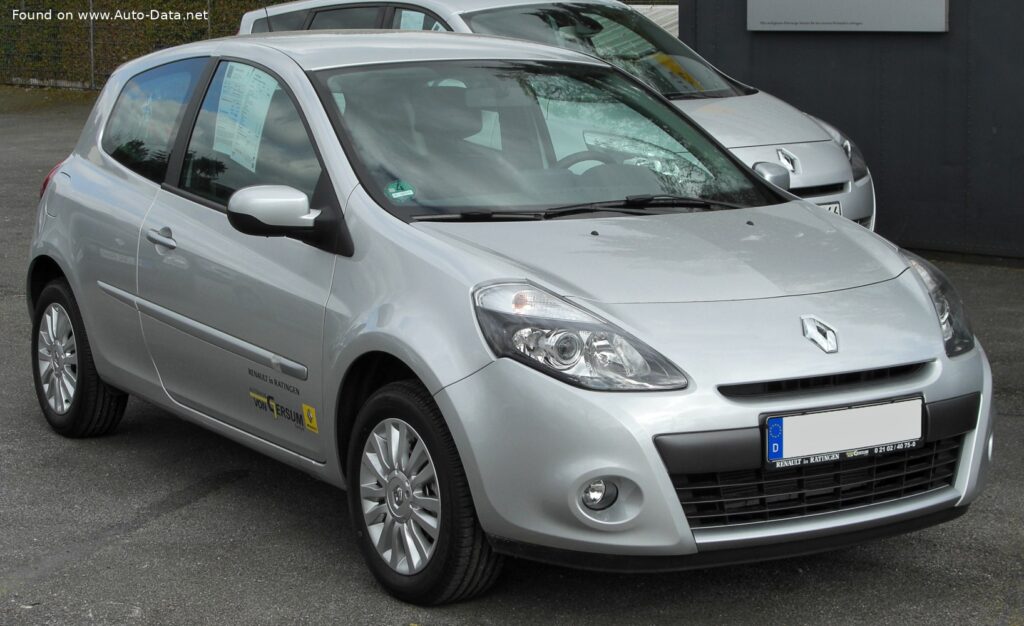
The Renault Clio III (Phase II, 2009) 3-door 1.6 16V (110 Hp): A European Supermini Stalwart
The Renault Clio III (Phase II, 2009) 3-door 1.6 16V (110 Hp) represents a significant chapter in the long-running history of Renault’s popular supermini lineup. Launched in 2009 as a refreshed iteration of the third-generation Clio, this particular variant, with its 1.6-liter 16-valve engine, solidified its position as a highly competitive and well-regarded offering in the fiercely contested European B-segment. While never officially imported to the United States, the Clio has been a cornerstone of Renault’s global strategy, particularly in its home market of France and across the European continent, where it consistently ranks among the best-selling vehicles. This Phase II model, produced until 2012, brought subtle but important updates to design, technology, and efficiency, ensuring the Clio III remained a compelling choice for urban commuters and small families seeking a blend of practicality, style, and economical performance.
The Clio III, first introduced in 2005, garnered critical acclaim, including the prestigious European Car of the Year award in 2006. The Phase II refresh aimed to build upon this success by refining its aesthetics and powertrain options. The 3-door hatchback configuration, a classic staple of the segment, emphasized a sportier, more dynamic profile compared to its 5-door sibling, appealing to a younger demographic or those prioritizing style over absolute rear-door convenience. This detailed overview will delve into the technical prowess, design philosophy, and market impact of the Renault Clio III (Phase II, 2009) 3-door 1.6 16V (110 Hp), showcasing why it remains a respected vehicle in the annals of European automotive history.
Engine & Performance: The Heart of the Renault Clio III Phase II
At the core of the Renault Clio III (Phase II, 2009) 3-door 1.6 16V (110 Hp) lies Renault’s well-proven K4M 800 engine. This naturally aspirated, 1.6-liter (1598 cm³ or 97.52 cu. in.) inline four-cylinder powerplant was renowned for its balance of lively performance and respectable fuel economy. Featuring a Double Overhead Camshaft (DOHC) valvetrain with four valves per cylinder, the engine was designed for efficient combustion and smooth power delivery. Fuel was delivered via a multi-port manifold injection system, a standard and reliable technology for the era, ensuring precise fuel metering.
The K4M 800 engine produced a healthy 110 horsepower (Hp) at 6000 rpm, a commendable output for a non-turbocharged engine of its displacement in the supermini class. Torque output stood at 111.37 lb.-ft. (151 Nm) available at 4250 rpm, providing a broad powerband suitable for both city driving and highway cruising. This combination allowed the Clio III Phase II to accelerate from 0 to 60 mph in a reasonable 11.6 seconds, with a top speed of 115.58 mph (186 km/h). While not a performance hot hatch, these figures positioned it as a sprightly and capable performer within its segment.
Power was sent to the front wheels via a five-speed manual transmission, a common and reliable setup for the segment. This manual gearbox allowed drivers to extract the most from the engine, offering an engaging driving experience. From an efficiency standpoint, the Clio III Phase II 1.6 16V delivered competitive fuel consumption figures for its time. It achieved an urban economy of 22.2 US mpg (10.6 l/100 km), an extra-urban economy of 38.6 US mpg (6.1 l/100 km), and a combined rating of 30.2 US mpg (7.8 l/100 km). Furthermore, it met the stringent Euro 5 emission standard, reflecting Renault’s commitment to environmental responsibility in the European market.
Design & Features: Practicality Meets European Style
The Renault Clio III (Phase II, 2009) retained the fundamental design language of the third generation, characterized by its rounded, friendly yet assertive styling. The Phase II facelift introduced subtle revisions, including updated headlights, a revised front bumper, and minor tweaks to the grille and rear lights, giving it a fresher, more contemporary appearance. The 3-door hatchback body type emphasized its youthful appeal, with a clean side profile and a slightly more raked roofline than its 5-door counterpart.
Despite its compact exterior dimensions—measuring 158.74 inches in length, 67.72 inches in width (79.72 inches including mirrors), and 58.94 inches in height—the Clio III was praised for its surprisingly spacious interior. With a wheelbase of 101.38 inches, it offered comfortable seating for five occupants, making it a viable option for small families or those regularly transporting passengers. The trunk space was practical, offering 10.17 cubic feet (288 liters) with the rear seats up, expandable to a generous 36.66 cubic feet (1038 liters) when the rear seats were folded down, providing excellent versatility for cargo.
Underneath its stylish skin, the Clio III featured a robust chassis designed for comfort and confident handling. The front suspension utilized a tried-and-true Spring Strut system, while the rear employed a Coil Spring setup, providing a compliant ride suitable for varying road conditions. Braking performance was handled by ventilated disc brakes at the front and solid disc brakes at the rear, augmented by an Anti-lock Braking System (ABS) for enhanced safety during emergency stops. The steering system was a rack and pinion type, complemented by electric power steering, which offered light and precise control, particularly beneficial for navigating tight urban environments and parking maneuvers. The vehicle rode on 185/60 R15 tires mounted on 6J x 15-inch wheel rims, a common specification for balancing grip, comfort, and cost in the segment. Its minimum turning circle of 35.1 feet (10.7 meters) further underscored its agility in crowded cityscapes.
Technical Specifications
| Category | Specification |
|---|---|
| General Information | |
| Brand | Renault |
| Model | Clio |
| Generation | Clio III (Phase II, 2009) 3-door |
| Type (Engine) | 1.6 16V (110 Hp) |
| Start of Production | 2009 year |
| End of Production | 2012 year |
| Powertrain Architecture | Internal Combustion engine |
| Body type | Hatchback |
| Seats | 5 |
| Doors | 3 |
| Performance Specs | |
| Fuel consumption (economy) – urban | 10.6 l/100 km (22.2 US mpg) |
| Fuel consumption (economy) – extra urban | 6.1 l/100 km (38.6 US mpg) |
| Fuel consumption (economy) – combined | 7.8 l/100 km (30.2 US mpg) |
| Fuel Type | Petrol (Gasoline) |
| Acceleration 0 – 60 mph | 11.6 sec |
| Maximum speed | 186 km/h (115.58 mph) |
| Emission standard | Euro 5 |
| Engine Specs | |
| Power | 110 Hp @ 6000 rpm |
| Power per liter | 68.8 Hp/l |
| Torque | 151 Nm @ 4250 rpm (111.37 lb.-ft. @ 4250 rpm) |
| Engine layout | Front, Transverse |
| Engine Model/Code | K4M 800 |
| Engine displacement | 1598 cm³ (97.52 cu. in.) |
| Number of cylinders | 4 |
| Engine configuration | Inline |
| Cylinder Bore | 79.5 mm (3.13 in.) |
| Piston Stroke | 80.5 mm (3.17 in.) |
| Compression ratio | 10:1 |
| Number of valves per cylinder | 4 |
| Fuel injection system | Multi-port manifold injection |
| Engine aspiration | Naturally aspirated engine |
| Valvetrain | DOHC |
| Engine oil capacity | 5 l (5.28 US qt) |
| Coolant | 6.5 l (6.87 US qt) |
| Space, Volume and Weights | |
| Trunk (boot) space – minimum | 288 l (10.17 cu. ft.) |
| Trunk (boot) space – maximum | 1038 l (36.66 cu. ft.) |
| Fuel tank capacity | 55 l (14.53 US gal) |
| Dimensions | |
| Length | 4032 mm (158.74 in.) |
| Width | 1720 mm (67.72 in.) |
| Width including mirrors | 2025 mm (79.72 in.) |
| Height | 1497 mm (58.94 in.) |
| Wheelbase | 2575 mm (101.38 in.) |
| Front track | 1472 mm (57.95 in.) |
| Rear (Back) track | 1470 mm (57.87 in.) |
| Front overhang | 830 mm (32.68 in.) |
| Rear overhang | 626 mm (24.65 in.) |
| Minimum turning circle (turning diameter) | 10.7 m (35.1 ft.) |
| Drivetrain, Brakes and Suspension Specs | |
| Drivetrain Architecture | Front-wheel drive, Internal Combustion Engine (ICE) |
| Drive wheel | Front wheel drive |
| Number of gears and type of gearbox | 5 gears, manual transmission |
| Front suspension | Spring Strut |
| Rear suspension | Coil spring |
| Front brakes | Ventilated discs |
| Rear brakes | Disc |
| Assisting systems | ABS (Anti-lock braking system) |
| Steering type | Steering rack and pinion |
| Power steering | Electric Steering |
| Tires size | 185/60 R15 |
| Wheel rims size | 6J x 15 |
Legacy & Market Impact
The Renault Clio III (Phase II, 2009) 3-door 1.6 16V (110 Hp) played a crucial role in maintaining Renault’s strong presence in the European supermini segment during its production run from 2009 to 2012. It faced stiff competition from formidable rivals such as the Volkswagen Polo, Ford Fiesta, Peugeot 207, Opel Corsa, and Fiat Punto. Despite this competitive landscape, the Clio III consistently performed well in sales, often vying for the top spot in several European countries.
Its market impact stemmed from a combination of factors. Renault had built a reputation for producing safe, comfortable, and practical small cars, and the Clio III continued this tradition. It frequently achieved high safety ratings in Euro NCAP crash tests, a significant selling point for European consumers. The car’s comfortable ride quality, refined interior for its class, and relatively quiet cabin made it an attractive option for daily commuting and longer journeys alike. The K4M engine, in particular, was known for its reliability and adequate performance, striking a good balance between daily usability and running costs.
The design, while conservative compared to some of its more adventurous predecessors, was widely accepted and contributed to its broad appeal. The Phase II updates ensured it remained visually fresh against newer competitors. Furthermore, the Clio’s strong residual values and extensive dealer network across Europe made it an accessible and reassuring purchase for many. It was a car that appealed to a wide demographic, from young drivers to small families looking for a dependable and efficient vehicle.
In conclusion, the Renault Clio III (Phase II, 2009) 3-door 1.6 16V (110 Hp) may not be a familiar sight on American roads, but its influence in its primary markets was substantial. It epitomized the strengths of European compact car engineering: thoughtful design, efficient packaging, robust powertrains, and a focus on safety and driving dynamics tailored for diverse road conditions. Its legacy is one of consistent performance, widespread appeal, and a testament to Renault’s enduring expertise in the supermini segment, solidifying its place as a true European automotive icon.