Introduction to the Renault Clio IV Grandtour (Phase I)
The Renault Clio IV Grandtour (Phase I) 1.2 TCe (120 Hp) EDC GT represents a significant offering within the European B-segment (subcompact) market, specifically catering to consumers seeking the practicality of a station wagon alongside the compact dimensions and efficiency of a subcompact car. Launched in 2013 as part of the fourth-generation Clio lineup, the Grandtour variant extended the popular hatchback’s appeal by providing increased cargo capacity and versatility. This particular configuration, the 1.2 TCe (Turbo Control efficiency) with 120 horsepower, paired with Renault’s Efficient Dual Clutch (EDC) automatic transmission, and presented in the GT trim, aimed to blend spirited performance with everyday usability and a touch of sportiness.
Produced from 2013 to 2016, this phase-one model of the Clio IV Grandtour was a direct competitor in a highly contested segment, primarily within Europe and other international markets where such compact estates were popular. While the Clio nameplate itself has a rich history of success, the Grandtour version was tailored for families and individuals prioritizing space without compromising on the urban agility for which the Clio is renowned. The GT designation further enhanced its appeal, offering specific styling cues and a more engaging driving experience than its standard counterparts.
Engine and Performance: The Heart of the Renault Clio IV Grandtour (Phase I)
Powering the Renault Clio IV Grandtour (Phase I) 1.2 TCe (120 Hp) EDC GT is a modern, downsized internal combustion engine, designated by the model code H5F 403. This 1.2-liter (1197 cm³ or 73.05 cu. in.) inline-four engine is positioned transversely at the front of the vehicle, driving the front wheels. Its “TCe” moniker highlights Renault’s commitment to turbocharging for enhanced efficiency and power delivery, a common trend in the automotive industry during its production years. The engine benefits from direct fuel injection, a turbocharger, and an intercooler, allowing it to produce a respectable 120 horsepower. This results in a power-per-liter output of 100.3 HP/L, indicative of its advanced design.
Torque output stands at 190 Nm (140.14 lb.-ft.), delivered effectively across the rev range thanks to the turbocharger, ensuring responsive acceleration and flexible in-gear performance. This engine is mated to a sophisticated 6-speed automatic transmission, specifically Renault’s EDC (Efficient Dual Clutch) system. The EDC gearbox provides smooth and rapid gear changes, contributing to both driving pleasure and fuel efficiency.
Performance figures for the Clio IV Grandtour 1.2 TCe GT are solid for its class. It boasts a maximum speed of 199 km/h (123.65 mph). Despite its spirited performance, the vehicle maintains impressive fuel economy, with a combined rating of 5.2 liters per 100 kilometers (45.2 US mpg). Urban driving yields 6.6 L/100 km (35.6 US mpg), while extra-urban cycles achieve an economical 4.4 L/100 km (53.5 US mpg). With CO2 emissions of 120 g/km, the vehicle met the Euro 5 emission standard, reflecting its relatively clean operation for the era. The lightweight nature of the car, with a curb weight of 2643.34 lbs (1199 kg), contributes to its agile handling and favorable weight-to-power ratio of 10 kg/Hp.
Design and Features
Body and Exterior Design
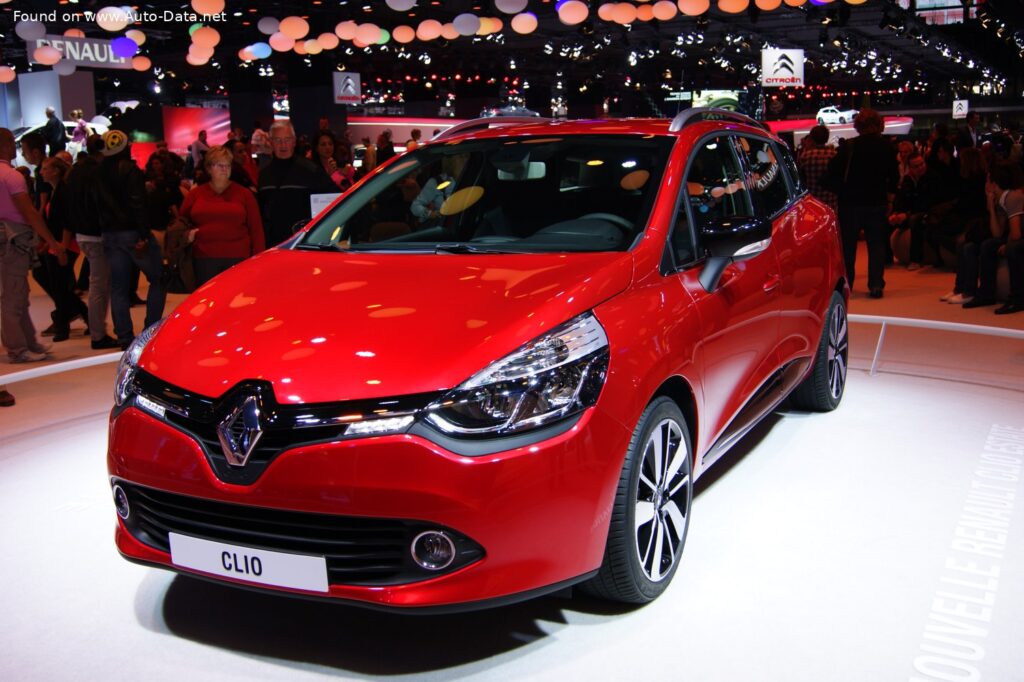
The Clio IV Grandtour (Phase I) adopted the striking and fluid design language introduced with the fourth-generation Clio hatchback, penned by Laurens van den Acker. As a 5-door station wagon (often referred to as an “estate” in Europe), it seamlessly integrated the extended roofline and larger cargo area with the Clio’s dynamic aesthetics. Key design elements included a prominent front grille featuring a large Renault diamond emblem, distinctive C-shaped LED daytime running lights (on higher trims), and sculpted body sides. The Grandtour variant cleverly disguised its practicality with a sleek profile, including hidden rear door handles that contributed to its coupe-like appearance from some angles. The GT trim further accentuated these features with sportier bumpers, unique alloy wheels, and potentially specific badging, giving it a more aggressive stance.
Interior and Practicality
Inside, the Clio IV Grandtour offered a contemporary cabin designed for comfort and user-friendliness. With seating for five occupants, the interior focused on ergonomics and a youthful ambiance. Material quality was competitive for the B-segment, with various trim levels offering different finishes. A central feature of the dashboard was often a touchscreen infotainment system, providing access to navigation, media, and connectivity options, reflecting the growing trend of integrated technology in modern vehicles.
However, the Grandtour’s primary appeal lay in its enhanced practicality. The extended rear overhang significantly boosted cargo capacity compared to the hatchback, offering a minimum trunk space of 443 liters (15.64 cu. ft.). This made it a highly versatile option for small families, individuals with active lifestyles, or even light commercial use. The rear seats could typically fold down, further expanding the usable load space, though specific figures for maximum cargo volume are not provided.
Chassis, Brakes, and Wheels
The Clio IV Grandtour utilized a robust chassis designed to offer a balance of comfort and dynamic handling. The GT trim typically featured a sportier suspension setup to complement its performance-oriented powertrain. Steering was handled by a rack and pinion system, providing precise control. For braking, the front wheels were equipped with ventilated disc brakes, offering strong stopping power, while the rear utilized drum brakes, a common configuration for vehicles in this class. Standard safety features for the era included ABS (Anti-lock Braking System), and it’s reasonable to infer the presence of airbags and electronic stability control (ESC) as standard equipment to meet European safety regulations. The vehicle rode on 17-inch wheel rims, fitted with 205/45 R17 tires, which contributed to both its aesthetic appeal and handling characteristics.
Technical Specifications
| Category | Specification |
|---|---|
| Brand | Renault |
| Model | Clio |
| Generation | Clio IV Grandtour (Phase I) |
| Type (Engine) | 1.2 TCe (120 Hp) EDC GT |
| Start of Production | 2013 year |
| End of Production | 2016 year |
| Powertrain Architecture | Internal Combustion engine |
| Body type | Station wagon (estate) |
| Seats | 5 |
| Doors | 5 |
| Fuel Consumption (Economy) – Urban | 6.6 L/100 km (35.6 US mpg) |
| Fuel Consumption (Economy) – Extra Urban | 4.4 L/100 km (53.5 US mpg) |
| Fuel Consumption (Economy) – Combined | 5.2 L/100 km (45.2 US mpg) |
| CO2 Emissions | 120 g/km |
| Fuel Type | Petrol (Gasoline) |
| Maximum Speed | 199 km/h (123.65 mph) |
| Emission Standard | Euro 5 |
| Weight-to-Power Ratio | 10 kg/Hp (100.1 Hp/tonne) |
| Weight-to-Torque Ratio | 6.3 kg/Nm (158.5 Nm/tonne) |
| Power | 120 Hp |
| Power per Liter | 100.3 Hp/L |
| Torque | 190 Nm (140.14 lb.-ft.) |
| Engine Layout | Front, Transverse |
| Engine Model/Code | H5F 403 |
| Engine Displacement | 1197 cm³ (1.2 Liters / 73.05 cu. in.) |
| Engine Configuration | Inline-4 |
| Fuel Injection System | Direct injection |
| Engine Aspiration | Turbocharger, Intercooler |
| Engine Oil Capacity | 4.6 L (4.86 US qt) |
| Engine Oil Specification | Not specified in data |
| Coolant Capacity | 5 L (5.28 US qt) |
| Kerb Weight | 1199 kg (2643.34 lbs) |
| Max. Weight | 1705 kg (3758.88 lbs) |
| Max Load | 506 kg (1115.54 lbs) |
| Trunk (Boot) Space – Minimum | 443 L (15.64 cu. ft.) |
| Fuel Tank Capacity | 45 L (11.89 US gal) |
| Minimum Turning Circle (Turning Diameter) | 10.6 m (34.78 ft) |
| Drivetrain Architecture | Front-wheel drive. Internal Combustion engine. |
| Drive Wheel | Front wheel drive |
| Number of Gears and Type of Gearbox | 6 gears, automatic transmission (EDC) |
| Front Brakes | Ventilated discs |
| Rear Brakes | Drum |
| Assisting Systems | ABS (Anti-lock braking system) |
| Steering Type | Steering rack and pinion |
| Tires Size | 205/45 R17 |
| Wheel Rims Size | 17 inches |
Legacy and Market Impact
The Renault Clio IV Grandtour (Phase I) 1.2 TCe (120 Hp) EDC GT played a vital role in Renault’s strategy for the European B-segment. In a market segment often dominated by hatchbacks, the Grandtour offered a compelling alternative for consumers who needed more cargo space and versatility without upsizing to a larger, more expensive vehicle. It competed directly with other compact estates prevalent in Europe, such as the Skoda Fabia Combi, SEAT Ibiza ST, and the Peugeot 207 SW (and later 208 SW). While not a huge volume seller compared to the Clio hatchback, the Grandtour carved out a niche for itself, appealing to young families, small businesses, and individuals who valued practicality in a stylish and compact package.
The Clio IV Grandtour, particularly in its GT trim with the 1.2 TCe engine and EDC transmission, showcased Renault’s advancements in powertrain technology. The widespread adoption of turbocharged, downsized engines like the 1.2 TCe was a significant trend during this period, aiming to deliver power comparable to larger naturally aspirated engines while drastically improving fuel economy and reducing emissions. The EDC dual-clutch transmission further enhanced this proposition, offering the convenience of an automatic with the efficiency and engagement typically associated with manual gearboxes. This combination positioned the Clio Grandtour GT as a modern, efficient, and enjoyable car to drive within its class.
The overall reputation of the Clio IV generation was positive, lauded for its distinctive design, comfortable ride, and improved interior quality compared to its predecessor. The Grandtour variant extended this reputation by adding a layer of practicality that was highly valued in its target markets. Its production run from 2013 to 2016 for the Phase I model ensured it remained competitive throughout its lifecycle, before being updated in subsequent phases. Though never officially sold in the United States, the Renault Clio IV Grandtour (Phase I) stands as a testament to European automotive design and engineering, demonstrating how a subcompact platform can be adapted to meet diverse consumer needs for space, style, and efficiency. Its legacy is one of a practical, well-engineered, and aesthetically pleasing option in the competitive European compact estate segment.