The Renault Clio IV Grandtour (Phase I) 1.5 dCi (90 Hp) EDC: A European Mainstay of Practicality and Efficiency
The Renault Clio IV Grandtour (Phase I) 1.5 dCi (90 Hp) EDC represents a compelling blend of practicality, efficiency, and modern design within Europe’s highly competitive B-segment. Launched in 2013 as part of the fourth-generation Clio lineup, the Grandtour, or estate wagon, variant offered a significantly enhanced cargo capacity over its hatchback sibling, catering to families and individuals requiring more versatile space. This particular configuration, featuring the renowned 1.5-liter dCi diesel engine paired with Renault’s Efficient Dual Clutch (EDC) automatic transmission, was engineered to deliver an economical and comfortable driving experience, making it a popular choice across the continent.
While the Renault Clio is a familiar sight on European roads, it was never officially sold in the United States market. Therefore, its significance is best understood within the context of its primary European and select Asian markets, where its compact dimensions, fuel efficiency, and adaptable interior proved highly attractive. The Clio IV Grandtour (Phase I) was produced from 2013 to 2016, establishing itself as a benchmark for small estate cars before the subsequent facelift and continuation of the generation.
Engine and Performance of the Renault Clio IV Grandtour (Phase I) 1.5 dCi (90 Hp) EDC
At the heart of this specific Clio Grandtour model is Renault’s well-regarded K9K 629 1.5-liter dCi (direct Commonrail injection) diesel engine. This inline four-cylinder unit, with a displacement of 1461 cubic centimeters (or 89.16 cubic inches), is a testament to modern diesel engineering, focusing on a balance of power, torque, and exceptional fuel economy. Equipped with a turbocharger and intercooler, the engine produces a respectable 90 horsepower at 4000 rpm. More importantly for daily driving and load-carrying in an estate vehicle, it generates a robust 220 Newton-meters (162.26 lb.-ft.) of torque at a low 1750 rpm, providing ample pulling power right off the line.
Power is delivered to the front wheels via a sophisticated 6-speed EDC (Efficient Dual Clutch) automatic transmission. This gearbox offers the convenience of an automatic with the efficiency and responsiveness often associated with manual transmissions, making it ideal for both city driving and longer highway journeys. The combination of the torquey diesel engine and the smooth-shifting EDC results in a practical performance profile. The Renault Clio IV Grandtour (Phase I) 1.5 dCi (90 Hp) EDC accelerates from 0 to 60 mph in a reasonable 12.3 seconds (0-100 km/h in 12.9 seconds) and can reach a maximum speed of 109.36 mph (176 km/h). These figures underscore its role as a competent daily driver, prioritizing efficiency over outright speed.
Fuel economy is a standout feature, particularly in the European market where diesel engines are highly valued for their efficiency. The combined fuel consumption is rated at an impressive 3.7 liters per 100 kilometers, translating to approximately 63.6 US miles per gallon. Urban driving yields about 4.3 l/100 km (54.7 US mpg), while extra-urban (highway) cruising achieves an outstanding 3.3 l/100 km (71.3 US mpg). With CO2 emissions of just 95 g/km, this Clio Grandtour also benefited from favorable tax incentives and environmental considerations in many European countries, further enhancing its appeal.
Design and Features
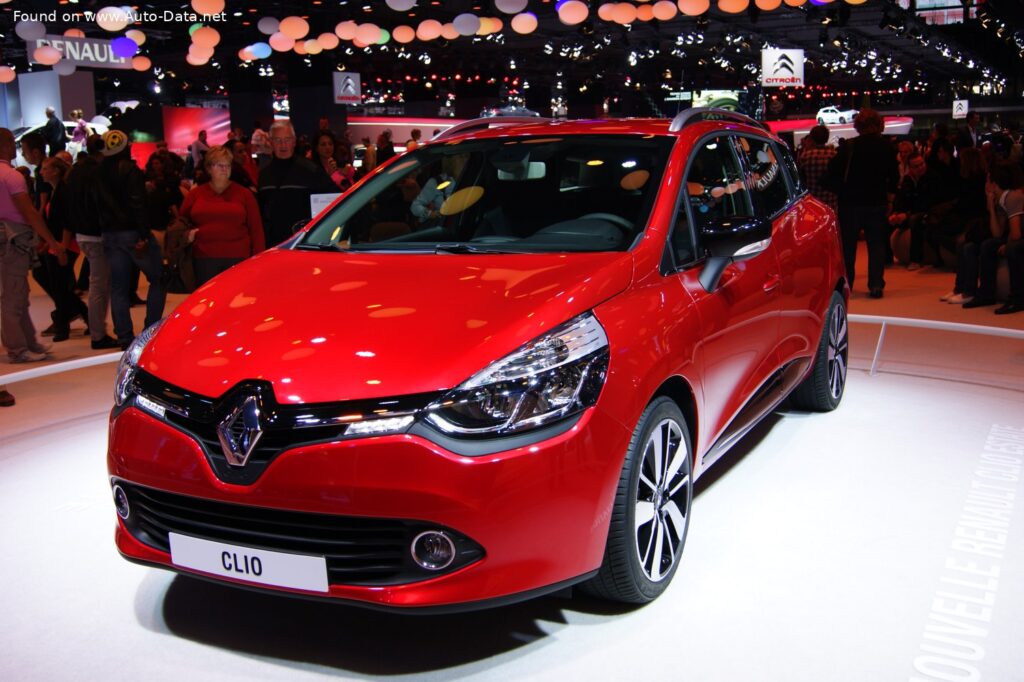
The Clio IV Grandtour inherited the dynamic and fluid design language introduced by Laurens van den Acker for the fourth-generation Clio hatchback. Its exterior aesthetics were characterized by smooth lines, a prominent front grille featuring the enlarged Renault diamond logo, and distinctive C-shaped daytime running lights (on higher trims). The Grandtour variant extended the Clio’s sleek profile into a practical station wagon (or estate) body, seamlessly integrating the added length required for increased cargo volume. Clever design elements, such as the hidden rear door handles, maintained a coupe-like appearance despite its five-door configuration.
Inside, the Clio IV Grandtour offered a contemporary cabin with a focus on ergonomics and connectivity for its time. While specific trim levels varied, common features included a user-friendly infotainment system, often with a touchscreen interface, Bluetooth connectivity, and navigation options. The primary advantage of the Grandtour body style was its enhanced utility. With a minimum trunk space of 443 liters (15.64 cubic feet), it significantly surpassed the hatchback’s capacity. When the rear seats were folded down, this expanded to a cavernous 1380 liters (48.73 cubic feet), rivaling vehicles from a segment above and making it ideal for hauling luggage, groceries, or even larger items for weekend trips. The car seats five occupants comfortably, making it a versatile family vehicle.
Safety features for the Clio IV Grandtour included standard Anti-lock Braking System (ABS), a suite of airbags, and a robust chassis designed to protect occupants. The steering system utilized electric power steering with a rack and pinion setup, providing light and precise control, particularly beneficial for urban maneuvering. The minimum turning circle of 10.6 meters (34.78 feet) further aided its agility in tight spaces. The vehicle rode on either 15-inch or 16-inch wheels, fitted with tire sizes 185/65 R15 88T or 195/55 R16 87H, respectively, offering a comfortable ride quality balanced with competent handling.
Technical Specifications
| Feature | Specification |
|---|---|
| Brand | Renault |
| Model | Clio |
| Generation | Clio IV Grandtour (Phase I) |
| Engine Type | 1.5 dCi (90 Hp) EDC |
| Production Start | 2013 |
| Production End | 2016 |
| Powertrain Architecture | Internal Combustion Engine |
| Body Type | Station wagon (estate) |
| Seats | 5 |
| Doors | 5 |
| Fuel Consumption (Urban) | 4.3 l/100 km (54.7 US mpg) |
| Fuel Consumption (Extra Urban) | 3.3 l/100 km (71.3 US mpg) |
| Fuel Consumption (Combined) | 3.7 l/100 km (63.6 US mpg) |
| CO2 Emissions | 95 g/km |
| Fuel Type | Diesel |
| Acceleration 0-60 mph | 12.3 seconds |
| Acceleration 0-100 km/h | 12.9 seconds |
| Maximum Speed | 176 km/h (109.36 mph) |
| Power | 90 Hp @ 4000 rpm |
| Power per Liter | 61.6 Hp/l |
| Torque | 220 Nm (162.26 lb.-ft.) @ 1750 rpm |
| Engine Layout | Front, Transverse |
| Engine Model/Code | K9K 629 |
| Engine Displacement | 1461 cm3 (89.16 cu. in.) |
| Number of Cylinders | 4 |
| Engine Configuration | Inline |
| Valves per Cylinder | 2 |
| Fuel Injection System | Diesel Commonrail |
| Engine Aspiration | Turbocharger, Intercooler |
| Engine Oil Capacity | 4.5 l (4.76 US qt) |
| Coolant Capacity | 5 l (5.28 US qt) |
| Trunk Space (Minimum) | 443 l (15.64 cu. ft.) |
| Trunk Space (Maximum) | 1380 l (48.73 cu. ft.) |
| Fuel Tank Capacity | 45 l (11.89 US gal) |
| Length | 4267 mm (167.99 in.) |
| Width | 1732 mm (68.19 in.) |
| Height | 1445 mm (56.89 in.) |
| Wheelbase | 2589 mm (101.93 in.) |
| Minimum Turning Circle | 10.6 m (34.78 ft.) |
| Drivetrain Architecture | Front-wheel drive, Internal Combustion Engine |
| Drive Wheel | Front-wheel drive |
| Gearbox Type | 6 gears, automatic transmission EDC |
| Assisting Systems | ABS (Anti-lock Braking System) |
| Steering Type | Steering rack and pinion |
| Power Steering | Electric Steering |
| Tire Sizes | 185/65 R15 88T; 195/55 R16 87H |
| Wheel Rim Sizes | 15; 16 |
Legacy and Market Impact
The Renault Clio series has a rich and enduring legacy in Europe, consistently ranking among the continent’s best-selling superminis for decades. The Clio IV Grandtour (Phase I) 1.5 dCi (90 Hp) EDC continued this tradition by offering a compelling package for a specific segment of the market: those needing the compact footprint and low running costs of a B-segment car but with the added versatility of an estate body style. Its primary competitors in this niche included vehicles like the Skoda Fabia Combi, Peugeot 207 SW (and later 208 SW), and occasionally the Volkswagen Polo Variant, though the latter often commanded a higher price point.
The success of this particular Clio variant can be attributed to several key factors. Firstly, the 1.5 dCi engine was a proven workhorse, renowned for its reliability and exceptional fuel efficiency, which was a critical consideration for European buyers facing high fuel prices and stringent emissions regulations. The integration of the EDC automatic transmission further broadened its appeal, offering a more relaxed driving experience without significantly compromising efficiency—a crucial technological advancement for compact cars of its era.
Secondly, the Grandtour’s design successfully married the Clio’s youthful and attractive styling with genuine practicality. The increased cargo volume made it a viable alternative to larger, more expensive C-segment vehicles for many families, offering a ‘right-sized’ solution for urban and suburban life. Its low CO2 emissions (95 g/km) also positioned it favorably in markets with emissions-based taxation schemes, making it an economically sound choice.
In conclusion, the Renault Clio IV Grandtour (Phase I) 1.5 dCi (90 Hp) EDC solidified Renault’s position as a leader in the compact car segment in Europe. It delivered a well-rounded package of stylish design, impressive fuel economy, practical space, and modern powertrain technology. While it never graced American showrooms, its impact across the Atlantic was significant, showcasing how a well-engineered small estate car could perfectly meet the diverse needs of a demanding market.