Introduction to the Renault Clio IV (Phase II)
The Renault Clio IV (Phase II), specifically the variant equipped with the 0.9 TCe (75 Hp) engine, represents a significant iteration of Renault’s highly successful supermini. First launched in 1990, the Clio has consistently been one of Europe’s best-selling cars, known for its stylish design, practical size, and engaging driving dynamics. The fourth generation, introduced in 2012, received a mid-cycle refresh, or “Phase II,” in 2016, which brought subtle aesthetic updates and technological improvements to keep it competitive in the fiercely contested B-segment market. The 0.9 TCe (75 Hp) model, produced between 2018 and 2019, was positioned as an economical and efficient option within the Clio lineup, perfectly suited for urban environments and offering a balance of performance and fuel efficiency crucial for European consumers.
While the Renault brand enjoys a storied history in automotive manufacturing, its presence in the United States market has been sporadic since the 1980s. Consequently, the Renault Clio, a staple on European roads, was never officially sold in North America. This article will delve into the technical specifications, design philosophy, and market impact of this particular Clio variant, using American English terminology and units where applicable, to provide an expert perspective on a vehicle that defines a core segment of the international automotive landscape.
Engine and Performance: The 0.9 TCe in the Renault Clio IV (Phase II)
At the heart of this specific Renault Clio IV (Phase II) model is the H4B 408 engine, a compact 0.9-liter (898 cm³ or 54.8 cubic inches) three-cylinder gasoline (petrol) unit. Despite its small displacement, this engine benefits from a turbocharger and intercooler, technology typically associated with larger powertrains, allowing it to produce a respectable 75 horsepower at 5000 revolutions per minute (rpm). This power output, combined with a peak torque of 88.51 pounds-feet (120 Nm) delivered at a low 2500 rpm, provides adequate responsiveness for city driving and comfortable cruising on European highways.
The engine’s front, transverse layout and inline three-cylinder configuration are standard for a modern front-wheel-drive supermini, optimizing interior space and weight distribution. Each cylinder features four valves, contributing to efficient breathing and combustion, managed by a multi-port manifold injection system. Power is channeled to the front wheels via a smooth-shifting 5-speed manual transmission, a common choice in Europe for its driver engagement and efficiency.
Performance figures for the 0.9 TCe (75 Hp) variant underscore its urban-centric design. It accelerates from 0 to 60 miles per hour in an estimated 11.7 seconds (0-100 km/h in 12.3 seconds) and can reach a maximum speed of 110.6 miles per hour (178 km/h). These figures, while not groundbreaking, are entirely suitable for its intended purpose. Crucially, fuel economy is a strong suit, with a combined rating of approximately 47 US miles per gallon (5 liters per 100 km). Urban driving yields around 37.3 US mpg (6.3 l/100 km), while extra-urban (highway) driving can achieve an impressive 56 US mpg (4.2 l/100 km). This efficiency is further bolstered by low CO2 emissions of 113 g/km, allowing the vehicle to meet stringent Euro 6 emission standards, a vital consideration in European markets.
Design and Features of the Renault Clio IV (Phase II)
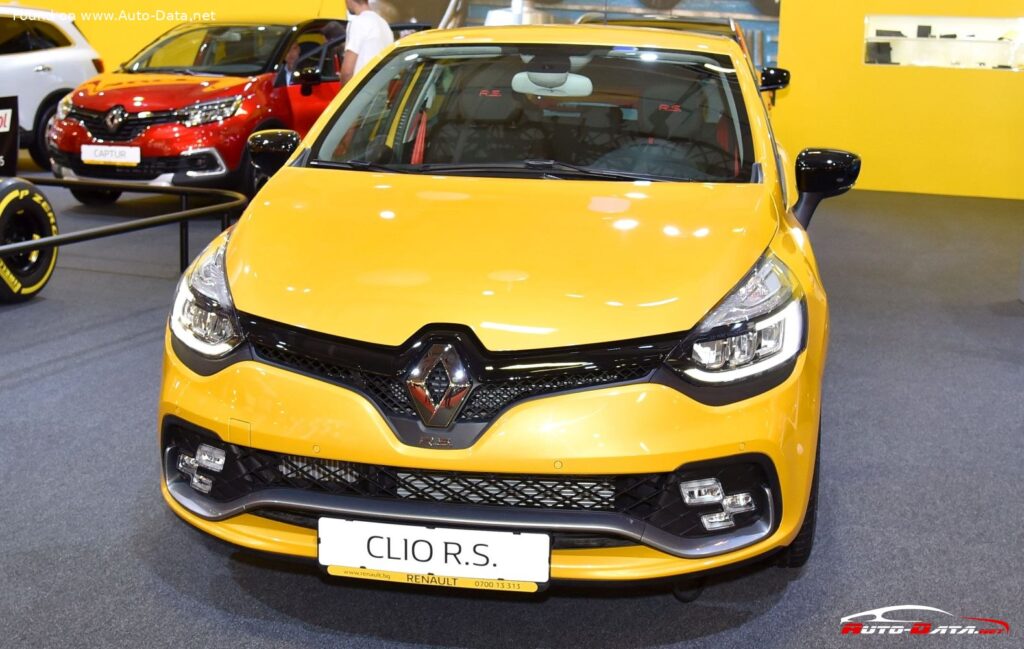
The Renault Clio IV (Phase II) retains the expressive and dynamic styling that characterized the fourth-generation model, a design language spearheaded by Laurens van den Acker. As a five-door hatchback, it offers a practical and versatile body type, accommodating five occupants comfortably. Its dimensions are compact yet functional: 159.92 inches (4062 mm) in length, 68.19 inches (1732 mm) in width (76.57 inches or 1945 mm including mirrors), and 57.01 inches (1448 mm) in height. The 101.93-inch (2589 mm) wheelbase ensures a stable ride and maximized interior volume for its class.
Visually, the Phase II update brought minor but impactful changes. These included revised headlamps, often featuring Renault’s signature C-shaped LED daytime running lights, a subtly restyled grille, and updated taillight graphics. The overall aesthetic remained curvaceous and sporty, appealing to a broad demographic. The interior, while primarily functional, received material upgrades and new trim options, enhancing perceived quality.
Practicality is a key feature of the Clio hatchback. It offers a minimum trunk (boot) space of 10.59 cubic feet (300 liters), expandable by folding the rear seats, making it capable of handling weekly groceries or weekend luggage. The fuel tank capacity of 11.89 US gallons (45 liters) contributes to its excellent cruising range.
In terms of safety and driver assistance, the Clio IV (Phase II) was equipped with essential systems for its time and segment. Front brakes are ventilated discs, providing effective stopping power, while the rear utilizes drum brakes, a cost-effective and adequate solution for a vehicle of this size and power. An Anti-lock Braking System (ABS) was standard, enhancing control during emergency braking. The steering system features an electric power-assisted rack and pinion setup, offering light steering at low speeds for easy maneuverability in urban areas and more feel at higher speeds. The turning circle of 36.09 feet (11.0 meters) further aids in tight city parking and navigation. The vehicle typically rode on 185/65 R15 or 195/55 R16 tires, depending on the trim level, mounted on 15 or 16-inch wheel rims.
Technical Specifications
| Category | Specification |
|---|---|
| Brand | Renault |
| Model | Clio |
| Generation | Clio IV (Phase II, 2016) |
| Type (Engine) | 0.9 TCe (75 Hp) |
| Start of Production | 2018 year |
| End of Production | 2019 year |
| Powertrain Architecture | Internal Combustion engine |
| Body type | Hatchback |
| Seats | 5 |
| Doors | 5 |
| Performance Specs | |
| Fuel consumption (urban) | 37.3 US mpg (6.3 l/100 km) |
| Fuel consumption (extra urban) | 56 US mpg (4.2 l/100 km) |
| Fuel consumption (combined) | 47 US mpg (5 l/100 km) |
| CO2 emissions | 113 g/km |
| Fuel Type | Petrol (Gasoline) |
| Acceleration 0 – 60 mph | 11.7 sec |
| Acceleration 0 – 100 km/h | 12.3 sec |
| Maximum speed | 110.6 mph (178 km/h) |
| Emission standard | Euro 6 |
| Engine Specs | |
| Power | 75 Hp @ 5000 rpm |
| Power per liter | 83.5 Hp/l |
| Torque | 88.51 lb.-ft. @ 2500 rpm (120 Nm @ 2500 rpm) |
| Engine layout | Front, Transverse |
| Engine Model/Code | H4B 408 |
| Engine displacement | 0.9 l (898 cm³, 54.8 cu. in.) |
| Number of cylinders | 3 |
| Engine configuration | Inline |
| Cylinder Bore | 2.84 in. (72.2 mm) |
| Piston Stroke | 2.88 in. (73.1 mm) |
| Number of valves per cylinder | 4 |
| Fuel injection system | Multi-port manifold injection |
| Engine aspiration | Turbocharger, Intercooler |
| Engine oil capacity | 4.33 US qt (4.1 l) |
| Coolant capacity | 5.28 US qt (5 l) |
| Space, Volume and Weights | |
| Trunk (boot) space – minimum | 10.59 cu. ft. (300 l) |
| Fuel tank capacity | 11.89 US gal (45 l) |
| Permitted trailer load with brakes (12%) | 2645.55 lbs (1200 kg) |
| Permitted trailer load without brakes | 1278.68 lbs (580 kg) |
| Dimensions | |
| Length | 159.92 in. (4062 mm) |
| Width | 68.19 in. (1732 mm) |
| Width including mirrors | 76.57 in. (1945 mm) |
| Height | 57.01 in. (1448 mm) |
| Wheelbase | 101.93 in. (2589 mm) |
| Front track | 59.29 in. (1506 mm) |
| Rear (Back) track | 59.29 in. (1506 mm) |
| Ride height (ground clearance) | 4.72 in. (120 mm) |
| Minimum turning circle (diameter) | 36.09 ft. (11.0 m) |
| Drivetrain, Brakes and Suspension Specs | |
| Drivetrain Architecture | The Internal combustion engine (ICE) drives the front wheels of the vehicle. |
| Drive wheel | Front wheel drive |
| Number of gears and type of gearbox | 5 gears, manual transmission |
| Front brakes | Ventilated discs |
| Rear brakes | Drum |
| Assisting systems | ABS (Anti-lock braking system) |
| Steering type | Steering rack and pinion |
| Power steering | Electric Steering |
| Tires size | 185/65 R15; 195/55 R16 |
| Wheel rims size | 15; 16 |
Legacy and Market Impact of the Renault Clio IV (Phase II)
The Renault Clio has consistently been one of Europe’s top-selling cars since its inception, and the fourth generation, including its Phase II iteration, continued this legacy. In a highly competitive segment dominated by models like the Ford Fiesta, Volkswagen Polo, Peugeot 208, and Opel/Vauxhall Corsa, the Clio IV carved out its niche through a combination of eye-catching design, practical packaging, and a strong value proposition. The 0.9 TCe (75 Hp) variant, in particular, was instrumental in offering an accessible entry point into the Clio range, appealing to first-time buyers, urban dwellers, and budget-conscious consumers seeking efficiency without sacrificing modern features.
Its impact on the European market was profound, consistently ranking among the best-selling cars in countries like France, Italy, and Spain. The Clio’s reputation for reliability, coupled with Renault’s extensive service network across the continent, contributed to its sustained popularity. The Phase II refresh ensured that the Clio remained visually fresh and technologically relevant against newer rivals, incorporating updated infotainment options and subtle interior refinements that buyers appreciated.
From a historical perspective, the Clio IV (Phase II) represented a mature evolution of the supermini concept. It demonstrated how a small car could offer sophisticated design, efficient turbocharged engines, and a decent level of comfort and technology, challenging the perception that compact vehicles had to be purely utilitarian. The shift towards smaller, turbocharged engines like the 0.9 TCe became a significant trend in Europe, driven by increasingly strict emission regulations and a demand for better fuel economy, a trend the Clio successfully embraced and popularized. Its success paved the way for the even more refined fifth-generation Clio, building on the strong foundation of its predecessor. The Clio IV (Phase II) stands as a testament to Renault’s ability to produce a stylish, efficient, and highly competitive vehicle for its primary market, solidifying its place as a cornerstone of European automotive culture.