The Renault Clio IV (Phase II, 2016): A European Subcompact Standard
The Renault Clio IV (Phase II, 2016) represents a significant iteration of one of Europe’s most beloved and consistently best-selling B-segment (subcompact) hatchbacks. Introduced in 2012, the fourth-generation Clio marked a pivotal moment for Renault’s design language under the direction of Laurens van den Acker, moving towards a more emotional and sensual aesthetic. The Phase II refresh, launched in 2016 and produced until 2018, brought subtle but impactful updates to further refine its appeal in a fiercely competitive market. This particular variant, equipped with the 1.2 16v (75 Hp) gasoline engine, served as an accessible and efficient entry point into the Clio lineup, embodying the car’s core values of style, practicality, and economical operation.
While the Renault Clio has achieved iconic status across Europe and many international markets, it has never been officially sold in the United States. Its role in its primary European market is that of a versatile daily driver, adept at navigating congested city streets while offering sufficient comfort and space for longer journeys. The Renault Clio IV (Phase II, 2016), especially in its 1.2 16v guise, was engineered to deliver a balance of low running costs, dependable performance, and a pleasant driving experience, making it a cornerstone of the supermini segment.
Engine and Performance: The 1.2 16v (75 Hp) Powertrain for the Renault Clio IV (Phase II, 2016)
At the heart of this particular Renault Clio IV (Phase II, 2016) is the D4F 740 engine, a naturally aspirated 1.1-liter (specifically, 1149 cm³ or 70.12 cubic inches) inline-four gasoline unit. This 16-valve engine is a well-established and reliable powertrain within Renault’s smaller vehicle offerings, designed for efficiency and smooth operation rather than outright performance. It delivers a modest but entirely adequate 75 horsepower at 5500 rpm, paired with 78.92 pound-feet of torque peaking at 4250 rpm.
Power is sent to the front wheels via a precise 5-speed manual transmission, a common and cost-effective choice for this segment that emphasizes driver engagement and fuel economy. The multi-port manifold injection system ensures efficient fuel delivery, contributing to the engine’s commendable fuel consumption figures. In terms of acceleration, the Renault Clio IV (Phase II, 2016) 1.2 16v (75 Hp) can accelerate from 0 to 60 mph in approximately 13.8 seconds, with a top speed reaching 103.77 mph. While these figures might not suggest a thrill-seeker, they are perfectly suitable for urban commuting and cruising on European highways where speed limits are often lower than in the U.S.
Fuel efficiency is a major highlight for this variant, reflecting its design philosophy. The combined fuel economy is rated at an impressive 42 US mpg (5.6 liters per 100 km), with city driving yielding 32.7 US mpg (7.2 l/100 km) and extra-urban (highway) driving achieving an outstanding 50 US mpg (4.7 l/100 km). These figures underscore the Clio’s appeal as an economical choice for daily transportation. Furthermore, the engine complies with the stringent Euro 6 b emission standard, with CO2 emissions of 127 g/km, showcasing Renault’s commitment to environmental responsibility even in its entry-level offerings. The engine oil capacity is 4 liters (4.23 US quarts), and the coolant capacity is 5 liters (5.28 US quarts), indicative of a compact and well-managed powertrain.
Design and Features of the Renault Clio IV (Phase II, 2016)
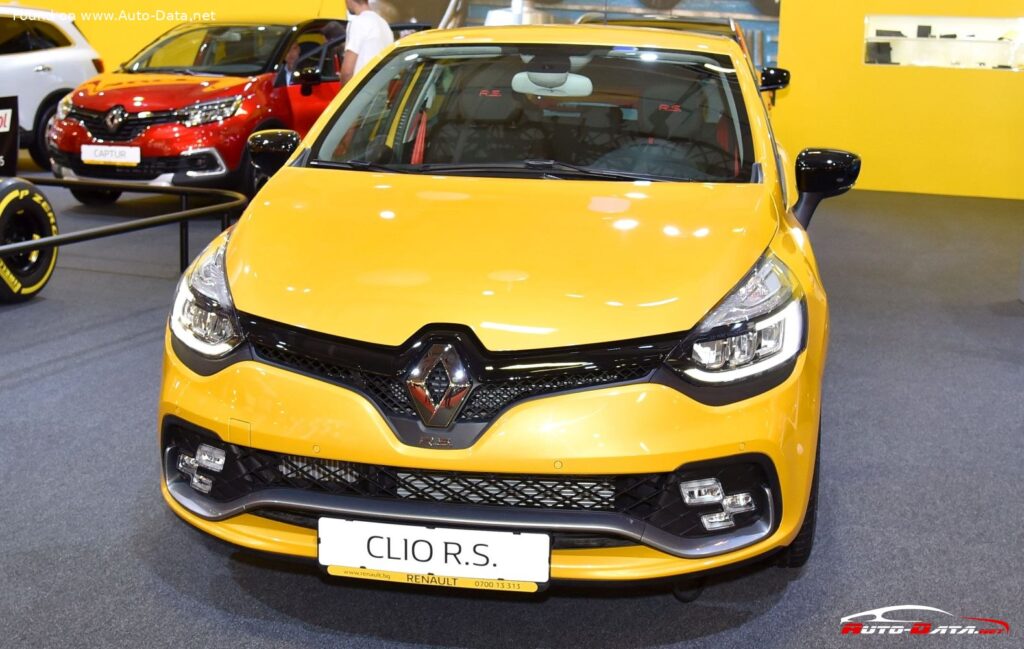
The Renault Clio IV (Phase II, 2016) retains the distinctive and acclaimed design language that made the fourth generation a visual standout. As a 5-door hatchback, it expertly blends the practicality of easy rear-seat access with the sporty silhouette often associated with a three-door model, thanks to its cleverly concealed rear door handles. The Phase II facelift introduced subtle enhancements, including a refreshed front grille, updated C-shaped LED daytime running lights (a signature element of modern Renaults), and revised rear light clusters, giving it a more contemporary and sophisticated appearance.
Dimensionally, the Clio IV is a compact vehicle perfectly suited for European urban environments. It measures 159.92 inches in length, 68.15 inches in width (76.57 inches including mirrors), and 57.01 inches in height. Its wheelbase of 101.93 inches contributes to a stable ride and good interior packaging for its class. The design ethos prioritizes a dynamic stance, with short overhangs (33.5 inches front, 24.49 inches rear) and a relatively low ride height of 4.72 inches, enhancing its road presence and handling characteristics.
Inside, the Renault Clio IV (Phase II, 2016) offers a practical and surprisingly spacious cabin for a subcompact. While the 1.2 16v (75 Hp) variant would typically be an entry-level trim, standard features would include a functional dashboard layout, comfortable seating for five, and a focus on essential amenities. Higher trims of the Phase II refresh could offer Renault’s R-Link Evolution infotainment system, providing navigation, connectivity, and media options, though this specific engine variant would likely feature a more basic audio system with Bluetooth connectivity. Material quality, while segment-appropriate, saw minor improvements in the Phase II, enhancing the perceived premium feel.
Safety features for the Renault Clio IV (Phase II, 2016) are robust for its class. The vehicle comes standard with an Anti-lock Braking System (ABS), and as a modern European car, it would also include Electronic Stability Control (ESC), multiple airbags, and other passive safety systems designed to meet rigorous European safety standards. The braking system consists of ventilated discs at the front and reliable drum brakes at the rear, providing adequate stopping power for its performance level. Steering is managed by a rack and pinion system, offering responsive and predictable handling. Various tire and wheel size options were available, ranging from 185/65 R15 to 205/45 R17, allowing for personalization and varying levels of grip and ride comfort.
Technical Specifications
| Feature | Specification |
|---|---|
| General Information | |
| Brand | Renault |
| Model | Clio |
| Generation | Clio IV (Phase II, 2016) |
| Type (Engine) | 1.2 16v (75 Hp) |
| Start of Production | 2016 year |
| End of Production | 2018 year |
| Powertrain Architecture | Internal Combustion engine |
| Body Type | Hatchback |
| Seats | 5 |
| Doors | 5 |
| Performance Specs | |
| Fuel consumption (economy) – urban | 7.2 l/100 km (32.7 US mpg) |
| Fuel consumption (economy) – extra urban | 4.7 l/100 km (50 US mpg) |
| Fuel consumption (economy) – combined | 5.6 l/100 km (42 US mpg) |
| CO2 emissions | 127 g/km |
| Fuel Type | Petrol (Gasoline) |
| Acceleration 0 – 60 mph | 13.8 sec |
| Acceleration 0 – 100 km/h | 14.5 sec |
| Maximum speed | 167 km/h (103.77 mph) |
| Emission standard | Euro 6 b |
| Weight-to-power ratio | 14.1 kg/Hp (70.8 Hp/tonne) |
| Weight-to-torque ratio | 9.9 kg/Nm (101 Nm/tonne) |
| Engine Specs | |
| Power | 75 Hp @ 5500 rpm |
| Power per liter | 65.3 Hp/l |
| Torque | 107 Nm @ 4250 rpm (78.92 lb.-ft. @ 4250 rpm) |
| Engine layout | Front, Transverse |
| Engine Model/Code | D4F 740 |
| Engine displacement | 1149 cm³ (1.1 liters / 70.12 cu. in.) |
| Number of cylinders | 4 |
| Engine configuration | Inline |
| Number of valves per cylinder | 4 |
| Fuel injection system | Multi-port manifold injection |
| Engine aspiration | Naturally aspirated engine |
| Engine oil capacity | 4 l (4.23 US qt) |
| Coolant | 5 l (5.28 US qt) |
| Space, Volume and Weights | |
| Kerb Weight | 1059-1066 kg (2334.7 – 2350.13 lbs) |
| Max. weight | 1564-1607 kg (3448.03 – 3542.83 lbs) |
| Max load | 505-541 kg (1113.33 – 1192.7 lbs) |
| Dimensions | |
| Length | 4062 mm (159.92 in) |
| Width | 1731 mm (68.15 in) |
| Width including mirrors | 1945 mm (76.57 in) |
| Height | 1448 mm (57.01 in) |
| Wheelbase | 2589 mm (101.93 in) |
| Front track | 1506 mm (59.29 in) |
| Rear (Back) track | 1506 mm (59.29 in) |
| Front overhang | 851 mm (33.5 in) |
| Rear overhang | 622 mm (24.49 in) |
| Ride height (ground clearance) | 120 mm (4.72 in) |
| Drivetrain, Brakes and Suspension Specs | |
| Drivetrain Architecture | The Internal combustion engine (ICE) drives the front wheels of the vehicle. |
| Drive wheel | Front wheel drive |
| Number of gears and type of gearbox | 5 gears, manual transmission |
| Front brakes | Ventilated discs |
| Rear brakes | Drum |
| Assisting systems | ABS (Anti-lock braking system) |
| Steering type | Steering rack and pinion |
| Tires size | 185/65 R15; 195/55 R16; 205/45 R17 |
| Wheel rims size | 15; 16; 17 |
Legacy and Market Impact in the European Landscape
The Renault Clio has, for decades, been a cornerstone of the European automotive market, consistently ranking among the continent’s best-selling vehicles. The Renault Clio IV (Phase II, 2016) continued this proud legacy, cementing its position as a formidable competitor in the highly contested B-segment. Its primary rivals included established stalwarts such as the Volkswagen Polo, Ford Fiesta, Peugeot 208, and Opel/Vauxhall Corsa. Against these competitors, the Clio often stood out with its more expressive styling, a characteristic that resonated strongly with European consumers looking for personality in their compact cars.
The 1.2 16v (75 Hp) variant played a crucial role in the Clio’s market strategy, serving as an attractive