The Renault Clio IV (Phase II, 2016) 1.5 dCi (75 Hp) S&S: A European Supermini Masterclass in Efficiency
The Renault Clio, a name synonymous with the European supermini segment, has long been a cornerstone of the French automaker’s global sales strategy. Introduced in 1990 as a successor to the iconic Renault 5, the Clio quickly established itself as a benchmark for style, practicality, and driving dynamics within its class. The fourth generation, the Clio IV, debuted in 2012, marking a significant departure in design language under the guidance of Laurens van den Acker. The specific model under review, the Renault Clio IV (Phase II, 2016) 1.5 dCi (75 Hp) S&S, represents the refreshed iteration of this successful generation, produced between 2016 and 2017. This facelift brought subtle exterior enhancements and technological upgrades, further solidifying its competitive edge in a fiercely contested market.
Primarily aimed at the European and other international markets where compact dimensions, fuel efficiency, and low running costs are paramount, the Clio IV was never officially sold in the United States. Its appeal lies in its ability to offer a compelling package for urban dwellers and those seeking an economical daily driver. This particular variant, powered by a 1.5-liter dCi diesel engine, exemplifies the European preference for diesel powertrains in smaller vehicles, a trend driven by favorable fuel pricing and taxation structures that prioritize low CO2 emissions.
Engine & Performance: The Efficient Heart of the Renault Clio IV (Phase II, 2016)
At the core of the Renault Clio IV (Phase II, 2016) 1.5 dCi (75 Hp) S&S lies the renowned K9K 628 diesel engine. This 1.5-liter (1461 cm3, or 89.16 cu. in.) inline four-cylinder unit is a testament to Renault’s expertise in developing highly efficient and durable small-displacement diesel powertrains. Equipped with a turbocharger and intercooler, along with a common rail fuel injection system, it delivers a modest but highly usable 75 horsepower at 4000 rpm. More significantly for its intended purpose, it generates a robust 147.51 lb.-ft. (200 Nm) of torque from a low 1750 rpm.
This torque characteristic is crucial for the Clio’s urban performance, providing ample pulling power for navigating city traffic and making it feel more responsive than its horsepower figure might suggest. Paired with a 5-speed manual transmission, the powertrain is optimized for fuel economy rather than outright speed. The acceleration from 0 to 60 mph is achieved in a respectable 13.6 seconds, with a top speed of 104.39 mph (168 km/h). These figures, while not exhilarating, are perfectly adequate for the Clio’s role as an economical commuter.
A key feature of this variant is the “S&S” designation, indicating the inclusion of a Start & Stop system. This technology automatically shuts off the engine when the vehicle is stationary (e.g., at a traffic light) and restarts it seamlessly when the driver presses the clutch, significantly reducing fuel consumption and CO2 emissions in stop-and-go conditions. Coupled with a particulate filter, the engine adheres to the stringent Euro 6b emission standard, underscoring its commitment to environmental responsibility. The combined fuel economy is an impressive 71.3 US mpg (3.3 l/100 km), with CO2 emissions of just 85 g/km, making it an exceptionally frugal choice in its segment.
Design & Features: Style Meets Practicality
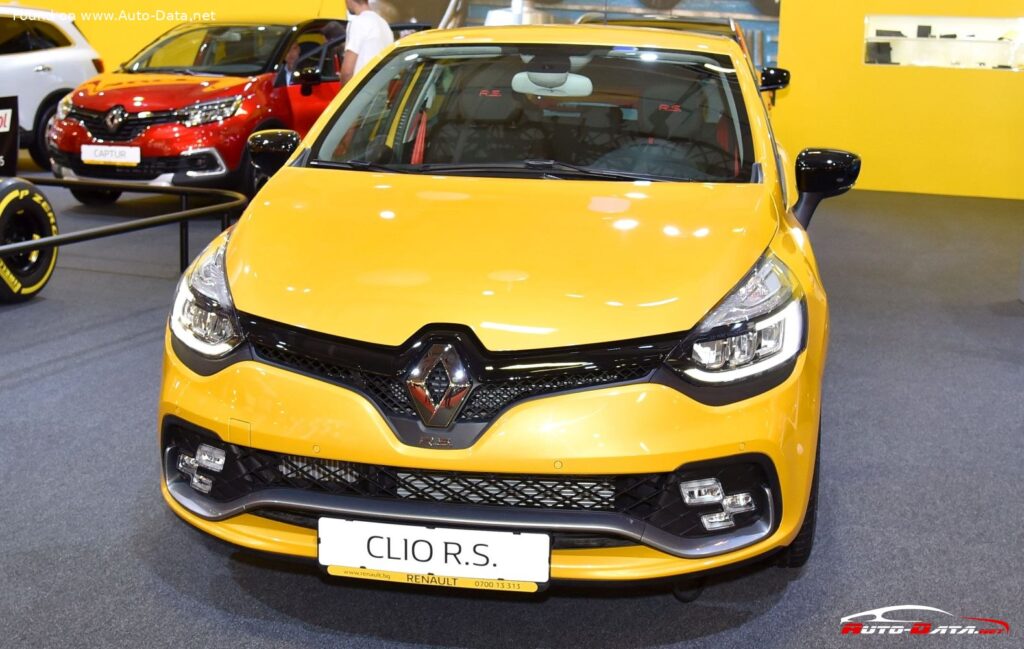
The Renault Clio IV, and especially its Phase II iteration, is celebrated for its distinctive and modern design. Breaking away from the more conservative styling of its predecessors, the Clio IV adopted a more curvaceous and dynamic aesthetic. The Phase II facelift refined this look with subtle updates to the grille, headlights (often incorporating LED daytime running lights), and taillights, giving it a fresh and contemporary appearance. Its hatchback body type, with five doors and seating for five, offers practical versatility for small families or individuals needing flexible cargo space.
Measuring 159.92 inches (4062 mm) in length, 68.15 inches (1731 mm) in width (76.57 inches or 1945 mm including mirrors), and 57.01 inches (1448 mm) in height, the Clio IV is a compact vehicle perfectly suited for navigating narrow European streets and tight parking spaces. Despite its small footprint, the 101.93-inch (2589 mm) wheelbase ensures a surprisingly spacious cabin for its class. The kerb weight ranges from 2403.04 to 2605.86 lbs (1090-1182 kg), contributing to its nimble handling and efficiency.
In terms of features, while detailed interior specifications are not provided, vehicles of this era and segment typically include essential safety and convenience technologies. The presence of ABS (Anti-lock Braking System) is standard, providing crucial stopping power. The front brakes are ventilated discs, while the rear utilizes drums, a common and cost-effective setup for a vehicle of this size and performance level. Steering is handled by a responsive rack and pinion system. Depending on the trim level, the Clio IV could be equipped with various tire and wheel sizes, ranging from 185/65 R15 up to 205/45 R17, allowing for different levels of grip and aesthetic appeal.
Technical Specifications
| Category | Specification |
|---|---|
| General Information | |
| Brand | Renault |
| Model | Clio |
| Generation | Clio IV (Phase II, 2016) |
| Type (Engine) | 1.5 dCi (75 Hp) S&S |
| Start of Production | 2016 year |
| End of Production | 2017 year |
| Powertrain Architecture | Internal Combustion engine |
| Body Type | Hatchback |
| Seats | 5 |
| Doors | 5 |
| Performance Specs | |
| Fuel Consumption (Urban) | 3.5 l/100 km (67.2 US mpg) |
| Fuel Consumption (Extra Urban) | 3.1 l/100 km (75.9 US mpg) |
| Fuel Consumption (Combined) | 3.3 l/100 km (71.3 US mpg) |
| CO2 Emissions | 85 g/km |
| Fuel Type | Diesel |
| Acceleration 0 – 62 mph (0-100 km/h) | 14.3 sec |
| Acceleration 0 – 60 mph (Calculated) | 13.6 sec |
| Maximum Speed | 104.39 mph (168 km/h) |
| Emission Standard | Euro 6b |
| Weight-to-Power Ratio | 14.5 kg/Hp (68.8 Hp/tonne) |
| Weight-to-Torque Ratio | 5.5 kg/Nm (183.5 Nm/tonne) |
| Engine Specs | |
| Power | 75 Hp @ 4000 rpm |
| Power per liter | 51.3 Hp/l |
| Torque | 147.51 lb.-ft. (200 Nm) @ 1750 rpm |
| Engine Layout | Front, Transverse |
| Engine Model/Code | K9K 628 |
| Engine Displacement | 1461 cm3 (89.16 cu. in.) |
| Number of Cylinders | 4 |
| Engine Configuration | Inline |
| Number of Valves per Cylinder | 2 |
| Fuel Injection System | Diesel Commonrail |
| Engine Aspiration | Turbocharger, Intercooler |
| Engine Oil Capacity | 4.5 l (4.76 US qt) |
| Coolant Capacity | 5 l (5.28 US qt) |
| Engine Systems | Start & Stop System, Particulate Filter |
| Space, Volume and Weights | |
| Kerb Weight | 2403.04 – 2605.86 lbs (1090-1182 kg) |
| Max. Weight | 3736.84 – 3752.27 lbs (1695-1702 kg) |
| Max Load | 1146.4 – 1333.8 lbs (520-605 kg) |
| Dimensions | |
| Length | 159.92 in. (4062 mm) |
| Width | 68.15 in. (1731 mm) |
| Width Including Mirrors | 76.57 in. (1945 mm) |
| Height | 57.01 in. (1448 mm) |
| Wheelbase | 101.93 in. (2589 mm) |
| Front Track | 59.29 in. (1506 mm) |
| Rear Track | 59.29 in. (1506 mm) |
| Front Overhang | 33.5 in. (851 mm) |
| Rear Overhang | 24.49 in. (622 mm) |
| Ride Height (Ground Clearance) | 4.72 in. (120 mm) |
| Drivetrain, Brakes and Suspension Specs | |
| Drivetrain Architecture | Front-wheel drive, Internal Combustion Engine |
| Drive Wheel | Front wheel drive |
| Number of Gears and Type of Gearbox | 5 gears, manual transmission |
| Front Brakes | Ventilated discs |
| Rear Brakes | Drum |
| Assisting Systems | ABS (Anti-lock braking system) |
| Steering Type | Steering rack and pinion |
| Tire Sizes | 185/65 R15; 195/55 R16; 205/45 R17 |
| Wheel Rims Size | 15; 16; 17 |
Legacy & Market Impact: The Enduring Appeal of the Renault Clio IV
The Renault Clio has consistently been one of Europe’s best-selling cars, frequently topping sales charts in France and ranking highly across the continent. The Clio IV, and particularly its Phase II update, continued this formidable legacy. In its primary markets, the Renault Clio IV (Phase II, 2016) 1.5 dCi (75 Hp) S&S was a significant player, competing directly with stalwarts like the Volkswagen Polo, Ford Fiesta, Peugeot 208, and Opel Corsa. What set the Clio apart was its blend of striking design, practical interior packaging, and a strong emphasis on efficiency, particularly with its dCi diesel engines.
The 1.5 dCi engine, in various states of tune, was a cornerstone of the Clio’s appeal. Its reputation for excellent fuel economy and robust reliability made it a favorite among fleet buyers, private owners, and those conscious of running costs. In regions where diesel fuel was historically cheaper and diesel cars benefited from lower taxation due to their lower CO2 emissions, this particular variant offered a compelling economic proposition. While diesel powertrains have faced increasing scrutiny and declining popularity in recent years, during its production run, this Clio model represented a highly rational and popular choice.
The Clio IV’s impact extended beyond just sales figures. Its bold design language influenced subsequent Renault models and helped redefine what a subcompact car could look like. It demonstrated that a small, economical car didn’t have to be bland or utilitarian. Its success contributed to Renault’s strong brand image in Europe as a provider of stylish, innovative, and practical vehicles. Although never reaching American shores, the Clio IV (Phase II, 2016) 1.5 dCi (75 Hp) S&S remains a prime example of a vehicle perfectly tailored to the specific demands and preferences of its global market, showcasing a balanced approach to design, performance, and environmental responsibility within its segment.