The Renault Clio Symbol 1.4 (75 Hp): A Practical Sedan for Global Markets
The Renault Clio Symbol 1.4 (75 Hp) represents an interesting chapter in the French automaker’s strategy to cater to diverse global markets. Launched in 1999 and produced until 2002, this subcompact sedan was essentially a three-box derivative of the highly successful second-generation Renault Clio hatchback. While the Clio hatchback was a staple in Western European markets, the Clio Symbol, often known as the Thalia in some regions, was specifically designed and marketed for countries where sedans were traditionally preferred over hatchbacks, particularly in Eastern Europe, Turkey, North Africa, and Latin America. It offered a compelling blend of affordability, robust engineering, and significantly enhanced trunk capacity, making it a popular choice for families and fleet operators seeking a practical and economical vehicle.
During its production run, the Clio Symbol carved out a niche for itself as a reliable and cost-effective personal transport solution. It leveraged the proven platform and mechanicals of the Clio B (Clio II), ensuring a familiar and dependable driving experience. The 1.4-liter engine, while not designed for blistering performance, provided adequate power for daily commuting and long-distance travel, emphasizing fuel efficiency and low running costs. This strategic model allowed Renault to expand its footprint in emerging economies by offering a tailored product that met local preferences and economic realities, solidifying its reputation as a global player.
Engineering and Performance of the Renault Clio Symbol 1.4 (75 Hp)
Powertrain Configuration
At the heart of the Renault Clio Symbol 1.4 (75 Hp) was a dependable 1.4-liter (1390 cubic centimeters, or 84.82 cubic inches) inline-four gasoline engine, internally designated as the E7J. This powerplant was a familiar unit within Renault’s lineup, known for its simplicity and robustness. It featured a naturally aspirated configuration with a multi-port manifold injection fuel system and an Overhead Camshaft (OHC) valvetrain with two valves per cylinder. This design prioritized reliability and ease of maintenance over cutting-edge technology, aligning perfectly with the vehicle’s market positioning.
The engine produced a modest but entirely adequate 75 horsepower at 5800 rpm, with a peak torque of 84.08 lb.-ft. (114 Nm) delivered at 4250 rpm. Power was sent to the front wheels via a five-speed manual transmission, a common and efficient setup for a vehicle in this segment. This drivetrain architecture, with the engine mounted transversely at the front, was optimized for space efficiency and cost-effectiveness, contributing to the Clio Symbol’s overall practicality.
Driving Dynamics and Fuel Economy
In terms of performance, the Clio Symbol 1.4 (75 Hp) was designed for practicality rather than outright speed. It could accelerate from 0 to 60 mph in a respectable 11.9 seconds, with a top speed of 105.63 mph (170 km/h). These figures positioned it as a capable performer for urban environments and highway cruising, without being overly demanding on the engine.
Fuel efficiency was a significant strong suit for this model, a crucial factor for its target markets. The combined fuel economy was rated at 33.6 US mpg (7 liters per 100 km). In city driving, it achieved 24.2 US mpg (9.7 liters per 100 km), while on extra-urban cycles, it could deliver an impressive 41.3 US mpg (5.7 liters per 100 km). These economy figures underscored its appeal as an economical daily driver, offering low running costs for its owners. The vehicle also featured a 13.21 US gallon (50 liter) fuel tank, providing a decent range between fill-ups.
Design, Features, and Practicality
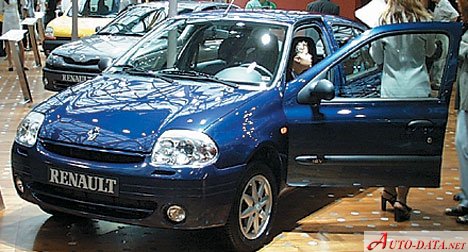
The design of the Renault Clio Symbol was a straightforward adaptation of the Clio II hatchback. The most significant alteration was the addition of a conventional trunk, transforming the compact hatchback into a four-door sedan. This body style was crucial for its success in markets where sedans were perceived as more prestigious and practical for family use, offering a secure and separate cargo area.
Measuring 163.39 inches (4150 mm) in length, 64.53 inches (1639 mm) in width, and 55.75 inches (1416 mm) in height, with a wheelbase of 97.32 inches (2472 mm), the Clio Symbol remained a compact vehicle, making it agile in city traffic and easy to park. Despite its compact footprint, the interior was designed to comfortably accommodate five occupants, thanks to clever packaging. The most compelling feature, however, was its generous trunk space, offering a minimum of 18.01 cubic feet (510 liters) of cargo volume. This was a substantial amount for a car of its class and a major selling point, often exceeding the capacity of larger, more expensive sedans.
Underneath, the Clio Symbol utilized a conventional suspension setup, featuring coil springs both at the front and rear, providing a comfortable and compliant ride well-suited for varying road conditions. Braking duties were handled by disc brakes at the front and drum brakes at the rear, a standard configuration for economy cars of its era. For enhanced safety, the vehicle was equipped with an Anti-lock Braking System (ABS), a significant feature for a subcompact in the late 1990s. Steering was managed by a hydraulic rack and pinion system, offering direct feedback and ease of maneuverability. The car typically rode on 13- or 14-inch wheels, fitted with 175/70 R13 or 175/65 R14 tires, respectively, balancing ride comfort with handling characteristics.
Technical Specifications: Renault Clio Symbol 1.4 (75 Hp)
| Category | Specification |
|---|---|
| Brand | Renault |
| Model | Clio Symbol |
| Generation | Clio Symbol (Derived from Clio II) |
| Engine Type | 1.4 (75 Hp) |
| Production Start | 1999 |
| Production End | 2002 |
| Body Type | Sedan |
| Doors | 4 |
| Seats | 5 |
| Performance | |
| Fuel Type | Petrol (Gasoline) |
| Fuel Consumption (Urban) | 24.2 US mpg (9.7 l/100 km) |
| Fuel Consumption (Extra Urban) | 41.3 US mpg (5.7 l/100 km) |
| Fuel Consumption (Combined) | 33.6 US mpg (7 l/100 km) |
| Acceleration 0-60 mph | 11.9 seconds |
| Maximum Speed | 105.63 mph (170 km/h) |
| Weight-to-Power Ratio | 12.5 kg/Hp, 79.8 Hp/tonne |
| Engine Specifications | |
| Power | 75 Hp @ 5800 rpm |
| Torque | 84.08 lb.-ft. (114 Nm) @ 4250 rpm |
| Engine Layout | Front, Transverse |
| Engine Model/Code | E7J |
| Engine Displacement | 1.4 liters (1390 cm³, 84.82 cu. in.) |
| Number of Cylinders | 4 |
| Engine Configuration | Inline |
| Cylinder Bore | 3.13 in. (79.5 mm) |
| Piston Stroke | 2.76 in. (70 mm) |
| Compression Ratio | 9.5:1 |
| Valves per Cylinder | 2 |
| Fuel Injection System | Multi-port manifold injection |
| Engine Aspiration | Naturally aspirated |
| Valvetrain | OHC |
| Engine Oil Capacity | 3.06 US qt (2.9 l) |
| Coolant Capacity | 5.81 US qt (5.5 l) |
| Dimensions & Weights | |
| Kerb Weight | 2072.35 lbs (940 kg) |
| Maximum Weight | 3141.59 lbs (1425 kg) |
| Maximum Load | 1069.24 lbs (485 kg) |
| Trunk Space (Minimum) | 18.01 cu. ft. (510 l) |
| Fuel Tank Capacity | 13.21 US gal (50 l) |
| Length | 163.39 in. (4150 mm) |
| Width | 64.53 in. (1639 mm) |
| Height | 55.75 in. (1416 mm) |
| Wheelbase | 97.32 in. (2472 mm) |
| Front Track | 55.35 in. (1406 mm) |
| Rear Track | 54.57 in. (1386 mm) |
| Drivetrain, Brakes & Suspension | |
| Drivetrain Architecture | Front-wheel drive, Internal Combustion Engine |
| Drive Wheel | Front-wheel drive |
| Gearbox | 5-speed manual transmission |
| Front Suspension | Coil spring |
| Rear Suspension | Coil spring |
| Front Brakes | Disc |
| Rear Brakes | Drum |
| Assisting Systems | ABS (Anti-lock braking system) |
| Steering Type | Steering rack and pinion |
| Power Steering | Hydraulic Steering |
| Tire Size | 175/70 R13; 175/65 R14 |
| Wheel Rim Size | 13; 14 |
Legacy and Market Impact of the Renault Clio Symbol
The Renault Clio Symbol, particularly the 1.4 (75 Hp) variant, played a significant role in Renault’s global strategy during the late 1990s and early 2000s. While not sold in the United States, its impact in its primary markets was substantial. It was a clear example of a “glocal” product – a global platform adapted to local preferences. In regions like Turkey, Eastern Europe, North Africa, and parts of Latin America, where sedans were culturally preferred and often represented a step up from hatchbacks, the Clio Symbol offered an attractive proposition.
Its main competitors varied by market but generally included other subcompact sedans tailored for similar segments, such as the Fiat Albea/Palio Weekend, Peugeot 206 Sedan, and later, the Skoda Fabia Sedan. What set the Clio Symbol apart was its combination of proven Renault engineering, a comfortable ride, and crucially, its class-leading trunk capacity. This practical aspect made it highly appealing to families and small businesses that needed ample cargo space without the expense or footprint of a larger vehicle.
The Clio Symbol’s reputation was built on reliability, low running costs, and good value for money. It was often praised for its robust suspension, which handled challenging road conditions common in its target markets with ease. The 1.4-liter engine, while not powerful, was economical and durable, contributing to its overall cost-effectiveness. The inclusion of features like ABS, even in an economy car of its time, further enhanced its appeal by offering a tangible safety benefit.
Ultimately, the Clio Symbol paved the way for future Renault models designed specifically for emerging markets, demonstrating the success of adapting existing platforms to meet specific regional demands. It allowed Renault to establish a strong presence and brand loyalty in these crucial growth regions, making it a truly impactful model in the company’s international portfolio. Its legacy lives on in the continued evolution of Renault’s strategy to offer market-specific vehicles that blend affordability, practicality, and the core engineering strengths of the Renault brand.