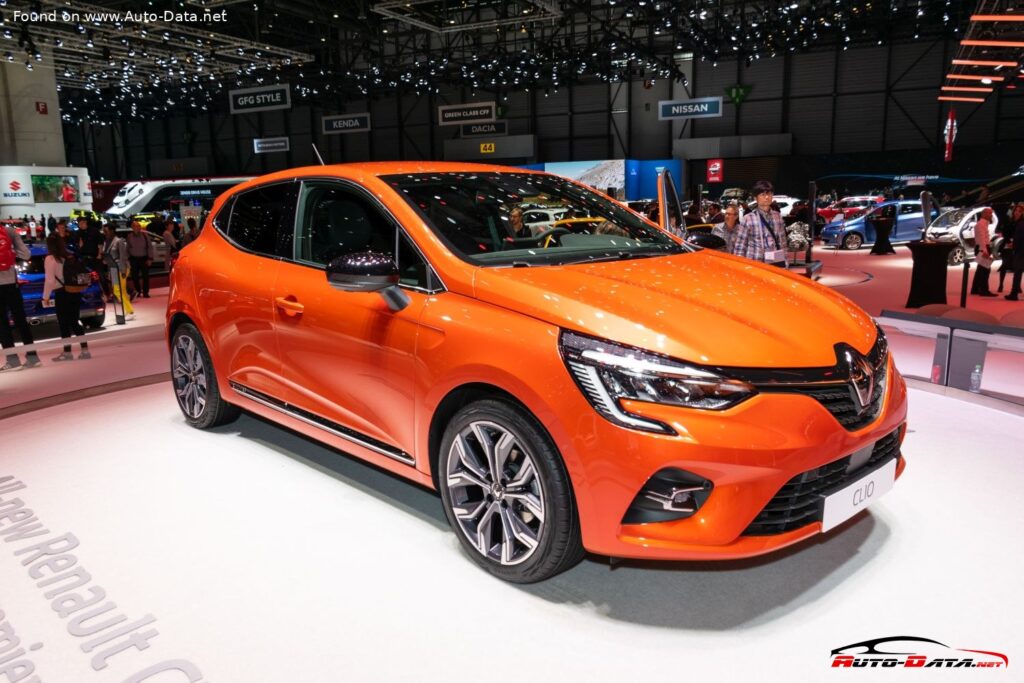
The Renault Clio V (Phase I) 1.3 TCe (130 Hp) EDC: A European Subcompact Powerhouse
The Renault Clio V (Phase I) 1.3 TCe (130 Hp) EDC represents a crucial iteration in the storied history of Renault’s highly successful subcompact hatchback. Launched in June 2019 as the fifth generation of the Clio, this particular variant, produced until December 2020, quickly established itself as a benchmark in the highly competitive European B-segment. Revered for its stylish design, advanced technology, and efficient powertrains, the Clio V continued the model’s legacy as one of Europe’s best-selling cars. While never officially sold in the United States, the Clio’s influence on global automotive design and its role as a volume leader in markets like France, Germany, and the UK cannot be overstated. This specific model, equipped with the potent 1.3 TCe (Turbo Control efficiency) engine and an automatic EDC (Efficient Dual Clutch) transmission, offered a compelling blend of performance and fuel economy, appealing to a broad spectrum of urban and highway drivers across the continent.
Engine and Performance: Powering the Renault Clio V (Phase I) 1.3 TCe (130 Hp) EDC
At the heart of this particular Renault Clio V (Phase I) 1.3 TCe (130 Hp) EDC model lies a sophisticated 1.3-liter (1330 cm3 or 81.16 cubic inches) turbocharged inline-four gasoline engine. Codenamed H5H 470, this powerplant is a product of a collaborative effort between Renault and Daimler, signifying a commitment to advanced engineering and efficiency. The engine features direct fuel injection and an intercooler-equipped turbocharger, optimizing air intake and combustion for both power and fuel efficiency. It delivers a robust 130 horsepower (Hp), equating to an impressive 97.7 Hp per liter, a strong figure for a compact engine. Torque output stands at a substantial 240 Nm (177.01 lb.-ft.), available at relatively low RPMs, ensuring responsive acceleration and effortless highway cruising.
Power is channeled to the front wheels via a smooth and efficient 7-speed automatic EDC (Efficient Dual Clutch) transmission. This dual-clutch system provides rapid gear changes, contributing to a sporty feel while maintaining excellent fuel economy. The Clio V 1.3 TCe (130 Hp) EDC accelerates from 0 to 60 mph in a brisk 8.6 seconds (0-100 km/h in 9 seconds), demonstrating its capability to handle various driving conditions with confidence. Its maximum speed is rated at 124.27 mph (200 km/h), making it perfectly suitable for sustained high-speed travel on European autobahns.
Fuel efficiency is a strong suit for this model, reflecting its modern design and advanced powertrain. According to WLTP (Worldwide Harmonized Light Vehicles Test Procedure) standards, the combined fuel consumption is 5.7 liters per 100 kilometers, which translates to an impressive 41.3 US miles per gallon. Under the NEDC (New European Driving Cycle) standard, urban consumption is 35.1 US mpg, extra-urban is 54.7 US mpg, and combined is 45.2 US mpg. These figures, coupled with CO2 emissions of 129-130 g/km (WLTP) and 119 g/km (NEDC), ensure the Clio V meets stringent Euro 6 d-TEMP emission standards, highlighting its environmental consciousness.
Design and Features: Modern Aesthetics and Practicality
The Renault Clio V (Phase I) 1.3 TCe (130 Hp) EDC is characterized by its contemporary and dynamic design, building upon the success of its predecessors while introducing a more refined and muscular aesthetic. As a 5-door hatchback, it offers a practical and versatile body style, ideal for city driving and family use. Measuring 159.45 inches in length, 70.79 inches in width (mirrors folded), and 56.69 inches in height, the Clio V maintains compact dimensions that facilitate maneuverability in congested urban environments, while a wheelbase of 101.69 inches ensures a stable ride.
Inside, the Clio V boasts a significantly upgraded cabin compared to previous generations, focusing on perceived quality, ergonomics, and technology. While specific interior features are not detailed in the raw data, as a modern car of its era, it typically included a sophisticated infotainment system, often featuring a large touchscreen display, digital instrument cluster, and connectivity options like Apple CarPlay and Android Auto. The 5-seat configuration provides comfortable seating for occupants, and the generous trunk space, ranging from 13.81 cubic feet (391 liters) with the rear seats up to 37.75 cubic feet (1069 liters) with them folded, offers ample cargo capacity for daily errands or longer trips.
In terms of safety, the Clio V incorporates a robust structural design and essential active safety features. The data explicitly lists ABS (Anti-lock Braking System) as an assisting system, which is standard. Modern vehicles in this segment also typically include multiple airbags, electronic stability control (ESC), and often advanced driver-assistance systems (ADAS) like lane-keeping assist and automatic emergency braking, further enhancing occupant protection. The braking system comprises ventilated discs at the front (280×24 mm) and solid discs at the rear (260×8 mm), providing confident stopping power. The suspension setup features an independent McPherson strut system at the front and a semi-independent elastic beam with coil springs at the rear, striking a balance between ride comfort and agile handling. Electric power steering ensures light and precise control, particularly at lower speeds.
Technical Specifications
| Category | Specification |
|---|---|
| Brand | Renault |
| Model | Clio |
| Generation | Clio V (Phase I) |
| Type (Engine) | 1.3 TCe (130 Hp) EDC |
| Start of Production | June, 2019 |
| End of Production | December, 2020 |
| Powertrain Architecture | Internal Combustion engine |
| Body type | Hatchback |
| Seats | 5 |
| Doors | 5 |
| Combined fuel consumption (WLTP) | 5.7 l/100 km (41.3 US mpg) |
| CO2 emissions (WLTP) | 129-130 g/km |
| Fuel consumption (economy) – urban (NEDC) | 6.7 l/100 km (35.1 US mpg) |
| Fuel consumption (economy) – extra urban (NEDC) | 4.3 l/100 km (54.7 US mpg) |
| Fuel consumption (economy) – combined (NEDC) | 5.2 l/100 km (45.2 US mpg) |
| CO2 emissions (NEDC) | 119 g/km |
| Fuel Type | Petrol (Gasoline) |
| Acceleration 0 – 60 mph | 8.6 sec |
| Acceleration 0 – 100 km/h | 9 sec |
| Maximum speed | 200 km/h (124.27 mph) |
| Emission standard | Euro 6 d-TEMP |
| Weight-to-power ratio | 9.6 kg/Hp (104.2 Hp/tonne) |
| Weight-to-torque ratio | 5.2 kg/Nm (192.3 Nm/tonne) |
| Power | 130 Hp |
| Power per liter | 97.7 Hp/l |
| Torque | 240 Nm (177.01 lb.-ft.) |
| Engine layout | Front, Transverse |
| Engine Model/Code | H5H 470 |
| Engine displacement | 1330 cm3 (81.16 cu. in.) |
| Number of cylinders | 4 |
| Engine configuration | Inline |
| Cylinder Bore | 72.2 mm (2.84 in.) |
| Piston Stroke | 81.2 mm (3.2 in.) |
| Number of valves per cylinder | 4 |
| Fuel injection system | Direct injection |
| Engine aspiration | Turbocharger, Intercooler |
| Engine oil capacity | 5.4 l (5.71 US qt) |
| Engine oil specification | Log in to see. |
| Coolant | 7.5 l (7.93 US qt) |
| Kerb Weight | 1248 kg (2751.37 lbs.) |
| Max. weight | 1673 kg (3688.33 lbs.) |
| Max load | 425 kg (936.96 lbs.) |
| Trunk (boot) space – minimum | 391 l (13.81 cu. ft.) |
| Trunk (boot) space – maximum | 1069 l (37.75 cu. ft.) |
| Fuel tank capacity | 42 l (11.1 US gal) |
| Permitted trailer load with brakes (12%) | 900 kg (1984.16 lbs.) |
| Permitted trailer load without brakes | 615 kg (1355.84 lbs.) |
| Length | 4050 mm (159.45 in.) |
| Width with mirrors folded | 1798 mm (70.79 in.) |
| Width including mirrors | 1988 mm (78.27 in.) |
| Height | 1440 mm (56.69 in.) |
| Wheelbase | 2583 mm (101.69 in.) |
| Front overhang | 830 mm (32.68 in.) |
| Rear overhang | 637 mm (25.08 in.) |
| Ride height (ground clearance) | 120 mm (4.72 in.) |
| Minimum turning circle (turning diameter) | 10.42 m (34.19 ft.) |
| Drivetrain Architecture | Front wheel drive, Internal Combustion engine |
| Drive wheel | Front wheel drive |
| Number of gears and type of gearbox | 7 gears, automatic transmission EDC |
| Front suspension | Independent type McPherson |
| Rear suspension | Semi-independent, coil spring, Elastic beam |
| Front brakes | Ventilated discs, 280×24 mm |
| Rear brakes | Disc, 260×8 mm |
| Assisting systems | ABS (Anti-lock braking system) |
| Steering type | Steering rack and pinion |
| Power steering | Electric Steering |
| Tires size | 205/45 R17 88H |
| Wheel rims size | 17 inches |
Legacy and Market Impact
The Renault Clio has, for decades, been a cornerstone of the European automotive landscape, consistently ranking among the continent’s best-selling cars. The Clio V (Phase I) 1.3 TCe (130 Hp) EDC continued this proud tradition, cementing its reputation as a highly desirable and competitive option in the supermini segment. Its launch was met with critical acclaim, with reviewers praising its improved interior quality, enhanced driving dynamics, and sophisticated technology.
In its primary markets, the Clio V faced fierce competition from established rivals such as the Volkswagen Polo, Peugeot 208, Ford Fiesta, Opel Corsa, and Toyota Yaris. Despite this formidable lineup, the Clio managed to carve out a significant market share, often vying for the top spot in sales charts. Its success can be attributed to a compelling combination of factors: a stylish and modern design that appealed to a wide audience, a comfortable and technologically advanced cabin, and a range of efficient and peppy powertrains, exemplified by the 1.3 TCe (130 Hp) EDC variant.
The 1.3 TCe engine, in particular, was a strategic move for Renault, offering a blend of performance typically found in larger engines with the fuel economy of a smaller displacement unit. This made the Clio V (Phase I) 1.3 TCe (130 Hp) EDC an attractive proposition for drivers seeking a spirited driving experience without compromising on running costs. The smooth and responsive EDC transmission further enhanced its appeal, especially in urban environments where automatic transmissions are increasingly preferred.
Historically, the Clio has been instrumental in shaping Renault’s brand image, showcasing its ability to produce high-quality, innovative, and mass-market vehicles. The fifth generation, and this specific 1.3 TCe variant, played a crucial role in maintaining this legacy, demonstrating Renault’s commitment to staying at the forefront of automotive design and engineering in the compact car segment. Its continued popularity underscores its significance not just as a successful product, but as a cultural icon in many European countries, representing accessible style, practicality, and driving enjoyment. The Clio V (Phase I) remains a testament to Renault’s enduring expertise in creating vehicles that resonate deeply with the needs and desires of the modern European consumer.