The Renault Clio V (Phase I) 1.5 Blue dCi (115 Hp): Europe’s Compact Diesel Champion
The Renault Clio, a cornerstone of the European B-segment (subcompact car class), entered its fifth generation in 2019, continuing a legacy of success that began in 1990. The particular variant under scrutiny, the Renault Clio V (Phase I) 1.5 Blue dCi (115 Hp), represents a crucial offering in its initial production phase from June 2019 to December 2020. As a five-door hatchback, this model was designed to appeal to a broad European audience seeking a blend of practicality, modern aesthetics, and, notably, exceptional fuel efficiency—a characteristic particularly valued in markets where diesel powertrains still held significant sway for their long-distance economy. While the Renault Clio has never been officially sold in the United States market, its impact and design philosophy are highly relevant to understanding global automotive trends, especially in the competitive European landscape. This expert analysis will delve into the engineering, performance, design, and market positioning of this significant European compact.
Engine & Performance: The Efficient Heart of the Clio V (Phase I) 1.5 Blue dCi (115 Hp)
At the core of the Renault Clio V (Phase I) 1.5 Blue dCi (115 Hp) lies a highly optimized 1.5-liter (1461 cm3 or 89.16 cu. in.) Blue dCi turbodiesel engine, identified by the engine code K9K 872. This inline-four cylinder unit, transversely mounted at the front, is a testament to Renault’s long-standing expertise in diesel engine development. It produces a robust 115 horsepower at 3750 rpm, delivering a power-to-liter ratio of 78.7 Hp/l, which is commendable for a diesel of its displacement. More significantly, it generates a substantial 191.77 lb.-ft. (260 Nm) of torque at a low 2000 rpm, providing excellent mid-range acceleration and responsiveness, ideal for both urban maneuvering and highway cruising.
Power is channeled to the front wheels via a slick-shifting 6-speed manual transmission, a popular choice in European markets for its engaging driving experience and efficiency benefits. This powertrain setup enables the Clio to accelerate from 0 to 60 mph in a swift 9.4 seconds (0-100 km/h in 9.9 seconds) and reach a top speed of 122.41 mph (197 km/h). These figures position the Blue dCi 115 Hp as a spirited performer within its segment, offering a compelling balance of performance and economy.
Fuel efficiency is a major highlight of this particular Clio variant. Under the WLTP cycle, it achieves a combined fuel consumption of 56 US mpg (4.2 l/100 km), with NEDC figures being even more impressive: 54.7 US mpg urban (4.3 l/100 km), 73.5 US mpg extra urban (3.2 l/100 km), and 65.3 US mpg combined (3.6 l/100 km). These figures underscore the diesel engine’s inherent efficiency, making it a cost-effective choice for drivers covering significant mileage. Furthermore, the engine meets the stringent Euro 6 d-TEMP emission standard, with CO2 emissions rated at 110 g/km (WLTP) and 95 g/km (NEDC), thanks to advanced emission control systems including a particulate filter and AdBlue injection (with an 11.6-liter or 3.06 US gal tank).
Design & Features: Modernity and Practicality
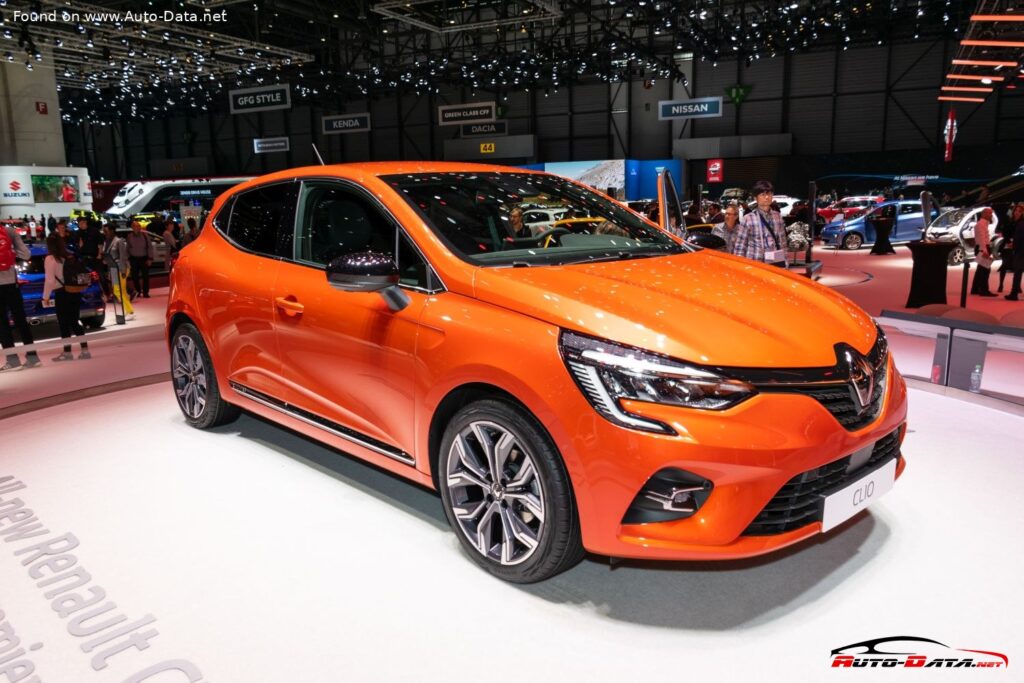
The Clio V (Phase I) builds upon Renault’s contemporary design language, presenting a more mature and athletic stance than its predecessors. With a length of 159.45 inches (4050 mm), a width of 70.79 inches (1798 mm) (78.27 inches or 1988 mm including mirrors), and a height of 56.69 inches (1440 mm), the Clio maintains its compact footprint while maximizing interior space. The 101.69-inch (2583 mm) wheelbase contributes to stable handling and a comfortable ride, while the minimum turning circle of 34.19 feet (10.42 meters) ensures excellent maneuverability in tight urban environments.
As a five-door, five-seat hatchback, practicality is paramount. The Clio V offers a generous trunk space of 13.81 cu. ft. (391 liters) with the rear seats up, expanding to a substantial 37.75 cu. ft. (1069 liters) when folded down. This cargo flexibility makes it suitable for a range of uses, from daily commuting to weekend getaways. The kerb weight of 2621.3 lbs (1189 kg) contributes to its agile handling and further aids in fuel efficiency.
Underneath, the Clio features a robust chassis with an independent McPherson-type front suspension and a semi-independent, coil spring, elastic beam rear suspension, a common and effective setup for compact cars balancing comfort and dynamic stability. Stopping power is provided by ventilated disc brakes (280 mm) at the front and solid discs (260 mm) at the rear, augmented by an Anti-lock Braking System (ABS) for enhanced safety. Electric power steering, a rack and pinion system, offers light and precise control, making parking and low-speed maneuvers effortless. The vehicle rides on 195/55 R16 87H tires mounted on 16-inch wheel rims, providing a good balance of grip and ride comfort.
Technical Specifications: Renault Clio V (Phase I) 1.5 Blue dCi (115 Hp)
| Category | Specification |
|---|---|
| Brand | Renault |
| Model | Clio |
| Generation | Clio V (Phase I) |
| Type (Engine) | 1.5 Blue dCi (115 Hp) |
| Start of Production | June, 2019 |
| End of Production | December, 2020 |
| Powertrain Architecture | Internal Combustion Engine (ICE) |
| Body Type | Hatchback |
| Seats | 5 |
| Doors | 5 |
| Performance Specs | |
| Combined Fuel Consumption (WLTP) | 56 US mpg (4.2 l/100 km) |
| CO2 Emissions (WLTP) | 110 g/km |
| Fuel Consumption – Urban (NEDC) | 54.7 US mpg (4.3 l/100 km) |
| Fuel Consumption – Extra Urban (NEDC) | 73.5 US mpg (3.2 l/100 km) |
| Fuel Consumption – Combined (NEDC) | 65.3 US mpg (3.6 l/100 km) |
| CO2 Emissions (NEDC) | 95 g/km |
| Fuel Type | Diesel |
| Acceleration 0 – 60 mph | 9.4 sec |
| Acceleration 0 – 62 mph (0-100 km/h) | 9.9 sec |
| Maximum Speed | 122.41 mph (197 km/h) |
| Emission Standard | Euro 6 d-TEMP |
| Weight-to-Power Ratio | 10.3 kg/Hp (96.7 Hp/tonne) |
| Weight-to-Torque Ratio | 4.6 kg/Nm (218.7 Nm/tonne) |
| Engine Specs | |
| Power | 115 Hp @ 3750 rpm |
| Power per Liter | 78.7 Hp/l |
| Torque | 191.77 lb.-ft. (260 Nm) @ 2000 rpm |
| Engine Layout | Front, Transverse |
| Engine Model/Code | K9K 872 |
| Engine Displacement | 1.5 liters (1461 cm3 / 89.16 cu. in.) |
| Number of Cylinders | 4 |
| Engine Configuration | Inline |
| Cylinder Bore | 2.99 in. (76 mm) |
| Piston Stroke | 3.17 in. (80.5 mm) |
| Number of Valves per Cylinder | 2 |
| Fuel Injection System | Diesel Commonrail |
| Engine Aspiration | Turbocharger, Intercooler |
| Engine Oil Capacity | 6.02 US qt (5.7 l) |
| Coolant Capacity | 10.57 US qt (10 l) |
| Engine Systems | Particulate Filter |
| Space, Volume and Weights | |
| Kerb Weight | 2621.3 lbs (1189 kg) |
| Max. Weight | 3752.27 lbs (1702 kg) |
| Max Load | 1130.97 lbs (513 kg) |
| Trunk (Boot) Space – Minimum | 13.81 cu. ft. (391 l) |
| Trunk (Boot) Space – Maximum | 37.75 cu. ft. (1069 l) |
| Fuel Tank Capacity | 10.3 US gal (39 l) |
| AdBlue Tank | 3.06 US gal (11.6 l) |
| Permitted Trailer Load with Brakes (12%) | 1984.16 lbs (900 kg) |
| Permitted Trailer Load without Brakes | 1388.91 lbs (630 kg) |
| Dimensions | |
| Length | 159.45 in. (4050 mm) |
| Width with Mirrors Folded | 70.79 in. (1798 mm) |
| Width Including Mirrors | 78.27 in. (1988 mm) |
| Height | 56.69 in. (1440 mm) |
| Wheelbase | 101.69 in. (2583 mm) |
| Front Overhang | 32.68 in. (830 mm) |
| Rear Overhang | 25.08 in. (637 mm) |
| Ride Height (Ground Clearance) | 4.72 in. (120 mm) |
| Minimum Turning Circle (Turning Diameter) | 34.19 ft. (10.42 m) |
| Drivetrain, Brakes and Suspension Specs | |
| Drivetrain Architecture | Front-wheel drive, Internal Combustion Engine |
| Drive Wheel | Front-wheel drive |
| Number of Gears and Type of Gearbox | 6 gears, Manual Transmission |
| Front Suspension | Independent type McPherson |
| Rear Suspension | Semi-independent, coil spring, Elastic beam |
| Front Brakes | Ventilated discs, 280 mm |
| Rear Brakes | Disc, 260 mm |
| Assisting Systems | ABS (Anti-lock Braking System) |
| Steering Type | Steering rack and pinion |
| Power Steering | Electric Steering |
| Tires Size | 195/55 R16 87H |
| Wheel Rims Size | 16 inches |
Legacy & Market Impact in the European Landscape
The Renault Clio has consistently been one of Europe’s best-selling cars for decades, and the fifth generation, including the Renault Clio V (Phase I) 1.5 Blue dCi (115 Hp), continued this strong tradition. It operates in the fiercely competitive B-segment, where it faces off against formidable rivals such as the Volkswagen Polo, Ford Fiesta, Peugeot 208, and Opel/Vauxhall Corsa. The Clio’s enduring appeal stems from a combination of stylish design, a comfortable ride, practical packaging, and a diverse range of powertrains, catering to various customer preferences.
The 1.5 Blue dCi (115 Hp) variant, in particular, played a vital role in its primary European market. During its production run, diesel engines, while facing increasing scrutiny, remained popular for their superior fuel economy and torque characteristics, especially for drivers who covered long distances or prioritized low running costs. The Clio’s Blue dCi engine offered a compelling proposition, combining strong performance with impressive efficiency and adherence to the latest emission standards, making it a responsible choice for its time. Its low CO2 emissions were also attractive in markets with emissions-based taxation.
The Clio V (Phase I) represented a significant step forward in terms of interior quality and technology compared to its predecessor, integrating modern infotainment systems and advanced driver-assistance features (though specific details are not provided in the technical data, these were characteristic of the generation). Its evolution demonstrated Renault’s commitment to keeping the Clio at the forefront of the segment, blending traditional strengths with contemporary demands for connectivity and safety.
Despite not gracing American showrooms, the Clio’s success in Europe highlights the regional differences in automotive tastes and regulatory environments. Its robust sales figures and critical acclaim underscore its importance as a benchmark in the subcompact class, influencing design and engineering trends across the globe. The Renault Clio V (Phase I) 1.5 Blue dCi (115 Hp) stands as a prime example of how European automakers adapt to market demands, offering sophisticated and efficient powertrains within a practical and attractive package, cementing the Clio’s legacy as a true European automotive icon.