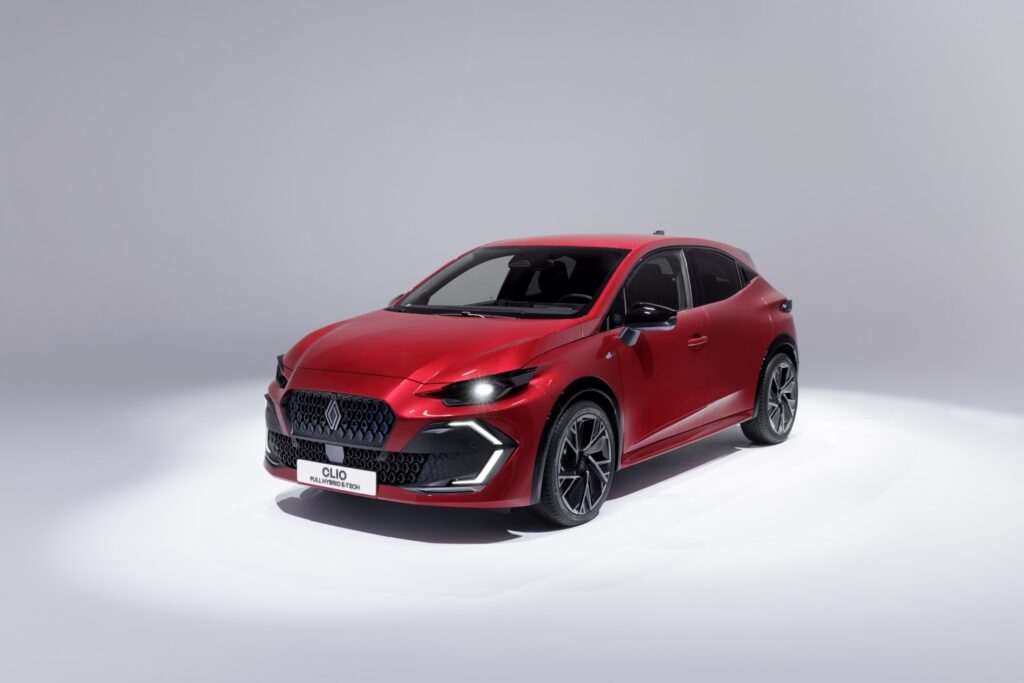
Renault Clio VI (Phase I) 1.8 (158 Hp) E-Tech Full Hybrid Multimode: A New Era of Efficiency
The Renault Clio VI (Phase I) 1.8 (158 Hp) E-Tech Full Hybrid Multimode represents the cutting edge of the iconic French automaker’s commitment to hybridization within the highly competitive European supermini segment. Slated for a 2025 production start, this sixth-generation Clio, in its initial Phase I iteration, introduces a sophisticated full-hybrid powertrain that promises exceptional fuel efficiency and reduced emissions without compromising on performance or practicality. While the Renault Clio is not officially sold in the United States, its technological advancements and market impact in Europe offer valuable insights into global automotive trends, particularly in the realm of compact, electrified vehicles. This model is designed to solidify the Clio’s position as a segment leader, combining a modern hatchback body style with advanced E-Tech hybrid technology.
Engine and Performance: The E-Tech Full Hybrid Multimode Drivetrain
At the heart of the Renault Clio VI (Phase I) 1.8 (158 Hp) E-Tech Full Hybrid Multimode lies an innovative FHEV (Full Hybrid Electric Vehicle) powertrain architecture, meticulously engineered to deliver a balanced blend of power and economy. Unlike many mild-hybrid systems, the E-Tech is a true full hybrid, capable of operating on electric power alone for significant periods, particularly in urban environments.
The system’s internal combustion engine (ICE) is a 1.8-liter (1798 cm3) inline four-cylinder unit, naturally aspirated and featuring direct fuel injection and a DOHC valvetrain. This engine produces a respectable 109 horsepower and 126.86 lb.-ft. of torque at 3000 rpm. While 1.8 liters is a somewhat larger displacement than typically found in a supermini, it is optimized for efficiency within the hybrid system, likely running on an Atkinson cycle or similar, to provide peak thermal efficiency when assisting the electric motor or recharging the battery.
Complementing the gasoline engine is a powerful electric motor, delivering 49 horsepower and a substantial 151.2 lb.-ft. of torque. This synchronous electric motor is transversely mounted at the front, working in conjunction with the ICE to drive the front wheels. The synergy between the two power sources results in a robust total system output of 158 horsepower at 5500 rpm and an impressive 199.14 lb.-ft. of system torque. This combined power allows the Clio E-Tech to accelerate from 0 to 60 mph in a brisk 7.9 seconds, with a top speed electronically limited to 111.85 mph (180 km/h).
The hybrid system is powered by a 1.4 kWh Lithium-ion battery, strategically located under the trunk floor to maintain optimal weight distribution and interior space. This battery allows for pure electric driving at speeds up to 65.24 mph (105 km/h), making short commutes and city driving exceptionally quiet and emission-free. The unique “Multimode” automatic transmission, a signature feature of Renault’s E-Tech system, utilizes dog clutches instead of traditional synchronizers or a continuously variable transmission (CVT). This innovative gearbox design allows for multiple hybrid operating modes, optimizing efficiency by seamlessly transitioning between electric, series-hybrid, parallel-hybrid, and engine-only propulsion, often without the driver noticing. It also facilitates efficient regenerative braking, recharging the battery during deceleration.
Fuel economy is a standout feature, with a combined WLTP rating of 60.3 to 58.8 US mpg (3.9-4.0 l/100 km), placing it among the most efficient vehicles in its class. CO2 emissions are equally low, ranging from 89-92 g/km, meeting the stringent Euro 6-bis emission standard. This makes the Clio E-Tech a highly attractive option for environmentally conscious drivers seeking to minimize their carbon footprint and fuel costs.
Design and Features: Modern Aesthetics and Practicality
The Renault Clio VI (Phase I) continues the model’s tradition of stylish and practical design, presenting a modern five-door hatchback body that is both aerodynamic and aesthetically pleasing. With a length of 162.05 inches, a width of 69.61 inches (78.98 inches including mirrors), and a height of 57.13 inches, the Clio maintains its compact footprint, ideal for navigating crowded European city streets while offering a surprisingly spacious interior. The wheelbase of 102.01 inches contributes to stable handling and a comfortable ride.
Inside, the Clio VI is designed to accommodate five occupants comfortably. Despite the hybrid battery’s placement, the trunk space remains practical, offering a minimum of 10.91 cubic feet (309 liters) with the rear seats up, expandable to a generous 38.63 cubic feet (1094 liters) when the rear seats are folded down. This flexibility underscores its suitability for both daily commutes and weekend excursions.
Key features for the 2025 model year emphasize modern convenience, safety, and driver engagement. The vehicle comes equipped with electric power steering for effortless maneuverability, and a robust braking system featuring disc brakes on both the front and rear wheels, complemented by an Anti-lock Braking System (ABS) for enhanced safety. The suspension system consists of an independent McPherson setup at the front and a torsion beam at the rear, a common and effective combination for compact cars that balances ride comfort with agile handling. The Clio also offers a choice of tire sizes, from 195/60 R16 to more aggressive 205/45 R18 options, allowing for personalization of ride and handling characteristics.
As a modern European vehicle, the Clio VI (Phase I) is expected to incorporate a full suite of passive and active safety features beyond just ABS, including multiple airbags, electronic stability control, and advanced driver-assistance systems (ADAS) such as lane-keeping assist and automatic emergency braking, though these specific details are not provided in the raw data. Other modern conveniences include a Start & Stop System for further fuel savings and a particulate filter to reduce emissions, underlining Renault’s commitment to environmental responsibility.
Technical Specifications
| General Information | |
|---|---|
| Brand | Renault |
| Model | Clio |
| Generation | Clio VI (Phase I) |
| Type (Engine) | 1.8 (158 Hp) E-Tech Full Hybrid Multimode |
| Start of Production | 2025 year |
| Powertrain Architecture | FHEV (Full Hybrid Electric Vehicle) |
| Body Type | Hatchback |
| Seats | 5 |
| Doors | 5 |
| Performance Specs | |
| Combined Fuel Consumption (WLTP) | 3.9-4.0 l/100 km (60.3 – 58.8 US mpg) |
| CO2 Emissions (WLTP) | 89-92 g/km |
| Fuel Type | Petrol (Gasoline) |
| Acceleration 0 – 60 mph | 7.9 sec |
| Acceleration 0 – 100 km/h | 8.3 sec |
| Maximum Speed | 180 km/h (111.85 mph) |
| Emission Standard | Euro 6-bis |
| Weight-to-Power Ratio | 8 kg/Hp (124.3 Hp/tonne) |
| Weight-to-Torque Ratio | 4.7 kg/Nm (212.4 Nm/tonne) |
| Electric Cars and Hybrids Specs | |
| Gross Battery Capacity | 1.4 kWh |
| Battery Technology | Lithium-ion (Li-Ion) |
| Battery Location | Under the trunk |
| Max Speed (Electric) | 105 km/h (65.24 mph) |
| Electric Motor 1 Power | 49 Hp |
| Electric Motor Torque | 205 Nm (151.2 lb.-ft.) |
| Electric Motor Location | Front, Transverse |
| Electric Motor Type | Synchronous |
| System Power | 158 Hp @ 5500 rpm. |
| System Torque | 270 Nm (199.14 lb.-ft.) |
| Internal Combustion Engine Specs | |
| Power | 109 Hp |
| Power per Liter | 60.6 Hp/l |
| Torque | 172 Nm @ 3000 rpm. (126.86 lb.-ft. @ 3000 rpm.) |
| Engine Layout | Front, Transverse |
| Engine Model/Code | H5P A2 |
| Engine Displacement | 1798 cm3 (1.8 l / 109.72 cu. in.) |
| Number of Cylinders | 4 |
| Engine Configuration | Inline |
| Number of Valves per Cylinder | 4 |
| Fuel Injection System | Direct injection |
| Engine Aspiration | Naturally aspirated engine |
| Valvetrain | DOHC |
| Engine Systems | Start & Stop System, Particulate filter |
| Space, Volume and Weights | |
| Kerb Weight | 1271 kg (2802.08 lbs.) |
| Max. Weight | 1770 kg (3902.18 lbs.) |
| Max Load | 499 kg (1100.11 lbs.) |
| Trunk (boot) Space – Minimum | 309 l (10.91 cu. ft.) |
| Trunk (boot) Space – Maximum | 1094 l (38.63 cu. ft.) |
| Fuel Tank Capacity | 39 l (10.3 US gal) |
| Permitted Trailer Load with Brakes (12%) | 900 kg (1984.16 lbs.) |
| Dimensions | |
| Length | 4116 mm (162.05 in.) |
| Width | 1768 mm (69.61 in.) |
| Width Including Mirrors | 2006 mm (78.98 in.) |
| Height | 1451 mm (57.13 in.) |
| Wheelbase | 2591 mm (102.01 in.) |
| Front Track | 1503 mm (59.17 in.) |
| Rear (Back) Track | 1503 mm (59.17 in.) |
| Front Overhang | 859 mm (33.82 in.) |
| Rear Overhang | 667 mm (26.26 in.) |
| Ride Height (Ground Clearance) | 142 mm (5.59 in.) |
| Minimum Turning Circle (Turning Diameter) | 10.4 m (34.12 ft.) |
| Drivetrain, Brakes and Suspension Specs | |
| Drivetrain Architecture | The Internal combustion engine (ICE) and electric motor drive the front wheels of the car with the ability to work in full electric or mixed mode. |
| Drive Wheel | Front wheel drive |
| Number of Gears and Type of Gearbox | automatic transmission Multimode |
| Front Suspension | Independent type McPherson |
| Rear Suspension | Torsion |
| Front Brakes | Disc |
| Rear Brakes | Disc |
| Assisting Systems | ABS (Anti-lock braking system) |
| Steering Type | Steering rack and pinion |
| Power Steering | Electric Steering |
| Tires Size | 195/60 R16; 205/45 R18 |
| Wheel Rims Size | 16; 18 |
Legacy and Market Impact in the European Supermini Segment
The Renault Clio has long been a cornerstone of the European supermini market, consistently ranking among the best-selling vehicles across the continent. Its legacy is built on a strong foundation of stylish design, practical utility, and accessible technology. The introduction of the Clio VI (Phase I) 1.8 (158 Hp) E-Tech Full Hybrid Multimode in 2025 signifies a crucial evolution, reinforcing its competitive edge in an increasingly electrified automotive landscape.
In Europe, the Clio faces fierce competition from established rivals such as the Peugeot 208, Volkswagen Polo, Opel Corsa, and the Toyota Yaris Hybrid. With its E-Tech full hybrid system, Renault directly challenges the fuel efficiency prowess of Toyota’s long-standing hybrid offerings, while aiming to surpass competitors still relying primarily on traditional internal combustion engines or less advanced mild-hybrid setups. The Clio’s E-Tech powertrain, particularly its unique Multimode gearbox, stands out as a sophisticated solution for optimizing energy management, providing smooth transitions and impressive real-world fuel economy that resonates strongly with European consumers facing high fuel prices and stringent emissions regulations.
The Clio’s historical significance lies in its ability to adapt and innovate. Each generation has brought new levels of refinement and technology to the supermini class, democratizing features once reserved for larger, more expensive cars. The sixth generation, with its focus on a highly efficient full-hybrid system, continues this tradition. It represents a significant step towards Renault’s broader electrification strategy, offering a compelling option for buyers who are not yet ready for a full battery electric vehicle but desire substantial reductions in fuel consumption and CO2 emissions.
While the Renault Clio VI (Phase I) 1.8 (158 Hp) E-Tech Full Hybrid Multimode may not grace American showrooms, its advanced engineering and market success in Europe reflect broader trends toward powertrain diversification and efficiency. It demonstrates how traditional automotive segments are embracing electrification to meet evolving consumer demands and regulatory pressures, ensuring the longevity and relevance of popular models like the Clio for years to come. The Clio’s continued evolution ensures it remains a benchmark for innovation and consumer appeal in its segment.