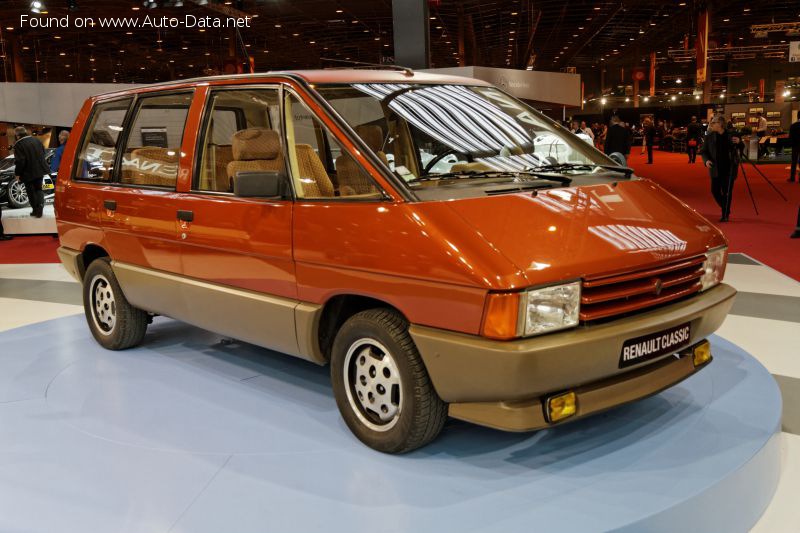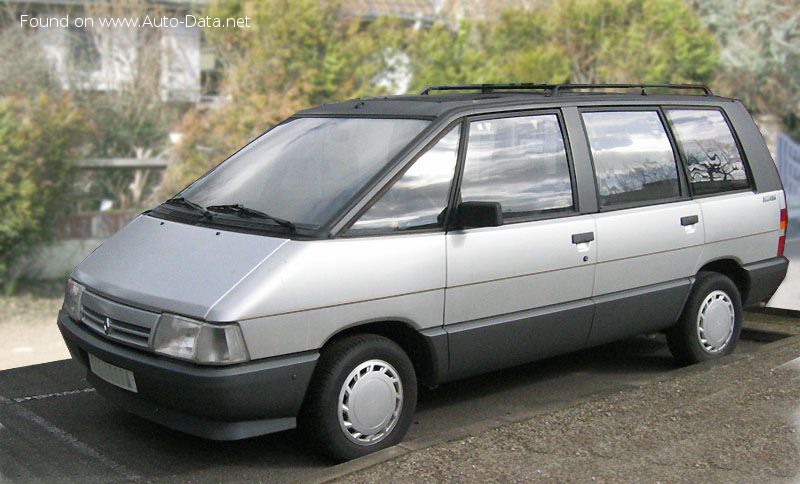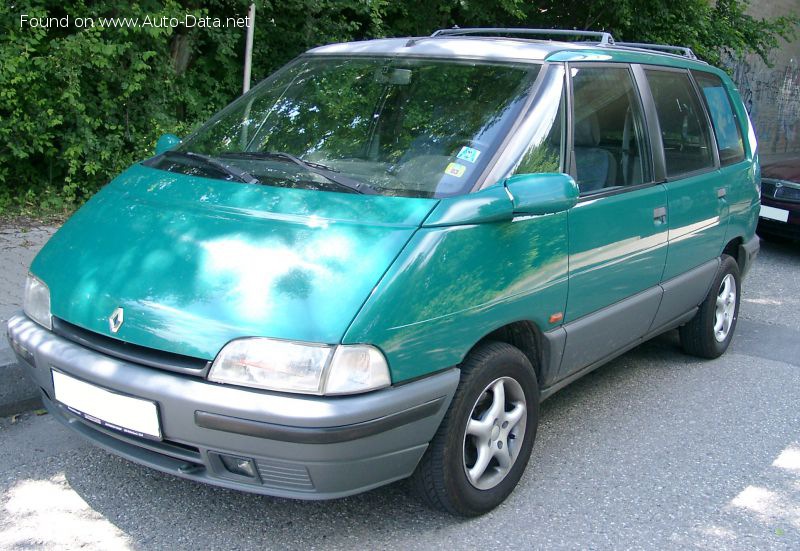
The Renault Espace II (J63) 2.0i (103 Hp): A European Minivan Icon
The Renault Espace, a name synonymous with the European minivan segment, entered its second generation in 1991 with the introduction of the J63 series. Building upon the revolutionary concept established by its predecessor, the Renault Espace II (J63) continued to define the multi-purpose vehicle (MPV) landscape in Europe. While never officially sold in the United States, the Espace played a pivotal role across the Atlantic, offering families unparalleled space, versatility, and a distinctly modern design for its time. This particular variant, the 2.0i with 103 horsepower, represented a popular and practical choice within the Espace II lineup, balancing everyday usability with adequate performance for European roads.
Produced from 1991 to 1996, the Espace II (J63) retained the innovative fiberglass body panels mounted on a galvanized steel chassis, a construction method inherited from Matra, Renault’s partner in the Espace project. This approach contributed to its unique styling, corrosion resistance, and relatively light weight. As a seven-seater minivan, it catered directly to the burgeoning demand for family-friendly vehicles that moved beyond traditional station wagons, offering superior passenger room and adaptable cargo configurations. Its impact was profound, solidifying Renault’s position as a leader in innovative family transport.
Engine and Performance of the Renault Espace II (J63) 2.0i
At the heart of the Renault Espace II (J63) 2.0i model was the J7R engine, a naturally aspirated, multi-port manifold injected 2.0-liter (1995 cubic centimeters) inline-four gasoline unit. This engine was longitudinally mounted at the front, driving the front wheels through a 5-speed manual transmission. While not a powerhouse, the J7R was engineered for reliability and smooth power delivery, providing 103 horsepower at 5250 rpm and a respectable 117.27 lb.-ft. of torque at a low 2500 rpm. This torque characteristic made the Espace II feel responsive in city driving and capable of hauling a full complement of passengers and luggage.
Performance figures for the 2.0i were adequate for a family-oriented vehicle of its era. It could accelerate from 0 to 60 mph in a calculated 13.1 seconds, with a top speed of 107.5 mph (173 km/h). Fuel economy was rated at approximately 24.5 US mpg (9.6 l/100 km) combined, which was competitive for a vehicle of its size and capacity in the early 1990s. The engine featured a 10:1 compression ratio and two valves per cylinder, a common configuration for mainstream engines at the time, prioritizing durability and ease of maintenance over outright performance or cutting-edge technology. Its 6.5-liter engine oil capacity and 8.4-liter coolant capacity further underscored its robust, workhorse design.
Design and Features
The design of the Renault Espace II (J63) was an evolution of the groundbreaking first generation, retaining its distinctive wedge-shaped profile and large glass area, which contributed to an airy cabin feel. It sported a more rounded and aerodynamic aesthetic compared to its predecessor, aligning with the design trends of the early 1990s. The body type was clearly defined as a Minivan or MPV, offering five doors and seating for seven passengers. The modular interior was a key selling point, allowing for various seating configurations, including the removal of rear seats to create a cavernous cargo area.
Measuring 174.37 inches in length, 70.67 inches in width (81.1 inches including mirrors), and 66.65 inches in height, the Espace II was a substantial vehicle. Its 101.57-inch wheelbase provided a stable ride and generous interior volume. The design prioritized practicality, with a minimum trunk space of 8.83 cubic feet (250 liters) that could expand dramatically to 105.94 cubic feet (3000 liters) with the rear seats removed or folded – a truly impressive figure for its class. The 77-liter (20.34 US gallons) fuel tank ensured a decent cruising range.
From a chassis perspective, the Espace II featured a double wishbone front suspension, a relatively sophisticated setup for a family vehicle, known for its ability to provide a good balance of ride comfort and handling. The rear suspension employed a semi-independent coil spring system. Braking was handled by ventilated discs at the front and drum brakes at the rear, a common arrangement for vehicles of this size and power output. Hydraulic power steering with a rack and pinion system made maneuvering the large vehicle manageable, evidenced by a turning circle of 38.06 feet. The Espace II rode on 195/65 R14 tires, fitted on 14-inch wheel rims.
Technical Specifications: Renault Espace II (J63) 2.0i (103 Hp)
| Category | Specification |
|---|---|
| General Information | |
| Brand | Renault |
| Model | Espace |
| Generation | Espace II (J63) |
| Engine Type | 2.0i (103 Hp) |
| Production Start | 1991 |
| Production End | 1996 |
| Powertrain Architecture | Internal Combustion Engine |
| Body Type | Minivan, MPV |
| Seats | 7 |
| Doors | 5 |
| Performance Specs | |
| Fuel Consumption (Combined) | 24.5 US mpg (9.6 l/100 km) |
| Fuel Type | Petrol (Gasoline) |
| Acceleration 0 – 60 mph | 13.1 sec |
| Acceleration 0 – 62 mph (0 – 100 km/h) | 13.8 sec |
| Maximum Speed | 107.5 mph (173 km/h) |
| Engine Specs | |
| Power | 103 Hp @ 5250 rpm |
| Power per liter | 51.6 Hp/l |
| Torque | 117.27 lb.-ft. @ 2500 rpm (159 Nm) |
| Engine Layout | Front, Longitudinal |
| Engine Model/Code | J7R |
| Engine Displacement | 121.74 cu. in. (1995 cm3) |
| Number of Cylinders | 4 |
| Engine Configuration | Inline |
| Cylinder Bore | 3.46 in. (88 mm) |
| Piston Stroke | 3.23 in. (82 mm) |
| Compression Ratio | 10:1 |
| Valves per Cylinder | 2 |
| Fuel Injection System | Multi-port manifold injection |
| Engine Aspiration | Naturally aspirated |
| Engine Oil Capacity | 6.87 US qt (6.5 l) |
| Coolant Capacity | 8.88 US qt (8.4 l) |
| Space, Volume and Weights | |
| Trunk (boot) Space – Minimum | 8.83 cu. ft. (250 l) |
| Trunk (boot) Space – Maximum | 105.94 cu. ft. (3000 l) |
| Fuel Tank Capacity | 20.34 US gal (77 l) |
| Dimensions | |
| Length | 174.37 in. (4429 mm) |
| Width | 70.67 in. (1795 mm) |
| Width (including mirrors) | 81.1 in. (2060 mm) |
| Height | 66.65 in. (1693 mm) |
| Wheelbase | 101.57 in. (2580 mm) |
| Front Track | 58.82 in. (1494 mm) |
| Rear Track | 59.25 in. (1505 mm) |
| Front Overhang | 38.35 in. (974 mm) |
| Rear Overhang | 34.45 in. (875 mm) |
| Ride Height (Ground Clearance) | 6.22 in. (158 mm) |
| Minimum Turning Circle | 38.06 ft. (11.60 m) |
| Drivetrain, Brakes and Suspension Specs | |
| Drivetrain Architecture | Front-wheel drive, Internal Combustion Engine |
| Drive Wheel | Front wheel drive |
| Gearbox Type | 5 gears, manual transmission |
| Front Suspension | Double wishbone |
| Rear Suspension | Semi-independent, coil spring |
| Front Brakes | Ventilated discs |
| Rear Brakes | Drum |
| Steering Type | Steering rack and pinion |
| Power Steering | Hydraulic Steering |
| Tires Size | 195/65 R14 |
| Wheel Rims Size | 14 inches |
Legacy and Market Impact of the Renault Espace II (J63)
The Renault Espace II (J63) was more than just a family car; it was a cultural phenomenon in Europe, building on the strong foundation of the original Espace. It continued to be a highly influential model in the burgeoning MPV segment, which it had, in many ways, helped to create. Its reputation was built on its exceptional interior space, flexible seating arrangements, and a comfortable, commanding driving position. For many European families, the Espace represented freedom and practicality, allowing for comfortable long-distance travel with multiple passengers and ample luggage.
In its primary market, the Espace II faced competition from a growing number of rivals as other manufacturers recognized the potential of the minivan concept. Key competitors included models like the Chrysler Voyager (which was sold in Europe as a badge-engineered model), the Ford Galaxy/Volkswagen Sharan/SEAT Alhambra trio (which arrived later in the Espace II’s lifecycle), and other European offerings such as the Peugeot 806/Citroën Evasion/Fiat Ulysse/Lancia Zeta (the Eurovans). Despite the increased competition, the Espace II held its own, largely due to its established reputation, distinctive styling, and well-regarded comfort.
The Espace II’s mechanical impact was significant for its class. The use of a longitudinal engine layout, which is less common in front-wheel-drive vehicles, was a carryover from its Matra origins and allowed for better crash protection and potentially more balanced weight distribution. Its sophisticated double wishbone front suspension provided a ride quality and handling prowess that often surpassed its more utilitarian rivals. The continued use of fiberglass body panels on a galvanized chassis was also a testament to its unique engineering and commitment to durability, particularly against rust, a common issue for vehicles in many parts of Europe.
Ultimately, the Renault Espace II (J63) cemented the Espace nameplate as a benchmark for European minivans. It demonstrated Renault’s commitment to innovation in family transport and played a crucial role in evolving the concept of the modern MPV. Its blend of practical design, comfortable interior, and robust engineering ensured its place in automotive history as a truly iconic European vehicle of the 1990s.