The Renault Espace II (J63): A European Minivan Icon
The Renault Espace II (J63) represents the second generation of Renault’s groundbreaking multi-purpose vehicle (MPV), a segment it largely pioneered in Europe. Produced from 1991 to 1996, the Espace II built upon the revolutionary concept of its predecessor, solidifying its position as the quintessential family hauler across the continent. While never officially imported to the United States, the Espace series profoundly influenced global automotive design, demonstrating the viability and versatility of the minivan concept long before it became a common sight worldwide. This particular variant, the 2.1 TD (88 Hp), offered a pragmatic and fuel-efficient diesel powertrain, catering to the European demand for economical long-distance travel and robust utility.
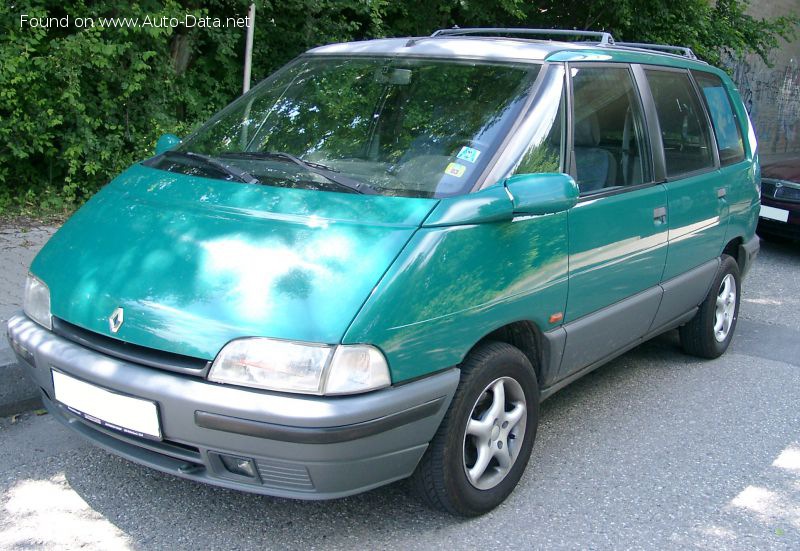
The Espace II maintained the distinctive “one-box” silhouette that made the original Espace instantly recognizable, but with a more refined and aerodynamic aesthetic. It continued to emphasize interior flexibility, comfort, and spaciousness, making it an ideal choice for large families, adventurers, and commercial users alike. This generation further cemented the Espace’s reputation for innovative design and practical engineering, setting benchmarks for interior modularity and passenger accommodation within its market segment. Its success underscored a fundamental shift in European automotive preferences, moving beyond traditional sedans and wagons for family transport towards more adaptable and capacious solutions.
Powertrain and Performance Characteristics
At the heart of the Renault Espace II (J63) 2.1 TD model was a robust 2.1-liter (2068 cm³ or 126.2 cu. in.) inline-four turbocharged diesel engine, designated by the code J8S. This engine was a workhorse for Renault during this era, known for its durability and efficiency. It produced a respectable 88 horsepower at 4250 revolutions per minute (rpm), a figure that, while modest by today’s standards, was entirely adequate for the Espace’s intended purpose as a family transporter. More significantly, the engine generated a healthy 181 Newton-meters (133.5 lb.-ft.) of torque at a low 2000 rpm. This ample low-end torque was crucial for effortless acceleration, particularly when carrying a full complement of passengers or cargo, and for navigating varied European road conditions.
Power was delivered to the front wheels via a smooth-shifting 5-speed manual transmission, a common and reliable setup for vehicles of its class and era. The powertrain architecture, with the engine mounted longitudinally at the front, ensured good weight distribution and traction. Performance figures for the 2.1 TD were pragmatic: the Espace II could accelerate from 0 to 60 miles per hour in approximately 14.3 seconds, with a top speed of around 99.42 mph (160 km/h). These figures underscored its role as a practical family vehicle rather than a performance machine, prioritizing reliability and economy.
Fuel efficiency was a key selling point for the diesel Espace II. It achieved an impressive 28.3 US miles per gallon in urban driving conditions and an even more remarkable 42 US mpg on the extra-urban cycle. With a substantial 20.34 US gallon fuel tank, the 2.1 TD offered an extended cruising range, a highly desirable trait for European families embarking on long holiday trips. The engine’s precombustion chamber injection system and turbocharger were advanced features for the early 1990s, contributing to its strong torque delivery and relatively clean operation for a diesel of its time, further enhancing its appeal in a market increasingly conscious of running costs.
Design Philosophy and Interior Versatility
The design of the Renault Espace II (J63) was a thoughtful evolution of its predecessor’s revolutionary concept, maintaining the distinctive “one-box” silhouette while incorporating more rounded, contemporary styling cues for the 1990s. Its exterior dimensions – a length of 174.37 inches, a width of 70.67 inches (81.1 inches including mirrors), and a height of 66.65 inches – contributed to its commanding road presence and exceptionally spacious interior. The relatively long wheelbase of 101.57 inches, coupled with minimal front and rear overhangs, maximized internal volume, a hallmark of the Espace’s design philosophy.
The Espace II was designed as a true multi-purpose vehicle, offering seating for up to seven occupants across three rows. Its interior was a masterclass in modularity and flexibility. The rear seats could be individually removed, reversed, or folded flat, allowing for an astonishing range of configurations. This adaptability meant the Espace could transform from a comfortable seven-seater family carrier to a vast cargo van with a maximum trunk volume of 105.94 cubic feet (3000 liters), making it incredibly practical for diverse needs, from hauling furniture to accommodating sports equipment. Even with all seats in place, a respectable 8.83 cubic feet (250 liters) of cargo space was available.
Features like large glass areas provided excellent visibility and contributed to an airy cabin feel, reducing claustrophobia on long journeys. For its era, the Espace II offered a comfortable and ergonomic driving position, with logically arranged controls. The suspension setup, featuring a double wishbone system at the front and a semi-independent coil spring arrangement at the rear, was tuned for passenger comfort, absorbing road imperfections effectively. Braking duties were handled by ventilated discs at the front and drum brakes at the rear, a standard configuration for family vehicles of the early ’90s, providing adequate stopping power. Hydraulic rack and pinion steering offered a direct and reassuring feel, essential for maneuvering a vehicle of its size. The 195/65 R14 tires on 14-inch wheel rims completed a package focused on practicality, comfort, and safety for its time.
Detailed Technical Specifications
| General Information | |
|---|---|
| Brand | Renault |
| Model | Espace |
| Generation | Espace II (J63) |
| Type (Engine) | 2.1 TD (88 Hp) |
| Start of Production | 1991 year |
| End of Production | 1996 year |
| Powertrain Architecture | Internal Combustion engine |
| Body Type | Minivan, MPV |
| Seats | 7 |
| Doors | 5 |
| Performance Specifications | |
| Fuel Consumption (Urban) | 8.3 l/100 km (28.3 US mpg) |
| Fuel Consumption (Extra Urban) | 5.6 l/100 km (42 US mpg) |
| Fuel Type | Diesel |
| Acceleration 0-60 mph | 14.3 sec |
| Maximum Speed | 160 km/h (99.42 mph) |
| Weight-to-Power Ratio | 15.3 kg/Hp (65.2 Hp/tonne) |
| Weight-to-Torque Ratio | 7.5 kg/Nm (134.1 Nm/tonne) |
| Engine Specifications | |
| Power | 88 Hp @ 4250 rpm |
| Power per Liter | 42.6 Hp/l |
| Torque | 181 Nm @ 2000 rpm (133.5 lb.-ft. @ 2000 rpm) |
| Engine Layout | Front, Longitudinal |
| Engine Model/Code | J8S |
| Engine Displacement | 2068 cm³ (126.2 cu. in.) |
| Number of Cylinders | 4 |
| Engine Configuration | Inline |
| Cylinder Bore | 86 mm (3.39 in.) |
| Piston Stroke | 89 mm (3.5 in.) |
| Compression Ratio | 21:1 |
| Number of Valves per Cylinder | 2 |
| Fuel Injection System | Precombustion chamber injection |
| Engine Aspiration | Turbocharger |
| Valvetrain | OHC |
| Engine Oil Capacity | 6 l (6.34 US qt) |
| Coolant Capacity | 8.8 l (9.3 US qt) |
| Space, Volume, and Weights | |
| Kerb Weight | 1350 kg (2976.24 lbs.) |
| Max. Weight | 2080 kg (4585.62 lbs.) |
| Max Load | 730 kg (1609.37 lbs.) |
| Trunk (Boot) Space – Minimum | 250 l (8.83 cu. ft.) |
| Trunk (Boot) Space – Maximum | 3000 l (105.94 cu. ft.) |
| Fuel Tank Capacity | 77 l (20.34 US gal) |
| Max. Roof Load | 60 kg (132.28 lbs.) |
| Permitted Trailer Load with Brakes (12%) | 1580 kg (3483.3 lbs.) |
| Permitted Trailer Load without Brakes | 600 kg (1322.77 lbs.) |
| Dimensions | |
| Length | 4429 mm (174.37 in.) |
| Width | 1795 mm (70.67 in.) |
| Width including Mirrors | 2060 mm (81.1 in.) |
| Height | 1693 mm (66.65 in.) |
| Wheelbase | 2580 mm (101.57 in.) |
| Front Track | 1494 mm (58.82 in.) |
| Rear (Back) Track | 1505 mm (59.25 in.) |
| Front Overhang | 974 mm (38.35 in.) |
| Rear Overhang | 875 mm (34.45 in.) |
| Ride Height (Ground Clearance) | 158 mm (6.22 in.) |
| Minimum Turning Circle (Diameter) | 11.60 m (38.06 ft.) |
| Drivetrain, Brakes, and Suspension | |
| Drivetrain Architecture | The Internal combustion engine (ICE) drives the front wheels of the vehicle. |
| Drive Wheel | Front wheel drive |
| Number of Gears and Type of Gearbox | 5 gears, manual transmission |
| Front Suspension | Double wishbone |
| Rear Suspension | Semi-independent, coil spring |
| Front Brakes | Ventilated discs |
| Rear Brakes | Drum |
| Steering Type | Steering rack and pinion |
| Power Steering | Hydraulic Steering |
| Tire Size | 195/65 R14 |
| Wheel Rims Size | 14 |
Legacy and Market Position of the Renault Espace II (J63)
The Renault Espace II (J63) cemented its legacy as a pivotal vehicle in the European automotive landscape. Building on the radical success of the first generation, it reinforced Renault’s reputation as an innovator in family transportation. The Espace II was lauded for its unparalleled interior space, exceptional modularity, and comfortable ride, making it a favorite among large families and those requiring a versatile vehicle for both daily use and long-distance travel. Its ability to transform from a spacious seven-seater to a cavernous cargo hauler with ease was a defining feature that set it apart from conventional sedans and station wagons.
In its primary European market, the Espace II faced competition from a growing number of rivals, though few could match its heritage and established market presence. Early competitors included vehicles like the Mitsubishi Space Wagon (known as the Chariot in some markets) and later, the Ford Galaxy, Volkswagen Sharan, and SEAT Alhambra, which arrived towards the mid-to-late 1990s. However, the Espace had a significant head start, having essentially created the European MPV segment. Even the European-market Chrysler Voyager, introduced in the mid-1980s, offered a different take on the minivan concept, but the Espace’s distinct styling and French flair kept it a unique proposition.
The 2.1 TD variant, in particular, played a crucial role in the Espace’s success, catering to the strong European demand for fuel-efficient diesel engines. Its combination of robust torque, respectable performance, and excellent fuel economy made it an economical choice for families, despite its larger size. The Espace II became synonymous with family road trips and active lifestyles, embodying a sense of freedom and practicality that resonated deeply with European consumers.
Historically, the Espace II is significant for demonstrating the enduring appeal of the MPV concept and its ability to adapt and evolve. It showcased how a vehicle could be both practical and stylish, offering a compelling alternative to traditional car types. While the minivan segment has since been largely eclipsed by the rise of SUVs in many markets, the Espace II remains a testament to a period when versatility and passenger comfort were paramount. Its influence can still be seen in the design of modern family vehicles, and it holds a special place in the history of European automotive innovation. The Espace II, especially in its efficient diesel guise, was more than just a car; it was a lifestyle enabler for countless families across Europe.