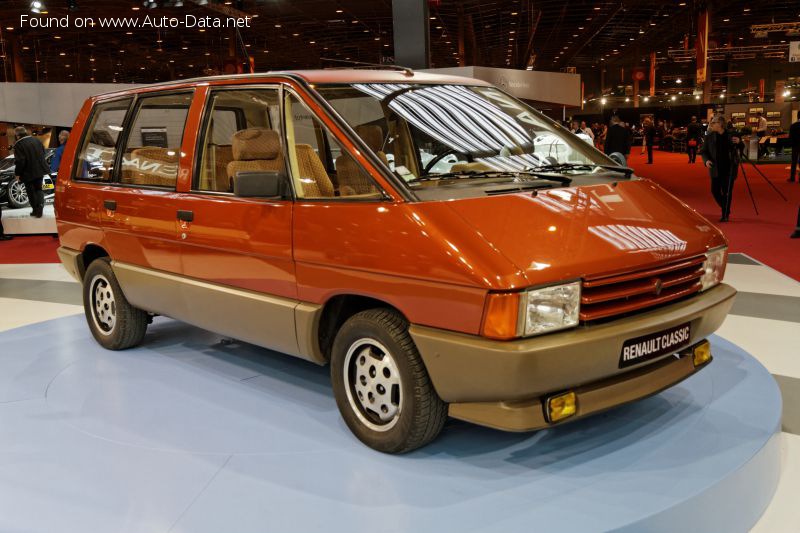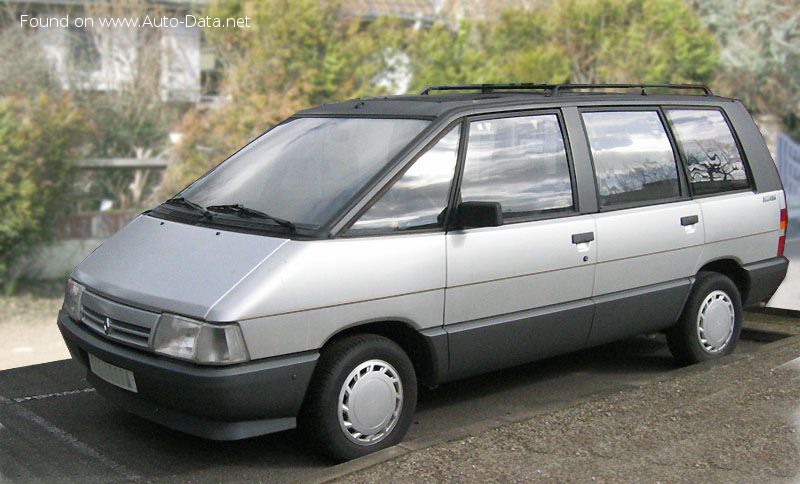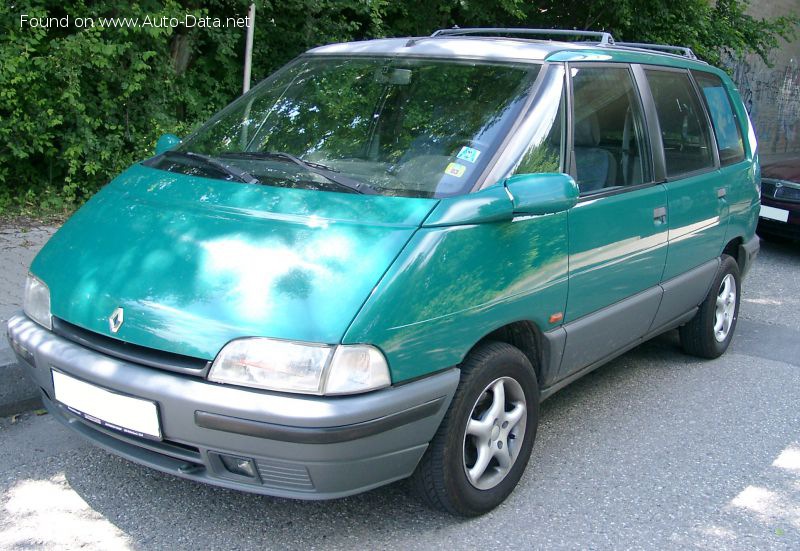
Introduction: The Renault Espace II (J63) 2.8 V6 (150 Hp)
The Renault Espace, a name synonymous with the European minivan segment, carved out a significant niche for itself by pioneering the concept of a versatile, family-oriented vehicle. Introduced in 1984, the Espace quickly became a benchmark for its innovative design and adaptable interior. The second generation, known internally as the J63 series, continued this legacy from its launch in 1991 until 1996. This article focuses on a particularly robust variant, the Renault Espace II (J63) 2.8 V6 (150 Hp), which represented the pinnacle of performance and refinement for the model line during its production run.
While the Espace was a household name across Europe, it was not officially sold in the United States, where the minivan market was dominated by domestic offerings such as the Chrysler Voyager and Dodge Caravan. However, the Espace’s influence extended globally, inspiring a generation of multi-purpose vehicles (MPVs) with its clever packaging and comfortable ride. The Espace II built upon the success of its predecessor, evolving its distinctive monobox silhouette with a more rounded, aerodynamic aesthetic that was characteristic of early 1990s automotive design. This particular 2.8 V6 model offered a compelling blend of power and practicality, positioning it as a premium choice within the competitive European family car market.
The Renault Espace II (J63) 2.8 V6 (150 Hp): Engine and Performance
At the heart of the most potent Espace II variant was a robust 2.8-liter V6 gasoline engine, designated with the internal code Z7W. This naturally aspirated, multi-port manifold injected power plant delivered 150 horsepower at 5400 rpm, providing ample motivation for the family hauler. Torque figures were equally impressive for its class and era, peaking at 165.95 lb.-ft. at a relatively low 2500 rpm, ensuring strong pulling power, especially useful when fully loaded with passengers and cargo or when towing.
Power was sent to the front wheels via a 5-speed manual transmission, a common setup for European vehicles prioritizing driver engagement and efficiency. This drivetrain architecture, with its front, longitudinal engine layout, contributed to the vehicle’s stable handling characteristics. Despite its primary role as a family minivan, the Renault Espace II (J63) 2.8 V6 (150 Hp) could accelerate from 0 to 60 mph in a respectable 9.8 seconds, with a top speed of 121.17 mph. These figures were quite competitive for a large MPV of its time, allowing for comfortable cruising on autobahns and effortless overtaking on two-lane roads.
Fuel economy, while not the primary focus of a V6 engine in a minivan, was rated at an estimated 21.8 US mpg combined. Urban driving saw consumption around 15.3 US mpg, while extra-urban cruising improved to 27.4 US mpg. This was achieved through careful engine tuning and the relatively lightweight construction of the Espace for its size, with a curb weight of 2958.6 lbs. The 77-liter (20.34 US gallon) fuel tank provided a decent cruising range, making it suitable for long European road trips.
Design and Features of the Renault Espace II (J63)
The Espace II maintained the innovative “monobox” design that made its predecessor famous, a single-volume body where the hood, cabin, and cargo area seamlessly blend. However, the J63 generation introduced a softer, more refined aesthetic. Its length of 174.37 inches, width of 70.67 inches (81.1 inches including mirrors), and height of 66.65 inches gave it a substantial road presence. The generous 101.57-inch wheelbase contributed to a spacious interior and a smooth ride.
As a true minivan/MPV, the Espace II was designed with modularity and passenger comfort in mind. It featured five doors and could comfortably seat up to seven occupants across three rows. The rear seats were often removable or configurable, allowing for immense flexibility in cargo and passenger arrangements. Minimum trunk space started at 8.83 cubic feet, expanding to an impressive 105.94 cubic feet with the rear seats removed or folded, transforming the Espace into a practical cargo hauler.
The suspension setup comprised a double wishbone system at the front and a semi-independent, coil spring arrangement at the rear, tuned to provide a comfortable ride quality synonymous with family vehicles. Braking was handled by ventilated discs at the front and solid discs at the rear, augmented by an Anti-lock Braking System (ABS), a significant safety feature for the early 1990s. Hydraulic rack and pinion steering provided direct and responsive control, while 195/65 R15 tires on 15-inch wheel rims offered a good balance of grip and ride comfort. The turning circle of 38.06 feet made it reasonably maneuverable in urban environments despite its size.
Technical Specifications
| Category | Specification |
|---|---|
| General Information | |
| Brand | Renault |
| Model | Espace |
| Generation | Espace II (J63) |
| Type (Engine) | 2.8 V6 (150 Hp) |
| Production Start | 1991 |
| Production End | 1996 |
| Powertrain Architecture | Internal Combustion Engine |
| Body Type | Minivan, MPV |
| Seats | 7 |
| Doors | 5 |
| Performance Specs | |
| Fuel Consumption (Urban) | 15.3 US mpg (15.4 l/100 km) |
| Fuel Consumption (Extra Urban) | 27.4 US mpg (8.6 l/100 km) |
| Fuel Consumption (Combined) | 21.8 US mpg (10.8 l/100 km) |
| Fuel Type | Petrol (Gasoline) |
| Acceleration 0-60 mph | 9.8 seconds |
| Maximum Speed | 121.17 mph (195 km/h) |
| Weight-to-Power Ratio | 8.9 kg/Hp (111.8 Hp/tonne) |
| Weight-to-Torque Ratio | 6 kg/Nm (167.7 Nm/tonne) |
| Engine Specs | |
| Power | 150 Hp @ 5400 rpm |
| Power per liter | 52.7 Hp/l |
| Torque | 165.95 lb.-ft. @ 2500 rpm (225 Nm) |
| Engine Layout | Front, Longitudinal |
| Engine Model/Code | Z7W |
| Engine Displacement | 173.86 cu. in. (2849 cm3) |
| Number of Cylinders | 6 |
| Engine Configuration | V-engine |
| Cylinder Bore | 3.58 in. (91 mm) |
| Piston Stroke | 2.87 in. (73 mm) |
| Compression Ratio | 9.5:1 |
| Valves per Cylinder | 2 |
| Fuel Injection System | Multi-port manifold injection |
| Engine Aspiration | Naturally aspirated |
| Engine Oil Capacity | 7.4 US qt (7 l) |
| Coolant Capacity | 10.57 US qt (10 l) |
| Space, Volume and Weights | |
| Kerb Weight | 2958.6 lbs. (1342 kg) |
| Max. Weight | 4717.89 lbs. (2140 kg) |
| Max Load | 1759.29 lbs. (798 kg) |
| Trunk (boot) Space – Minimum | 8.83 cu. ft. (250 l) |
| Trunk (boot) Space – Maximum | 105.94 cu. ft. (3000 l) |
| Fuel Tank Capacity | 20.34 US gal (77 l) |
| Permitted Trailer Load (with brakes) | 3747.86 lbs. (1700 kg) |
| Permitted Trailer Load (without brakes) | 1433 lbs. (650 kg) |
| Dimensions | |
| Length | 174.37 in. (4429 mm) |
| Width | 70.67 in. (1795 mm) |
| Width (including mirrors) | 81.1 in. (2060 mm) |
| Height | 66.65 in. (1693 mm) |
| Wheelbase | 101.57 in. (2580 mm) |
| Front Track | 59.72 in. (1517 mm) |
| Rear Track | 59.37 in. (1508 mm) |
| Front Overhang | 38.35 in. (974 mm) |
| Rear Overhang | 34.45 in. (875 mm) |
| Ride Height (Ground Clearance) | 6.65 in. (169 mm) |
| Minimum Turning Circle | 38.06 ft. (11.60 m) |
| Drivetrain, Brakes and Suspension | |
| Drivetrain Architecture | Front wheel drive, Internal Combustion Engine |
| Drive Wheel | Front wheel drive |
| Gearbox Type | 5 gears, manual transmission |
| Front Suspension | Double wishbone |
| Rear Suspension | Semi-independent, coil spring |
| Front Brakes | Ventilated discs |
| Rear Brakes | Disc |
| Assisting Systems | ABS (Anti-lock braking system) |
| Steering Type | Steering rack and pinion |
| Power Steering | Hydraulic Steering |
| Tire Size | 195/65 R15 |
| Wheel Rims Size | 15 inches |
Legacy and Market Impact
The Renault Espace II (J63) played a crucial role in solidifying the MPV segment in Europe. Building on the groundbreaking success of the first generation, the Espace II refined the concept of a spacious, versatile family vehicle that prioritized comfort and practicality. Its distinctive design, which blended elements of a station wagon with the elevated driving position and interior volume of a van, resonated deeply with European families seeking an alternative to traditional sedans and wagons.
In its primary European market, the Renault Espace II (J63) 2.8 V6 (150 Hp) faced competition from a growing number of rivals. While the original Espace had a near-monopoly, by the time the second generation arrived, other manufacturers had entered the fray. Key competitors included the Volkswagen Sharan and its badge-engineered siblings, the Ford Galaxy and SEAT Alhambra, which offered similar seven-seater configurations. Other contenders might have been the Citroën Evasion/Peugeot 806 (Eurovans) and the Fiat Ulysse/Lancia Zeta, which emerged later in the Espace II’s lifespan. However, the Espace maintained a strong reputation for its innovative design, comfortable ride, and the flexibility of its interior.
The 2.8 V6 variant, in particular, offered a premium driving experience, appealing to buyers who desired both practicality and robust performance. It demonstrated that an MPV didn’t have to be sluggish or unrefined, providing brisk acceleration and a relaxed cruising ability that set it apart from many of its four-cylinder counterparts. The Espace II’s success further cemented Renault’s position as a leader in innovative family transport solutions.
Today, the Espace II is remembered as a significant step in the evolution of the MPV. While the minivan segment has largely been supplanted by SUVs in many markets, including Europe, the Espace’s influence on vehicle design and family car expectations is undeniable. It remains a recognizable classic in Europe, appreciated for its comfort, spaciousness, and the pioneering spirit it embodied. Its heritage continues to inform modern vehicle design, proving that thoughtful engineering and a focus on passenger needs can create a lasting impact on the automotive landscape.