The Renault Espace III (JE): A European Minivan Icon
The Renault Espace III (JE) represents the third generation of Renault’s groundbreaking multi-purpose vehicle (MPV), a segment the French automaker largely pioneered in Europe. Produced from 1998 to 2000 in its 3.0 V6 24V (190 Hp) Automatic guise, this iteration continued the Espace’s tradition of offering a spacious, flexible, and comfortable family hauler. While never officially sold in the United States, the Espace carved out a significant niche in the European market, defining the modern minivan concept with its innovative design and adaptable interior. This specific variant, featuring a potent V6 engine coupled with an automatic transmission, aimed to provide a more refined and powerful driving experience for those seeking premium comfort and performance within the MPV segment.
The Espace III built upon the success of its predecessors, evolving the distinctive cab-forward silhouette and emphasizing interior modularity. Its role in its primary European market was crucial, offering a compelling alternative to traditional station wagons and sedans for families requiring more space and versatility. The 3.0 V6 24V model, in particular, positioned itself at the higher end of the Espace lineup, catering to buyers who desired strong performance and effortless highway cruising, distinguishing it from the more common four-cylinder diesel and gasoline options.
Engine and Performance of the Renault Espace III (JE)
At the heart of this particular Renault Espace III (JE) was a sophisticated 3.0-liter V6, a naturally aspirated gasoline engine designated as the L7X. This powerplant was a collaboration between PSA Peugeot Citroën and Renault, also known as the “ES9” in PSA vehicles, and it represented a significant step up in power and refinement for the Espace. Featuring a DOHC (Double Overhead Camshaft) valvetrain with 24 valves (four per cylinder), the engine was engineered for smooth operation and a broad power band. It delivered a robust 190 horsepower at 5750 rpm, providing ample thrust for a vehicle of its size and purpose.
The torque output was equally impressive for a naturally aspirated V6 of its era, peaking at 196.93 lb.-ft. (267 Nm) at a relatively accessible 4000 rpm. This substantial torque figure was crucial for ensuring strong acceleration, especially when the Espace was fully loaded with passengers and cargo. Power was transmitted to the front wheels via a 4-speed automatic transmission, a common choice for comfort-oriented family vehicles at the time. This combination allowed the Espace III to accelerate from 0 to 60 mph in a respectable 10.1 seconds, with 0 to 100 km/h achieved in 10.6 seconds. Top speed was rated at 126.14 mph (203 km/h), making it a capable performer on European autobahns and highways.
Despite its performance capabilities, the Espace III 3.0 V6 24V was a large family vehicle, and fuel economy reflected this. Combined fuel consumption was rated at 20.3 US mpg (11.6 l/100 km), with urban driving seeing figures around 14.4 US mpg (16.3 l/100 km) and extra-urban cruising improving to 26.4 US mpg (8.9 l/100 km). CO2 emissions stood at 273 g/km, adhering to the Euro 2 emission standard prevalent during its production years. The engine’s displacement of 179.78 cubic inches (2946 cm3) and a compression ratio of 10.5:1 underscored its design for efficiency and power delivery.
Design and Features
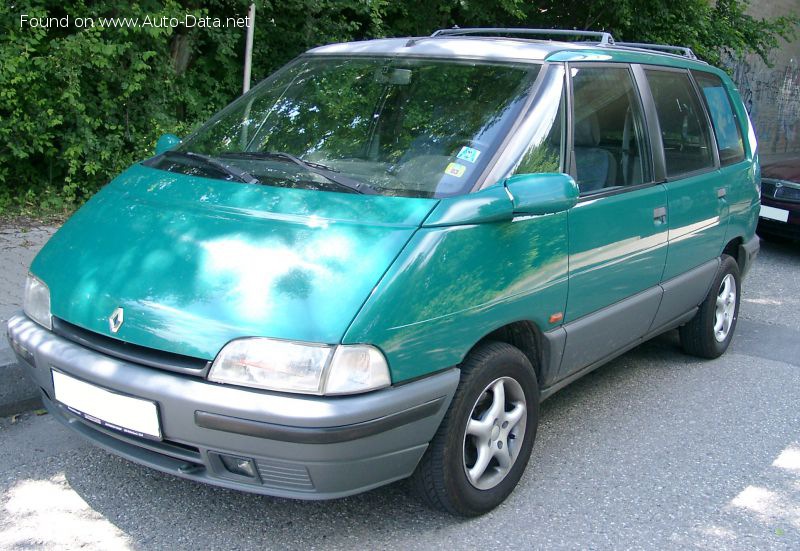
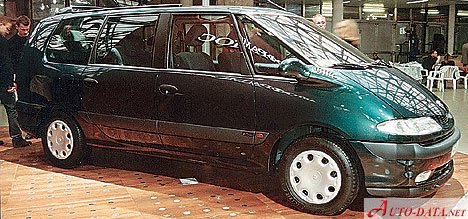
The Renault Espace III (JE) continued the distinctive “monobox” or “cab-forward” design language that had characterized the Espace since its inception. Its exterior styling was smoother and more aerodynamic than the previous generation, featuring rounded lines and a more integrated appearance. As a minivan or MPV, its primary focus was on maximizing interior space and versatility. The Espace III offered seating for seven passengers, with a highly configurable interior that allowed for individual seats to be removed, slid, or folded to create various cargo and passenger arrangements. This modularity was a key selling point, providing unparalleled flexibility for families and their diverse needs.
Dimensions were generous for its class, with a length of 177.83 inches, a width of 71.26 inches, and a height of 69.8 inches. The substantial 106.38-inch wheelbase contributed to a spacious cabin and a stable ride. Cargo capacity was impressive, ranging from a minimum of 9.71 cubic feet with all seats in place to an cavernous 100.65 cubic feet with the rear seats removed, making it exceptionally practical for hauling large items.
In terms of features, the Espace III was well-equipped for its time. The driver-focused cockpit featured a unique central instrument cluster, a design choice that aimed to create a more open and airy feel for front occupants. Standard safety features included an Anti-lock Braking System (ABS), which was becoming increasingly common in the late 1990s. The braking system utilized ventilated discs at the front and solid discs at the rear, providing adequate stopping power for the vehicle’s weight. The suspension setup consisted of an independent McPherson strut system with coil springs and an anti-roll bar at the front, paired with a semi-independent coil spring rear suspension, designed to balance comfort with stability. Power steering was hydraulic, offering a direct and communicative feel.
Technical Specifications
| Category | Specification |
|---|---|
| Brand | Renault |
| Model | Espace III (JE) |
| Type (Engine) | 3.0 V6 24V (190 Hp) Automatic |
| Production Years | 1998 – 2000 |
| Body Type | Minivan, MPV |
| Seats / Doors | 7 / 5 |
| Performance Specs | |
| Fuel Consumption (Urban) | 14.4 US mpg (16.3 l/100 km) |
| Fuel Consumption (Extra Urban) | 26.4 US mpg (8.9 l/100 km) |
| Fuel Consumption (Combined) | 20.3 US mpg (11.6 l/100 km) |
| CO2 Emissions | 273 g/km |
| Fuel Type | Petrol (Gasoline) |
| Acceleration 0-60 mph | 10.1 sec |
| Acceleration 0-100 km/h | 10.6 sec |
| Maximum Speed | 126.14 mph (203 km/h) |
| Emission Standard | Euro 2 |
| Weight-to-power ratio | 8.8 kg/Hp (113.1 Hp/tonne) |
| Engine Specs | |
| Power | 190 Hp @ 5750 rpm |
| Torque | 196.93 lb.-ft. (267 Nm) @ 4000 rpm |
| Engine Layout | Front, Transverse |
| Engine Model/Code | L7X |
| Engine Displacement | 2.9 Liters (2946 cm3 / 179.78 cu. in.) |
| Number of Cylinders | 6 (V-engine) |
| Valves per Cylinder | 4 |
| Bore x Stroke | 3.43 in. x 3.25 in. (87 mm x 82.6 mm) |
| Compression Ratio | 10.5:1 |
| Fuel Injection System | Multi-port manifold injection |
| Engine Aspiration | Naturally aspirated |
| Valvetrain | DOHC |
| Engine Oil Capacity | 5.18 US qt (4.9 l) |
| Coolant Capacity | 8.45 US qt (8 l) |
| Space, Volume and Weights | |
| Kerb Weight | 3703.77 lbs. (1680 kg) |
| Max. Weight | 5533.6 lbs. (2510 kg) |
| Max Load | 1829.84 lbs. (830 kg) |
| Trunk Space (Min/Max) | 9.71 – 100.65 cu. ft. (275 – 2850 l) |
| Fuel Tank Capacity | 20.61 US gal (78 l) |
| Max. Roof Load | 176.37 lbs. (80 kg) |
| Permitted Trailer Load (with brakes) | 4409.25 lbs. (2000 kg) |
| Permitted Trailer Load (without brakes) | 1653.47 lbs. (750 kg) |
| Dimensions | |
| Length | 177.83 in. (4517 mm) |
| Width | 71.26 in. (1810 mm) |
| Height | 69.8 in. (1773 mm) |
| Wheelbase | 106.38 in. (2702 mm) |
| Front Track | 60.39 in. (1534 mm) |
| Rear Track | 60.63 in. (1540 mm) |
| Front Overhang | 36.57 in. (929 mm) |
| Rear Overhang | 34.88 in. (886 mm) |
| Ground Clearance | 4.33 in. (110 mm) |
| Minimum Turning Circle | 37.4 ft. (11.4 m) |
| Drivetrain, Brakes and Suspension | |
| Drivetrain Architecture | Front-wheel drive, Internal Combustion Engine |
| Drive Wheel | Front-wheel drive |
| Gearbox Type | 4-speed Automatic |
| Front Suspension | Independent, McPherson with coil spring and anti-roll bar |
| Rear Suspension | Semi-independent, coil spring |
| Front Brakes | Ventilated discs |
| Rear Brakes | Disc |
| Assisting Systems | ABS (Anti-lock braking system) |
| Steering Type | Rack and pinion |
| Power Steering | Hydraulic |
| Tires Size | 205/65 R15 |
| Wheel Rims Size | 15 inches |
Legacy and Market Impact of the Renault Espace III (JE)
The Renault Espace III (JE) played a pivotal role in solidifying the MPV segment in Europe, carrying forward the innovative spirit of its predecessors. When the original Espace launched in 1984, it was a truly revolutionary vehicle, essentially creating the modern European minivan. The third generation, introduced in 1996, refined this concept, making it more appealing to a broader family audience with enhanced aesthetics, improved build quality, and a wider range of engines, including the powerful 3.0 V6 24V.
In its competitive landscape, the Espace III faced rivals such as the Ford Galaxy, Volkswagen Sharan, and SEAT Alhambra (a joint venture trio), as well as other European contenders like the Chrysler Voyager (which had a stronger presence in the US but was sold in Europe) and the Peugeot 806/Citroën Evasion/Fiat Ulysse. What set the Espace apart was its continued commitment to a unique, almost futuristic design, and its unparalleled interior flexibility. While competitors often adopted more conventional van-like aesthetics, the Espace maintained its sleek, car-like profile and innovative interior layout, including the distinctive central dashboard.
The 3.0 V6 24V Automatic variant, specifically, contributed to the Espace’s reputation as a premium family vehicle. It offered a level of performance and refinement that was uncommon in the MPV segment, appealing to buyers who didn’t want to compromise on driving dynamics or comfort, even when transporting a large family. This engine option underscored Renault’s intent to position the Espace as more than just a utilitarian people mover, but as a sophisticated and enjoyable vehicle.
Despite its success in Europe, the Espace was never exported to the United States. The American market for minivans was already well-established with domestic offerings from Chrysler, Ford, and General Motors, which offered larger dimensions and different feature sets tailored to American consumer preferences. However, the Espace’s influence on global automotive design is undeniable. It demonstrated that a family vehicle could be both practical and stylish, setting a benchmark for interior versatility and packaging efficiency.
The Espace III’s legacy is that of a trendsetter. It evolved the MPV concept, proving its viability and desirability across multiple generations. Its modular interior, comfortable ride, and, particularly in the V6 variant, its strong performance, ensured its place as a significant vehicle in European automotive history. The Espace continued to evolve through subsequent generations, eventually transitioning into a crossover MPV, a testament to its enduring adaptability and Renault’s commitment to innovation in the family car segment.