The Renault Espace III: A European Minivan Icon
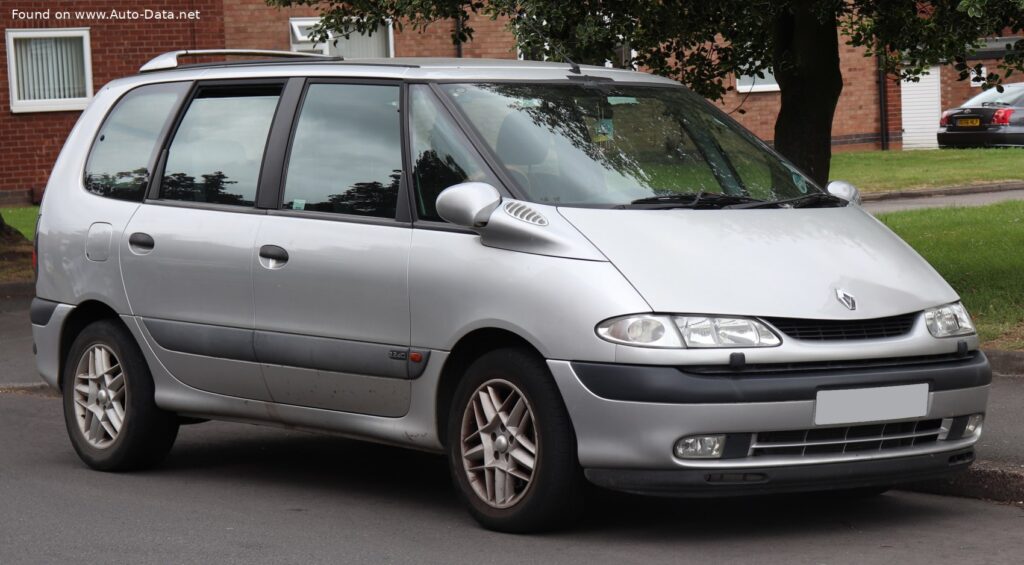
The Renault Espace, a name synonymous with the European Multi-Purpose Vehicle (MPV) segment, revolutionized family transport when it first debuted. The iteration under examination, the Renault Espace III (JE, Phase II, 2000) 1.9 dTi (98 Hp), represents a refined evolution of this pioneering concept. Launched in 2000 as part of the third generation’s mid-cycle refresh, this particular model was a staple in the European market until its production concluded in 2002. Unlike many of its counterparts, the Espace was never officially sold in the United States, carving out its legacy exclusively across the Atlantic. This third-generation model, known internally by its “JE” chassis code, continued to push boundaries in terms of interior flexibility, comfort, and safety for its time, cementing its position as a leading choice for European families seeking a versatile and spacious vehicle.
The Espace III Phase II, with its 1.9 dTi diesel engine, offered a compelling blend of practicality and efficiency, catering specifically to the demands of European drivers who prioritized fuel economy and robust torque for long-distance cruising. It maintained the Espace’s distinctive silhouette, which had become instantly recognizable, while integrating subtle aesthetic and technological updates. This vehicle was a testament to Renault’s commitment to innovation in family vehicles, providing a comfortable and adaptable environment for up to seven occupants.
Powertrain and Performance of the Renault Espace III (JE, Phase II, 2000) 1.9 dTi (98 Hp)
At the heart of this particular Espace III model was the F9QT 1.9-liter dTi (Direct Turbo Injection) inline-four diesel engine, a workhorse designed for efficiency and reliability. This powertrain architecture, an internal combustion engine driving the front wheels, delivered a respectable 98 horsepower at 4000 rpm. While 98 horsepower might seem modest by contemporary standards, it was well-suited to the vehicle’s purpose as a family hauler, especially when considering the robust torque output. The engine produced 140.14 lb.-ft. of torque at a low 2000 rpm, providing ample pulling power for everyday driving and highway cruising, even when fully loaded.
The 1.9 dTi engine featured direct fuel injection and a turbocharger, technologies that were crucial for maximizing efficiency and performance from a smaller displacement diesel in the early 2000s. With a compression ratio of 18.3:1 and an OHC valvetrain with two valves per cylinder, the engine was engineered for durability and economical operation. Power was managed through a 5-speed manual transmission, offering the driver direct control and contributing to the vehicle’s impressive fuel economy figures.
In terms of performance, the Espace III 1.9 dTi accelerated from 0 to 60 mph in a calculated 14.3 seconds, with a top speed of 103.77 mph. These figures underscore its design as a practical family vehicle rather than a performance machine. Where it truly shone was in its fuel efficiency. The combined fuel consumption was rated at an impressive 35.6 US mpg, with extra-urban driving yielding up to 41.3 US mpg. These numbers were highly competitive for a vehicle of its size and capacity, making it an economically sound choice for European families facing higher fuel prices. The vehicle adhered to the Euro 2 emission standard, reflecting the environmental regulations of its time.
Design Philosophy and Interior Versatility
The Renault Espace III continued the distinctive styling language established by its predecessors, characterized by a sleek, aerodynamic, and single-box design that maximized interior volume. With a length of 177.83 inches, a width of 71.26 inches (81.5 inches including mirrors), and a height of 69.8 inches, the Espace offered substantial interior space without being overly cumbersome for European city driving. Its 106.38-inch wheelbase contributed to a stable ride and generous cabin room.
The body type was a classic minivan or MPV, featuring five doors and seating for seven passengers. The interior was the Espace’s true selling point, renowned for its exceptional modularity. Seats could be individually removed, slid, and reconfigured in numerous ways to adapt to varying passenger and cargo needs. With a minimum trunk space of 9.71 cubic feet, the Espace could expand its cargo capacity dramatically to a cavernous 100.65 cubic feet with the rear seats removed, transforming it into a highly capable cargo hauler. This versatility was a key differentiator in its market segment.
Key features included a hydraulic power steering system, making maneuvering the large vehicle easier. For safety, the Espace III was equipped with an Anti-lock Braking System (ABS), a crucial feature for improving stopping performance. The front suspension utilized an independent McPherson strut setup with coil springs and an anti-roll bar, while the rear featured a semi-independent design with coil springs, providing a comfortable and stable ride characteristic of family vehicles. Braking was handled by ventilated discs at the front and drum brakes at the rear, a common setup for vehicles of this class and era. The vehicle rode on 195/65 R15 tires, mounted on 15-inch wheel rims.
Technical Specifications
| Category | Specification |
|---|---|
| Brand | Renault |
| Model | Espace III (JE, Phase II, 2000) |
| Type (Engine) | 1.9 dTi (98 Hp) |
| Production Start / End | 2000 – 2002 |
| Powertrain Architecture | Internal Combustion Engine, Front Wheel Drive |
| Body Type | Minivan, MPV |
| Seats / Doors | 7 / 5 |
| Performance | |
| Fuel Consumption (Urban) | 8.2 l/100 km (28.7 US mpg) |
| Fuel Consumption (Extra Urban) | 5.7 l/100 km (41.3 US mpg) |
| Fuel Consumption (Combined) | 6.6 l/100 km (35.6 US mpg) |
| CO2 Emissions | 175 g/km |
| Fuel Type | Diesel |
| Acceleration 0 – 60 mph | 14.3 seconds |
| Maximum Speed | 103.77 mph (167 km/h) |
| Emission Standard | Euro 2 |
| Weight-to-Power Ratio | 16.3 kg/Hp (35.9 lbs/Hp) |
| Weight-to-Torque Ratio | 8.4 kg/Nm (18.5 lbs/Nm) |
| Engine Specs | |
| Power | 98 Hp @ 4000 rpm |
| Power per Liter | 52.4 Hp/l |
| Torque | 140.14 lb.-ft. @ 2000 rpm (190 Nm) |
| Engine Layout | Front, Transverse |
| Engine Model/Code | F9QT |
| Engine Displacement | 1.9 liters (1870 cm3, 114.11 cu. in.) |
| Number of Cylinders | 4, Inline |
| Cylinder Bore | 3.15 in. (80 mm) |
| Piston Stroke | 3.66 in. (93 mm) |
| Compression Ratio | 18.3:1 |
| Valves per Cylinder | 2 |
| Fuel Injection System | Direct Injection |
| Engine Aspiration | Turbocharger |
| Valvetrain | OHC |
| Engine Oil Capacity | 4.1 l (4.33 US qt) |
| Coolant Capacity | 7.5 l (7.93 US qt) |
| Dimensions, Volume, and Weights | |
| Kerb Weight | 3516.37 lbs. (1595 kg) |
| Maximum Weight | 5004.49 lbs. (2270 kg) |
| Maximum Load | 1488.12 lbs. (675 kg) |
| Trunk Space (Minimum) | 9.71 cu. ft. (275 l) |
| Trunk Space (Maximum) | 100.65 cu. ft. (2850 l) |
| Fuel Tank Capacity | 20.61 US gal (78 l) |
| Maximum Roof Load | 176.37 lbs. (80 kg) |
| Permitted Trailer Load (with brakes) | 3439.21 lbs. (1560 kg) |
| Permitted Trailer Load (without brakes) | 1653.47 lbs. (750 kg) |
| Length | 177.83 in. (4517 mm) |
| Width | 71.26 in. (1810 mm) |
| Width (including mirrors) | 81.5 in. (2070 mm) |
| Height | 69.8 in. (1773 mm) |
| Wheelbase | 106.38 in. (2702 mm) |
| Front Track | 60.39 in. (1534 mm) |
| Rear Track | 60.63 in. (1540 mm) |
| Front Overhang | 36.57 in. (929 mm) |
| Rear Overhang | 34.88 in. (886 mm) |
| Ride Height (Ground Clearance) | 4.33 in. (110 mm) |
| Minimum Turning Circle | 37.4 ft. (11.4 m) |
| Drivetrain, Brakes, and Suspension | |
| Drive Wheel | Front Wheel Drive |
| Gearbox | 5-speed Manual Transmission |
| Front Suspension | Independent, McPherson with coil spring and anti-roll bar |
| Rear Suspension | Semi-independent, coil spring |
| Front Brakes | Ventilated Discs |
| Rear Brakes | Drum |
| Assisting Systems | ABS (Anti-lock Braking System) |
| Steering Type | Steering rack and pinion |
| Power Steering | Hydraulic Steering |
| Tires Size | 195/65 R15 |
| Wheel Rims Size | 15 inches |
Legacy and Market Standing in the European Segment
The Renault Espace holds a significant place in automotive history as one of the original and most influential European minivans. Its third generation, particularly the Phase II models from 2000-2002, continued to uphold this reputation, reinforcing Renault’s dominance in the segment. The 1.9 dTi variant, in particular, was emblematic of the European preference for diesel powertrains, offering a pragmatic balance of performance and exceptional fuel economy that was crucial for families across the continent.
In its primary market, the Espace III faced stiff competition from other European and Asian manufacturers who had quickly recognized the potential of the MPV segment. Key rivals included the Ford Galaxy, Volkswagen Sharan, and SEAT Alhambra (the jointly developed “Eurovans”), as well as the Chrysler Voyager, which enjoyed popularity in Europe. Later, models like the Citroën C8 and Peugeot 807 also emerged as direct competitors. Despite this competition, the Espace maintained a strong following due to its pioneering design, superior interior flexibility, and reputation for comfort on long journeys.
The Espace’s legacy is defined by its innovative approach to interior space and modularity. It effectively transformed the concept of family travel, moving beyond traditional station wagons to offer a more adaptable and spacious environment. The diesel engine option further solidified its appeal by offering lower running costs, a significant factor for European consumers. While never making its way to the American market, the Renault Espace III remains a testament to European automotive design and engineering, an influential vehicle that shaped the expectations for family transport for a generation.
Its impact extended beyond mere sales figures; the Espace became a cultural icon in many European countries, representing the modern family vehicle capable of handling everything from daily school runs to cross-continental vacations with ease. The Renault Espace III (JE, Phase II, 2000) 1.9 dTi (98 Hp), with its blend of practicality, efficiency, and comfort, stands as a prime example of Renault’s enduring vision for the family car.