The Renault Espace IV 2.2 dCi (150 Hp) Automatic: A European MPV Benchmark
The Renault Espace, a name synonymous with the Multi-Purpose Vehicle (MPV) segment in Europe, entered its fourth generation in 2002, building upon a legacy established nearly two decades prior. The Renault Espace IV 2.2 dCi (150 Hp) Automatic variant, produced between 2002 and 2006, represented a significant evolution in design, technology, and refinement for this pioneering family hauler. Unveiled at a time when the European automotive market embraced versatility and diesel efficiency, the Espace IV positioned itself as a premium, comfortable, and highly adaptable vehicle designed to transport up to seven occupants with ease.
Unlike many of its predecessors and competitors, the Espace IV moved towards a more sophisticated and upscale aesthetic, shedding some of its earlier utilitarian image. While never officially sold in the United States, the Espace played a crucial role in shaping the MPV segment across Europe and other international markets, influencing design trends and consumer expectations for family vehicles. This particular variant, powered by a robust 2.2-liter common-rail turbo-diesel engine paired with an automatic transmission, aimed to deliver a balance of performance, fuel economy, and driving comfort essential for long-distance family travel.
Engine and Performance: Powering the Renault Espace IV 2.2 dCi (150 Hp) Automatic
At the heart of the Renault Espace IV 2.2 dCi (150 Hp) Automatic was Renault’s G9T series 2.2-liter (2188 cm3 or 133.52 cu. in.) inline-four cylinder diesel engine. This powertrain was a crucial component in the Espace’s appeal, especially in European markets where diesel engines were highly favored for their efficiency and torque delivery. The engine utilized a common-rail fuel injection system, a sophisticated technology for its time, which allowed for precise fuel atomization and combustion, contributing to better fuel economy and reduced emissions. Further enhancing its performance and efficiency, the engine was equipped with a turbocharger and intercooler, ensuring a strong power delivery across a broad RPM range.
The engine produced a healthy 150 horsepower at 4000 rpm, translating to a power-per-liter ratio of 68.6 Hp/l. More significantly for an MPV designed to carry passengers and cargo, it delivered a substantial 320 Nm (236.02 lb.-ft.) of torque at a low 1750 rpm. This ample low-end torque was critical for effortless acceleration, particularly when fully loaded, and for comfortable cruising. Power was sent to the front wheels via a 5-speed automatic transmission, offering smooth shifts and contributing to a relaxed driving experience.
In terms of performance, the Espace IV 2.2 dCi (150 Hp) Automatic was capable of accelerating from 0 to 60 mph in a respectable 11.2 seconds (0-100 km/h in 11.8 seconds) and reaching a top speed of 118 mph (190 km/h). These figures underscored its capability as a competent highway cruiser, despite its substantial curb weight of 4122.64 lbs. (1870 kg). Fuel economy was a strong point for this diesel variant, with a combined consumption rating of 26.4 US mpg (8.9 l/100 km), demonstrating its efficiency for its size and era. It adhered to the Euro 3 emission standard, reflecting the environmental considerations of its production period.
Design and Features: Redefining the MPV Experience
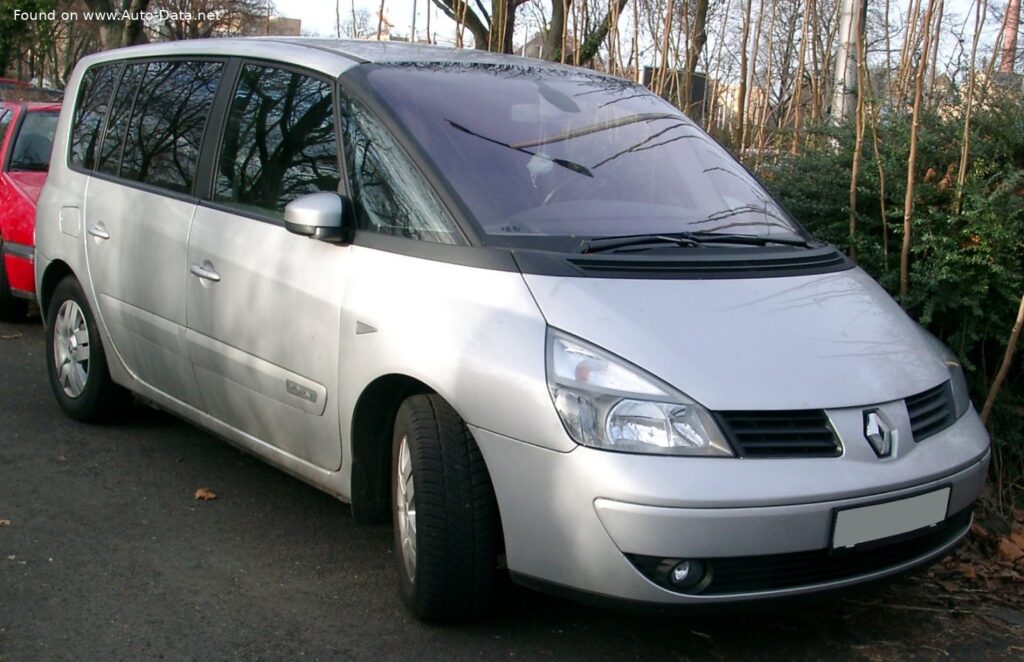
The fourth generation of the Renault Espace marked a significant departure from its predecessors in terms of design philosophy. While retaining the fundamental “monovolume” or single-box silhouette that defined the MPV segment, the Espace IV embraced a more contemporary and aerodynamic aesthetic. Its sleek lines, prominent grille, and distinctive lighting elements gave it a more modern and less utilitarian appearance compared to many of its rivals. With a length of 183.5 inches (4661 mm) and a width of 73.23 inches (1860 mm), it offered a commanding presence on the road.
The body type remained a 5-door minivan/MPV, designed for maximum interior flexibility. The Espace IV typically offered seating for seven, with a highly versatile interior layout. The rear seats could be individually removed, slid, or folded, allowing for numerous configurations to prioritize passenger comfort or cargo capacity. Minimum trunk space started at 10.28 cu. ft. (291 liters), but with the rear seats removed or folded, this could expand to an impressive 101 cu. ft. (2860 liters), making it exceptionally practical for large families or those needing significant hauling capability.
Key features for the Espace IV generation often included a spacious and airy cabin, enhanced by large windows and, in many trims, an optional panoramic glass roof. The driver-focused cockpit featured a centrally mounted digital instrument cluster, a distinctive design choice that emphasized the vehicle’s futuristic appeal. Safety was a paramount concern, and the Espace IV came equipped with standard features like ABS (Anti-lock Braking System), a suite of airbags, and a robust chassis designed to protect occupants. The front suspension utilized an independent McPherson type, while the rear featured a trailing arm setup, providing a comfortable ride quality. Steering was managed by a rack and pinion system with electric power steering, contributing to ease of maneuvering despite the vehicle’s size. Large 17-inch wheels, shod with 225/55 R17 tires, provided a good balance of grip and ride comfort.
Technical Specifications
| Category | Specification |
|---|---|
| Brand | Renault |
| Model | Espace IV |
| Type (Engine) | 2.2 dCi (150 Hp) Automatic |
| Production Years | 2002 – 2006 |
| Body Type | Minivan, MPV |
| Seats / Doors | 7 / 5 |
| Fuel Type | Diesel |
| Engine Layout | Front, Transverse |
| Engine Model/Code | G9T |
| Engine Displacement | 2188 cm3 (133.52 cu. in.) |
| Number of Cylinders | 4, Inline |
| Valves per Cylinder | 4 |
| Valvetrain | DOHC |
| Compression Ratio | 18:1 |
| Bore / Stroke | 87 mm (3.43 in.) / 92 mm (3.62 in.) |
| Fuel Injection System | Diesel Commonrail |
| Engine Aspiration | Turbocharger, Intercooler |
| Power | 150 Hp @ 4000 rpm |
| Power per Liter | 68.6 Hp/l |
| Torque | 320 Nm @ 1750 rpm (236.02 lb.-ft. @ 1750 rpm) |
| Acceleration 0-60 mph | 11.2 sec |
| Acceleration 0-100 km/h | 11.8 sec |
| Maximum Speed | 190 km/h (118.06 mph) |
| Fuel Consumption (Urban) | 11.8 l/100 km (19.9 US mpg) |
| Fuel Consumption (Extra Urban) | 7.3 l/100 km (32.2 US mpg) |
| Fuel Consumption (Combined) | 8.9 l/100 km (26.4 US mpg) |
| CO2 Emissions | 238 g/km |
| Emission Standard | Euro 3 |
| Drivetrain Architecture | Front-wheel drive |
| Transmission | 5 gears, automatic |
| Front Suspension | Independent type McPherson |
| Rear Suspension | Trailing arm |
| Front Brakes | Ventilated discs |
| Rear Brakes | Disc |
| Assisting Systems | ABS (Anti-lock braking system) |
| Steering Type | Steering rack and pinion, Electric Power Steering |
| Tires Size | 225/55 R17 |
| Wheel Rims Size | 17 inches |
| Kerb Weight | 1870 kg (4122.64 lbs.) |
| Maximum Weight | 2555 kg (5632.81 lbs.) |
| Maximum Load | 685 kg (1510.17 lbs.) |
| Trunk Space (Min/Max) | 291 – 2860 l (10.28 – 101 cu. ft.) |
| Fuel Tank Capacity | 83 l (21.93 US gal) |
| Engine Oil Capacity | 6.3 l (6.66 US qt) |
| Coolant Capacity | 9.1 l (9.62 US qt) |
| Length | 4661 mm (183.5 in.) |
| Width (excl. mirrors) | 1860 mm (73.23 in.) |
| Width (incl. mirrors) | 2104 mm (82.83 in.) |
| Height | 1728-1782 mm (68.03 – 70.16 in.) |
| Wheelbase | 2803 mm (110.35 in.) |
| Front Track | 1574 mm (61.97 in.) |
| Rear Track | 1556 mm (61.26 in.) |
| Front Overhang | 1026 mm (40.39 in.) |
| Rear Overhang | 832 mm (32.76 in.) |
| Ride Height (Ground Clearance) | 175 mm (6.89 in.) |
| Drag Coefficient (Cd) | 0.35 |
| Minimum Turning Circle | 11.3 m (37.07 ft.) |
| Weight-to-Power Ratio | 12.5 kg/Hp (80.2 Hp/tonne) |
| Weight-to-Torque Ratio | 5.8 kg/Nm (171.1 Nm/tonne) |
Legacy and Market Impact
The Renault Espace holds a significant place in automotive history, particularly in Europe, as one of the pioneers of the modern MPV. The Espace IV generation, including the 2.2 dCi (150 Hp) Automatic, continued this legacy by offering a compelling package of space, comfort, and advanced features for its time. It faced stiff competition in the burgeoning European MPV segment from rivals such as the Ford Galaxy/VW Sharan/SEAT Alhambra trio, the Citroën C8/Peugeot 807/Fiat Ulysse/Lancia Phedra quad, and even premium offerings like the Mercedes-Benz V-Class. However, the Espace carved out its niche by emphasizing a blend of French flair, innovative interior design, and a comfortable, refined driving experience.
Its reputation was built on its exceptional interior modularity, enabling families to adapt the cabin to various needs, from long road trips with seven passengers to hauling bulky items with all rear seats removed. The diesel engine options, like the 2.2 dCi, were instrumental in its success, providing the fuel efficiency and robust torque necessary for family transportation across diverse European terrains. The Espace IV was generally well-received for its ride comfort, quiet cabin, and overall sophisticated ambiance, elevating the MPV concept beyond mere utility.
While the Espace IV represented a high point for the traditional MPV design, its production run from 2002 to 2006 also coincided with the nascent rise of the SUV segment. Over time, consumer preferences gradually shifted away from MPVs towards SUVs, which offered a perceived blend of ruggedness, higher driving position, and often, a more fashionable image. Despite this broader market trend, the Espace IV remains a testament to Renault’s ingenuity in creating highly functional and comfortable family vehicles. Its influence can still be seen in the design principles of modern crossover and family vehicles, underscoring its historical significance as a benchmark in its segment and a key player in European automotive culture. The Espace nameplate continued for several more generations, eventually transforming into a crossover-SUV in its fifth iteration, reflecting the evolving demands of the global automotive market.