The Renault Espace IV: A European Minivan Icon
The Renault Espace IV 3.0 dCi (177 Hp) Automatic represents the fourth generation of Renault’s pioneering multi-purpose vehicle (MPV), a segment the French automaker largely defined in Europe. Produced from 2002 to 2006 for this specific powertrain variant, the Espace IV continued its legacy as a spacious, versatile, and comfortable family hauler, though it was never officially marketed in the United States. In its primary European markets, the Espace was synonymous with innovative design and exceptional interior flexibility, offering a compelling alternative to traditional sedans and station wagons for larger families or those requiring significant cargo capacity. This generation marked a significant evolution in design and technology, moving towards a more contemporary and refined aesthetic while retaining the core principles of its predecessors.
As a large minivan, the Espace IV was designed to offer premium comfort and a commanding road presence, distinguishing itself with its distinctive styling and advanced features for its time. The 3.0 dCi variant, equipped with a powerful diesel engine and an automatic transmission, was positioned as a top-tier option, balancing robust performance with the fuel efficiency highly valued in European markets. Its role was to cement Renault’s dominance in the MPV segment, providing a sophisticated and practical vehicle that could effortlessly tackle long-distance journeys with a full complement of passengers and luggage.
Engine and Performance of the Renault Espace IV
At the heart of the Renault Espace IV 3.0 dCi (177 Hp) Automatic lies a formidable 3.0-liter V6 diesel engine, designated by the code P9X. This powertrain was a testament to the growing popularity and technological advancement of diesel engines in Europe during the early 2000s. The V-engine configuration, coupled with a DOHC valvetrain, ensured a smooth and refined operation, a crucial characteristic for a vehicle designed for family comfort. Generating a robust 177 horsepower at 4400 rpm, the engine provided ample power for highway cruising and confident overtaking maneuvers.
Perhaps even more impressive was the torque output: 350 Newton-meters (258.15 lb.-ft.) delivered at a low 1800 rpm. This substantial low-end torque was instrumental in the Espace IV’s ability to accelerate effortlessly, particularly when fully laden, and contributed significantly to its relaxed driving dynamics. The engine utilized a Diesel Commonrail fuel injection system, a sophisticated technology that allowed for precise fuel delivery, optimizing both performance and fuel economy. Furthermore, the inclusion of a turbocharger and intercooler boosted the engine’s efficiency and power delivery, making the most of its displacement.
Mated to a 5-speed automatic transmission, the powertrain delivered power smoothly to the front wheels, ensuring a comfortable and undemanding driving experience. Despite its substantial curb weight of 4232.88 lbs., the Espace IV 3.0 dCi could accelerate from 0 to 60 mph in a respectable 10.4 seconds, reaching a maximum speed of 127.38 mph. While not a performance car, these figures demonstrated its capability to keep pace with traffic and handle long journeys with ease. Fuel efficiency was a key consideration, with a combined economy rating of 24.8 US mpg, a commendable figure for a vehicle of its size and power, especially for a diesel in its era. It also met the Euro 3 emission standard, reflecting the environmental considerations of the time.
Design and Features
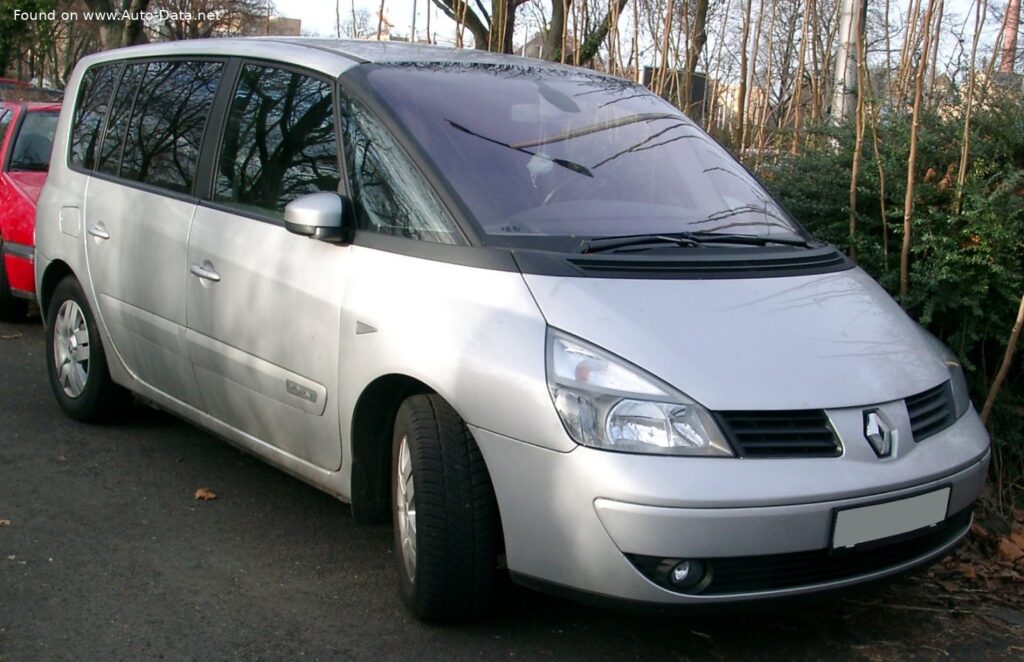
The Renault Espace IV represented a radical departure from its predecessors in terms of design, adopting a more monolithic and futuristic aesthetic that was both bold and practical. Its body type, classified as a Minivan or MPV, featured five doors and a versatile seven-seat configuration, emphasizing passenger comfort and modularity. The exterior design was characterized by smooth, flowing lines, a steeply raked windshield, and a distinctive front fascia that integrated seamlessly with the overall silhouette. With a length of 183.5 inches, a width of 73.23 inches (82.83 inches including mirrors), and a height ranging from 68.03 to 70.16 inches, the Espace IV had a substantial footprint, contributing to its commanding road presence and spacious interior. The long 110.35-inch wheelbase was key to maximizing interior volume and ride comfort.
Inside, the Espace IV was a masterclass in flexible packaging. The ability to configure the seating arrangements, including removing individual seats, provided unparalleled versatility for carrying passengers or cargo. With all seats in place, it offered a minimum trunk space of 10.28 cubic feet, which could expand dramatically to an cavernous 101 cubic feet with the rear seats removed or folded. This adaptability was a cornerstone of the Espace’s appeal to families and those with active lifestyles.
Key features included hydraulic power steering, providing a comfortable and communicative driving feel, and a robust suspension setup with an independent McPherson type in the front and a trailing arm design at the rear, ensuring a compliant ride. Braking duties were handled by ventilated discs at the front and solid discs at the rear, complemented by an Anti-lock Braking System (ABS) for enhanced safety. The vehicle rode on 225/55 R17 tires, mounted on 17-inch wheel rims, providing a good balance of grip and ride comfort. The Espace IV also boasted a relatively low drag coefficient (Cd) of 0.35, contributing to its fuel efficiency and reduced wind noise at higher speeds. From a safety perspective, the Espace IV, like many European family vehicles of its era, featured multiple airbags and a strong chassis designed to protect occupants.
Technical Specifications: Renault Espace IV 3.0 dCi (177 Hp) Automatic
| Category | Specification |
|---|---|
| Brand | Renault |
| Model | Espace |
| Generation | Espace IV |
| Type (Engine) | 3.0 dCi (177 Hp) Automatic |
| Production Start | 2002 year |
| Production End | 2006 year |
| Powertrain Architecture | Internal Combustion engine |
| Body type | Minivan, MPV |
| Seats | 7 |
| Doors | 5 |
| Performance Specs | |
| Fuel consumption (economy) – urban | 13.3 l/100 km (17.7 US mpg) |
| Fuel consumption (economy) – extra urban | 7.4 l/100 km (31.8 US mpg) |
| Fuel consumption (economy) – combined | 9.5 l/100 km (24.8 US mpg) |
| CO2 emissions | 252 g/km |
| Fuel Type | Diesel |
| Acceleration 0 – 60 mph | 10.4 sec |
| Maximum speed | 205 km/h (127.38 mph) |
| Emission standard | Euro 3 |
| Weight-to-power ratio | 10.8 kg/Hp (92.2 Hp/tonne) |
| Weight-to-torque ratio | 5.5 kg/Nm (182.3 Nm/tonne) |
| Engine Specs | |
| Power | 177 Hp @ 4400 rpm |
| Power per liter | 59.8 Hp/l |
| Torque | 350 Nm @ 1800 rpm (258.15 lb.-ft. @ 1800 rpm) |
| Engine layout | Front, Transverse |
| Engine Model/Code | P9X |
| Engine displacement | 2958 cm3 (3.0 liters, 180.51 cu. in.) |
| Number of cylinders | 6 |
| Engine configuration | V-engine |
| Cylinder Bore | 87.5 mm (3.44 in.) |
| Piston Stroke | 82 mm (3.23 in.) |
| Compression ratio | 18.5:1 |
| Number of valves per cylinder | 4 |
| Fuel injection system | Diesel Commonrail |
| Engine aspiration | Turbocharger, Intercooler |
| Valvetrain | DOHC |
| Engine oil capacity | 7.3 l (7.71 US qt) |
| Coolant capacity | 9.5 l (10.04 US qt) |
| Space, Volume and Weights | |
| Kerb Weight | 1920 kg (4232.88 lbs.) |
| Max. weight | 2620 kg (5776.11 lbs.) |
| Max load | 700 kg (1543.24 lbs.) |
| Trunk (boot) space – minimum | 291 l (10.28 cu. ft.) |
| Trunk (boot) space – maximum | 2860 l (101 cu. ft.) |
| Fuel tank capacity | 83 l (21.93 US gal) |
| Max. roof load | 80 kg (176.37 lbs.) |
| Permitted trailer load with brakes (12%) | 2000 kg (4409.25 lbs.) |
| Permitted trailer load without brakes | 750 kg (1653.47 lbs.) |
| Permitted towbar download | 85 kg (187.39 lbs.) |
| Dimensions | |
| Length | 4661 mm (183.5 in.) |
| Width | 1860 mm (73.23 in.) |
| Width including mirrors | 2104 mm (82.83 in.) |
| Height | 1728-1782 mm (68.03 – 70.16 in.) |
| Wheelbase | 2803 mm (110.35 in.) |
| Front track | 1574 mm (61.97 in.) |
| Rear (Back) track | 1556 mm (61.26 in.) |
| Front overhang | 1026 mm (40.39 in.) |
| Rear overhang | 832 mm (32.76 in.) |
| Ride height (ground clearance) | 175 mm (6.89 in.) |
| Drag coefficient (Cd) | 0.35 |
| Minimum turning circle (turning diameter) | 11.3 m (37.07 ft.) |
| Drivetrain, Brakes and Suspension Specs | |
| Drivetrain Architecture | Front-wheel drive, Internal Combustion engine |
| Drive wheel | Front wheel drive |
| Number of gears and type of gearbox | 5 gears, automatic transmission |
| Front suspension | Independent type McPherson |
| Rear suspension | Trailing arm |
| Front brakes | Ventilated discs |
| Rear brakes | Disc |
| Assisting systems | ABS (Anti-lock braking system) |
| Steering type | Steering rack and pinion |
| Power steering | Hydraulic Steering |
| Tires size | 225/55 R17 |
| Wheel rims size | 17 inches |
Legacy and Market Impact of the Renault Espace IV
The Renault Espace holds a significant place in automotive history, particularly in Europe, as one of the pioneers of the modern MPV segment. The fourth generation, the Espace IV, launched in 2002, continued this legacy by pushing boundaries in design, space utilization, and comfort. While never sold in the United States, where the minivan segment was dominated by models like the Chrysler Voyager (which incidentally had a significant presence in Europe), Honda Odyssey, and Toyota Sienna, the Espace IV carved out its niche as a premium and sophisticated family vehicle across the Atlantic.
In Europe, the Espace IV faced stiff competition from other large MPVs such as the Volkswagen Sharan/Ford Galaxy twins, the SEAT Alhambra, and later, more SUV-like crossovers. However, its distinctive styling, particularly the daring interior with its centrally mounted digital instrument cluster and highly modular seating, set it apart. The 3.0 dCi variant, with its powerful and efficient diesel engine, was particularly well-suited to European driving conditions, offering strong performance for autobahn cruising and impressive fuel economy for long family trips. Its reputation for comfort, quietness, and a spacious, airy cabin made it a favorite among families who prioritized practicality without sacrificing style or driving refinement.
The Espace IV’s impact extended beyond just sales figures; it influenced the design direction of other MPVs and even contributed to the broader trend of more car-like, less van-like family vehicles. Its emphasis on safety, with features like ABS and a robust body structure, also helped to raise the bar for family transport. Although the MPV segment eventually saw a decline in favor of SUVs and crossovers, the Espace IV remains a testament to Renault’s innovative spirit and its ability to create highly functional and desirable family cars. It solidified the Espace brand as a benchmark for versatility and comfort in its class, leaving a lasting mark on the European automotive landscape before the Espace nameplate eventually transitioned into a crossover in its fifth generation.