The Renault Espace IV (Phase II, 2006) 1.9 dCi (120 Hp): A European Family Hauler
The Renault Espace IV (Phase II, 2006) represents a significant iteration of a pioneering vehicle in the European multi-purpose vehicle (MPV) segment. Launched in 1984, the Espace carved out a niche for itself as one of the original and most successful people carriers, defining the segment for decades. The fourth generation, introduced in 2002, continued this legacy, evolving the concept with more sophisticated design, improved comfort, and enhanced safety features. The Phase II refresh, arriving in 2006, brought subtle updates to keep the Espace competitive in a rapidly evolving market. This particular variant, equipped with the 1.9 dCi (120 Hp) turbodiesel engine, was a popular choice for European families seeking a balance of practicality, fuel efficiency, and a comfortable ride for up to seven passengers.
While the Renault Espace was never officially sold in the United States, its impact on the European automotive landscape was profound. It epitomized the shift towards spacious, versatile vehicles designed to accommodate the needs of modern families, offering a flexible interior, excellent visibility, and a car-like driving experience that traditional vans could not match. The 2006 1.9 dCi model, specifically, underscored Renault’s commitment to diesel power, a prevalent choice across Europe for its superior fuel economy and torque characteristics, especially beneficial for a vehicle of this size and intended use.
Engine and Performance: The Heart of the Renault Espace IV (Phase II, 2006)
At the core of this particular Espace model was the F9Q 1.9-liter dCi turbodiesel engine. This inline four-cylinder unit, with a displacement of 1870 cubic centimeters (114.11 cu. in.), delivered a respectable 120 horsepower at 4000 rpm. More importantly for a large family vehicle, it produced a robust 199.14 lb.-ft. of torque at a low 2000 rpm. This ample low-end torque was crucial for effortless acceleration, especially when the vehicle was fully loaded with passengers and luggage, and for maintaining cruising speed on highways.
The engine featured a common rail diesel fuel injection system, which at the time was a key technology for optimizing fuel delivery, improving efficiency, and reducing emissions. Coupled with a turbocharger and intercooler, this setup ensured a responsive power delivery across the rev range. The engine’s OHC (Overhead Camshaft) valvetrain with two valves per cylinder contributed to its robust and durable design. With a high compression ratio of 18.3:1, it was optimized for diesel combustion efficiency.
Power was delivered to the front wheels via a 6-speed manual transmission, a choice that offered drivers greater control and contributed to the vehicle’s impressive fuel economy figures. The Renault Espace IV (Phase II, 2006) 1.9 dCi achieved a combined fuel consumption of 34.6 US mpg (6.8 liters per 100 km), which was highly competitive for a vehicle of its size and capacity. In urban settings, it managed 26.4 US mpg, while on the highway, it could reach an impressive 39.9 US mpg. These figures, combined with an 83-liter (21.93 US gallon) fuel tank, gave the Espace a substantial cruising range, making it an ideal choice for long family trips across Europe.
Performance-wise, the 1.9 dCi Espace was not designed for speed but rather for comfortable and confident progress. It accelerated from 0 to 60 mph in a calculated 12.5 seconds, with a top speed of 111.85 mph (180 km/h). Its emission standard was Euro 3, reflecting the environmental regulations of its production year. The weight-to-power ratio stood at 15.1 kg/Hp (66.1 Hp/tonne), indicating a balanced approach to power and efficiency for its segment.
Design and Features: Practicality Meets European Style
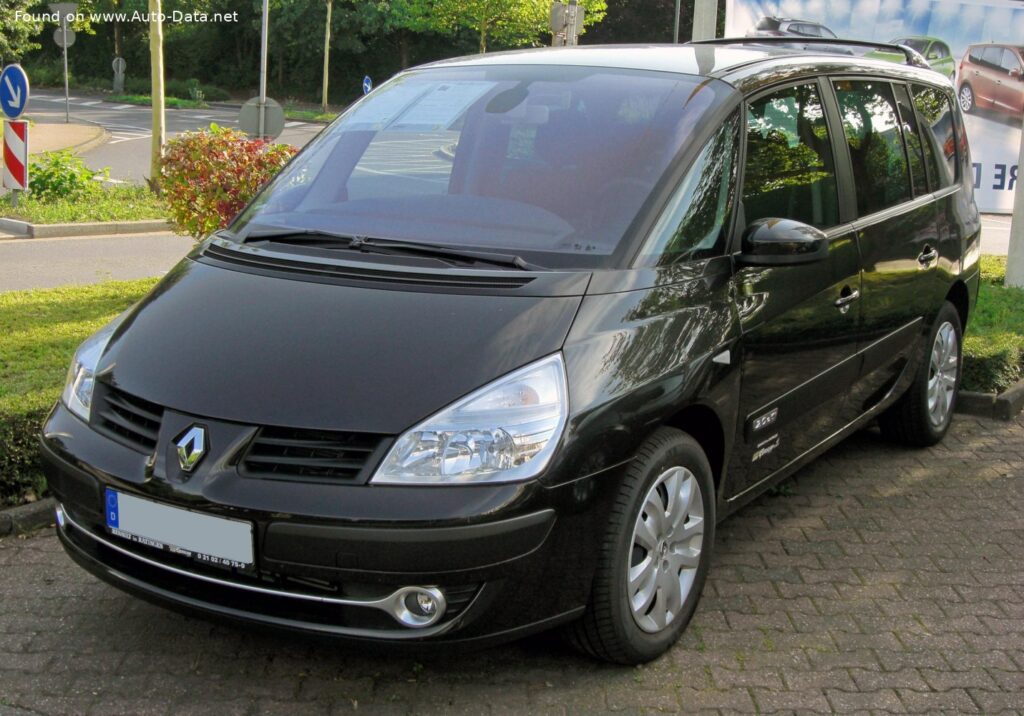
The Renault Espace IV (Phase II, 2006) maintained the distinctive, sleek, and somewhat futuristic design language introduced with the fourth generation. As a minivan or MPV, its primary function was to provide maximum interior space and versatility. The vehicle measured 183.31 inches (4656 mm) in length, 73.23 inches (1860 mm) in width (74.57 inches including mirrors), and 68.03 inches (1728 mm) in height. Its generous 110.35-inch (2803 mm) wheelbase contributed significantly to interior room and ride comfort.
The Espace was designed to comfortably seat seven passengers, with a highly modular interior. The individual rear seats could be slid, folded, or removed entirely, allowing for numerous configurations to prioritize passenger space or cargo volume. With all seats in place, the trunk offered a respectable 10.28 cubic feet (291 liters) of space. However, when the rear seats were removed or folded, the cargo capacity expanded dramatically to a cavernous 101 cubic feet (2860 liters), transforming the Espace into a highly capable hauler.
From a chassis perspective, the Espace featured an independent McPherson strut suspension at the front, known for its balance of comfort and handling. The rear utilized a semi-independent, coil spring setup, which was common for MPVs of the era, providing a good compromise between load-carrying ability and ride quality. Braking was handled by ventilated discs at the front and solid discs at the rear, complemented by an Anti-lock Braking System (ABS) for enhanced safety during emergency stops. The steering system was a rack and pinion type, offering predictable and easy maneuverability, especially with a minimum turning circle of 37.07 feet (11.3 meters). The vehicle rode on 225/60 R16 tires mounted on 16-inch wheel rims, providing a comfortable and stable footprint.
The Phase II refresh brought minor cosmetic tweaks, including updated headlights, taillights, and interior trim, to keep the design fresh without altering its fundamental character. The focus remained on ergonomic efficiency, with intuitive controls and a bright, airy cabin thanks to large windows, creating a pleasant environment for long journeys.
Technical Specifications
| Category | Specification |
|---|---|
| Brand | Renault |
| Model | Espace IV (Phase II, 2006) |
| Engine Type | 1.9 dCi (120 Hp) |
| Production Years | 2006 – 2006 |
| Body Type | Minivan, MPV |
| Seats | 7 |
| Doors | 5 |
| Fuel Type | Diesel |
| Fuel Consumption (Urban) | 8.9 l/100 km (26.4 US mpg) |
| Fuel Consumption (Extra Urban) | 5.9 l/100 km (39.9 US mpg) |
| Fuel Consumption (Combined) | 6.8 l/100 km (34.6 US mpg) |
| CO2 Emissions | 184 g/km |
| Emission Standard | Euro 3 |
| Acceleration 0-60 mph | 12.5 seconds |
| Maximum Speed | 111.85 mph (180 km/h) |
| Power | 120 Hp @ 4000 rpm |
| Torque | 199.14 lb.-ft. @ 2000 rpm (270 Nm) |
| Engine Layout | Front, Transverse |
| Engine Model/Code | F9Q |
| Engine Displacement | 1.9 liters (1870 cm3 / 114.11 cu. in.) |
| Number of Cylinders | 4, Inline |
| Valves per Cylinder | 2 |
| Compression Ratio | 18.3:1 |
| Fuel Injection System | Diesel Commonrail |
| Engine Aspiration | Turbocharger, Intercooler |
| Valvetrain | OHC |
| Engine Oil Capacity | 5.07 US qt (4.8 l) |
| Coolant Capacity | 9.83 US qt (9.3 l) |
| Kerb Weight | 4001.39 lbs (1815 kg) |
| Max. Weight | 5588.72 lbs (2535 kg) |
| Max. Load | 1587.33 lbs (720 kg) |
| Trunk Space (Minimum) | 10.28 cu. ft. (291 l) |
| Trunk Space (Maximum) | 101 cu. ft. (2860 l) |
| Fuel Tank Capacity | 21.93 US gal (83 l) |
| Max. Roof Load | 176.37 lbs (80 kg) |
| Permitted Trailer Load (with brakes) | 4409.25 lbs (2000 kg) |
| Permitted Trailer Load (without brakes) | 1653.47 lbs (750 kg) |
| Length | 183.31 inches (4656 mm) |
| Width | 73.23 inches (1860 mm) |
| Width (incl. mirrors) | 74.57 inches (1894 mm) |
| Height | 68.03 inches (1728 mm) |
| Wheelbase | 110.35 inches (2803 mm) |
| Front Track | 61.97 inches (1574 mm) |
| Rear Track | 61.26 inches (1556 mm) |
| Ground Clearance | 4.72 inches (120 mm) |
| Minimum Turning Circle | 37.07 ft (11.3 m) |
| Drive Wheel | Front Wheel Drive |
| Gearbox | 6 gears, manual transmission |
| Front Suspension | Independent type McPherson |
| Rear Suspension | Semi-independent, coil spring |
| Front Brakes | Ventilated discs |
| Rear Brakes | Disc |
| Assisting Systems | ABS (Anti-lock braking system) |
| Steering Type | Steering rack and pinion |
| Tire Size | 225/60 R16 |
| Wheel Rims Size | 16 inches |
Legacy and Market Impact in Europe
The Renault Espace, particularly its fourth generation, held a significant position in the European automotive market. It was a direct competitor to other popular European MPVs such as the Ford Galaxy/S-Max, Volkswagen Sharan, SEAT Alhambra, Citroën C8, and Peugeot 807. What set the Espace apart was its consistent emphasis on innovative design, modularity, and a comfortable, refined driving experience. While some rivals opted for a more conventional van-like aesthetic, the Espace maintained a distinct, almost futuristic appearance that resonated with many European buyers.
The 1.9 dCi (120 Hp) variant, specifically, played a crucial role in the Espace’s success. Diesel engines dominated the European market for family vehicles in the mid-2000s due to their superior fuel economy and strong torque, which made them ideal for long-distance travel and hauling heavy loads. The Espace’s efficiency and practicality were key selling points for families prioritizing running costs and versatility. Its ability to transform from a comfortable seven-seater to a vast cargo hauler in minutes made it an indispensable tool for active households.
The Espace’s reputation was built on its blend of practicality, comfort, and a distinctly French approach to automotive design. It was known for its quiet cabin, supple ride, and a sense of refinement that often exceeded its segment. While its sales eventually faced pressure from the rising popularity of SUVs in the late 2000s and 2010s, the Espace remained a benchmark for MPV design and functionality for a considerable period.
For the American market, the Espace, like many European MPVs, was never introduced. The minivan segment in the US was dominated by larger, often V6-powered vehicles like the Chrysler Pacifica, Honda Odyssey, and Toyota Sienna, which catered to different consumer preferences for size, engine power, and features. The European MPV, with its focus on diesel efficiency and compact-yet-spacious design, didn’t align with the prevalent American demand for larger, gasoline-fueled family vehicles that eventually gave way to full-size SUVs. Nevertheless, the Renault Espace IV (Phase II, 2006) 1.9 dCi (120 Hp) stands as a testament to Renault’s expertise in creating highly functional, comfortable, and efficient family vehicles for its primary European audience, leaving a lasting legacy in the MPV segment.