Renault Espace IV (Phase II, 2006): A European Minivan Icon
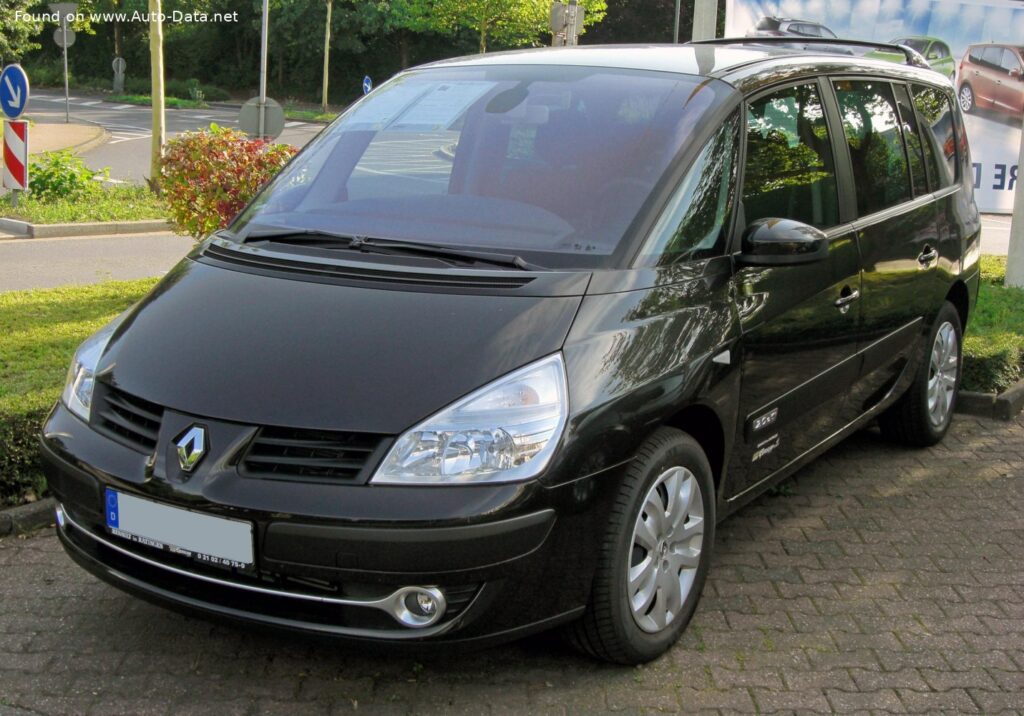
The Renault Espace IV (Phase II, 2006) represents a significant iteration of Renault’s groundbreaking multi-purpose vehicle (MPV), a segment the French automaker largely pioneered in Europe. Introduced as a facelift to the fourth-generation Espace, which debuted in 2002, the Phase II model refined its design, enhanced its features, and updated its powertrain options to maintain its competitive edge in the fiercely contested European family vehicle market. This particular variant, equipped with the 2.0 16V (136 Hp) gasoline engine, was a popular choice for its balance of performance and practicality.
Unlike many vehicles, the Espace was never officially sold in the United States, making it a distinctly European phenomenon. In its primary markets, the Espace established itself as a benchmark for spaciousness, modularity, and comfort, offering an attractive alternative to traditional station wagons and SUVs for large families. The Phase II refresh, which commenced production in 2006 and ran until 2010, solidified its reputation as a sophisticated and versatile family hauler, designed to cater to the diverse needs of European consumers.
Engine and Performance of the Renault Espace IV (Phase II, 2006)
At the heart of this specific Renault Espace IV (Phase II, 2006) model lies a robust 2.0-liter 16-valve inline-four gasoline engine, internally designated as the F4R. This naturally aspirated powerplant delivers a respectable 136 horsepower at 5500 rpm, paired with 141.61 lb-ft of torque peaking at 3750 rpm. For a vehicle designed primarily for family transport and long-distance comfort, these figures offered adequate motivation without being overtly sporty. The engine’s configuration, with four valves per cylinder and Double Overhead Camshafts (DOHC), contributed to its smooth operation and efficient combustion.
Power is channeled to the front wheels through a 6-speed manual transmission, a common and preferred choice in the European market for its driver engagement and efficiency. While not a performance car, the Espace 2.0 16V could accelerate from 0 to 60 mph in a reasonable 11.9 seconds, with a top speed of nearly 115 mph (185 km/h). These performance metrics underscore its role as a capable cruiser rather than a speed demon, perfectly suited for highway journeys with a full complement of passengers and luggage.
Fuel economy, a critical consideration for European buyers, was rated at an estimated 24.5 US mpg combined (9.6 l/100 km). While not class-leading, it was a respectable figure for a vehicle of its size and weight, especially considering its gasoline engine. Urban consumption stood at 18.2 US mpg, improving to 30.5 US mpg on the extra-urban cycle. Emissions were rated at 228 g/km of CO2, meeting the Euro 4 emission standard prevalent at the time, reflecting Renault’s commitment to environmental compliance.
Design and Features
The Renault Espace IV (Phase II, 2006) continued the distinctive styling of the fourth-generation model, characterized by its sleek, futuristic lines and expansive glass areas. As a minivan or MPV, its design was inherently driven by functionality, providing maximum interior volume and versatility. The Phase II refresh brought subtle cosmetic updates, including revised headlights, taillights, and bumpers, giving it a more contemporary look without altering its fundamental silhouette. With a length of 183.31 inches (4656 mm) and a width of 73.23 inches (1860 mm), the Espace commanded a significant road presence.
The interior was where the Espace truly shone. Designed to accommodate up to seven occupants across three rows, the cabin offered exceptional modularity. Individual seats in the second and third rows could be easily removed, reconfigured, or slid, allowing owners to customize the interior layout for various passenger and cargo needs. With all seven seats in place, trunk space was a modest 10.28 cubic feet (291 liters), but removing the rear seats expanded this to an enormous 101 cubic feet (2860 liters), transforming the Espace into a highly capable cargo hauler. This flexibility was a cornerstone of its appeal.
Standard features for the era included a comprehensive safety suite, with ABS (Anti-lock Braking System) as a crucial assisting system for braking. The steering was a rack and pinion type, offering precise control for a vehicle of its size. The suspension setup featured an independent McPherson type at the front and a semi-independent, coil spring arrangement at the rear, tuned for a comfortable ride. The Espace rolled on 225/60 R16 tires, mounted on 16-inch wheel rims, providing a good balance of grip and ride comfort. The vehicle’s high seating position and large windows offered excellent visibility, a key safety and comfort aspect for family driving.
Technical Specifications
| Category | Specification |
|---|---|
| General Information | |
| Brand | Renault |
| Model | Espace |
| Generation | Espace IV (Phase II, 2006) |
| Type (Engine) | 2.0 16V (136 Hp) |
| Start of Production | 2006 year |
| End of Production | 2010 year |
| Powertrain Architecture | Internal Combustion engine |
| Body type | Minivan, MPV |
| Seats | 7 |
| Doors | 5 |
| Performance Specs | |
| Fuel consumption (economy) – urban | 12.9 l/100 km (18.2 US mpg) |
| Fuel consumption (economy) – extra urban | 7.7 l/100 km (30.5 US mpg) |
| Fuel consumption (economy) – combined | 9.6 l/100 km (24.5 US mpg) |
| CO2 emissions | 228 g/km |
| Fuel Type | Petrol (Gasoline) |
| Acceleration 0 – 60 mph | 11.9 sec |
| Maximum speed | 114.95 mph (185 km/h) |
| Emission standard | Euro 4 |
| Weight-to-power ratio | 13.1 kg/Hp |
| Weight-to-torque ratio | 9.3 kg/Nm |
| Engine Specs | |
| Power | 136 Hp @ 5500 rpm |
| Power per liter | 68.1 Hp/l |
| Torque | 192 Nm @ 3750 rpm (141.61 lb.-ft.) |
| Engine layout | Front, Transverse |
| Engine Model/Code | F4R |
| Engine displacement | 1998 cm3 (121.93 cu. in.) |
| Number of cylinders | 4 |
| Engine configuration | Inline |
| Cylinder Bore | 82.7 mm (3.26 in.) |
| Piston Stroke | 93 mm (3.66 in.) |
| Compression ratio | 9.8:1 |
| Number of valves per cylinder | 4 |
| Fuel injection system | Multi-port manifold injection |
| Engine aspiration | Naturally aspirated engine |
| Valvetrain | DOHC |
| Engine oil capacity | 5.4 l (5.71 US qt) |
| Coolant | 8.8 l (9.3 US qt) |
| Space, Volume and Weights | |
| Kerb Weight | 1785 kg (3935.25 lbs.) |
| Max. weight | 2480 kg (5467.46 lbs.) |
| Max load | 695 kg (1532.21 lbs.) |
| Trunk (boot) space – minimum | 291 l (10.28 cu. ft.) |
| Trunk (boot) space – maximum | 2860 l (101 cu. ft.) |
| Fuel tank capacity | 83 l (21.93 US gal) |
| Max. roof load | 80 kg (176.37 lbs.) |
| Permitted trailer load with brakes (12%) | 1800 kg (3968.32 lbs.) |
| Permitted trailer load without brakes | 750 kg (1653.47 lbs.) |
| Permitted towbar download | 80 kg (176.37 lbs.) |
| Dimensions | |
| Length | 4656 mm (183.31 in.) |
| Width | 1860 mm (73.23 in.) |
| Width including mirrors | 1894 mm (74.57 in.) |
| Height | 1728 mm (68.03 in.) |
| Wheelbase | 2803 mm (110.35 in.) |
| Front track | 1574 mm (61.97 in.) |
| Rear (Back) track | 1556 mm (61.26 in.) |
| Ride height (ground clearance) | 120 mm (4.72 in.) |
| Minimum turning circle (turning diameter) | 11.3 m (37.07 ft.) |
| Drivetrain, Brakes and Suspension Specs | |
| Drivetrain Architecture | Front wheel drive. Internal Combustion engine. |
| Drive wheel | Front wheel drive |
| Number of gears and type of gearbox | 6 gears, manual transmission |
| Front suspension | Independent type McPherson |
| Rear suspension | Semi-independent, coil spring |
| Front brakes | Ventilated discs |
| Rear brakes | Disc |
| Assisting systems | ABS (Anti-lock braking system) |
| Steering type | Steering rack and pinion |
| Tires size | 225/60 R16 |
| Wheel rims size | 16 |
Legacy and Market Impact
The Renault Espace, particularly its fourth generation and the Phase II refresh, holds a significant place in the history of the European automotive market. It was a true pioneer in the MPV segment, having effectively created the category with its original launch in 1984. By the time the Renault Espace IV (Phase II, 2006) arrived, the market had become crowded with formidable competitors, including the Ford Galaxy/VW Sharan/SEAT Alhambra triplets, the Citroën C8, Peugeot 807, and Fiat Ulysse (often referred to as the “Eurovans”), as well as more compact MPVs like the Opel Zafira and Renault’s own Scénic.
Despite increased competition, the Espace maintained its reputation for offering a premium, spacious, and comfortable family experience. Its strengths lay in its exceptional interior flexibility, high-quality materials, and a smooth, refined ride that made long journeys less taxing. It was often praised for its innovative design, both inside and out, which provided a sense of light and space rarely found in other vehicles. The 2.0 16V engine, while not the most powerful in the Espace lineup (which also included more potent gasoline and diesel options), was a reliable and economical choice for many families, offering a good compromise for daily driving and occasional longer trips.
The Espace’s influence extended beyond its sales figures; it helped define what a modern European family vehicle could be, emphasizing versatility, safety, and passenger comfort. Its legacy is one of innovation and adaptability, constantly evolving to meet the changing demands of its target audience. While the traditional MPV segment has since seen a decline in favor of SUVs, the Espace’s contribution to family motoring in Europe remains undeniable, cementing its status as a true automotive icon that perfectly balanced practicality with a distinctive French flair.