Renault Espace IV (Phase III, 2010) 2.0 dCi (173 Hp)
The Renault Espace IV (Phase III, 2010) represents a significant chapter in the history of the European multi-purpose vehicle (MPV) segment. As an icon of family transportation and a pioneer in its class, the Espace, first introduced in 1984, consistently set benchmarks for spaciousness, modularity, and comfort. The fourth generation, launched in 2002, continued this legacy, and the Phase III update in 2010 brought a series of refinements to keep it competitive in a rapidly evolving market. This particular iteration, powered by the robust 2.0 dCi (173 Hp) diesel engine, was a popular choice for European families seeking a blend of performance, fuel efficiency, and unparalleled interior versatility. While never officially sold in the United States, the Espace played a crucial role in shaping the MPV landscape across Europe and other international markets, demonstrating Renault’s expertise in creating innovative, family-oriented vehicles.
Engine and Performance of the Renault Espace IV (Phase III, 2010)
Under the hood, the Renault Espace IV (Phase III, 2010) 2.0 dCi variant featured a sophisticated M9R series engine, an inline four-cylinder turbodiesel powerplant that offered a compelling balance of power and economy. With a displacement of 1,995 cubic centimeters (approximately 2.0 liters), this engine was engineered for smooth operation and strong low-end torque, ideal for hauling a fully loaded MPV. It delivered a healthy 173 horsepower at 3,750 revolutions per minute, providing ample motivation for highway cruising and confident overtakes.
Perhaps even more impressive was the torque output: 265.52 pound-feet (360 Nm) available at a remarkably low 1,750 rpm. This characteristic ensured responsive acceleration from a standstill and reduced the need for frequent downshifts, contributing to a relaxed driving experience. The engine utilized a common rail direct fuel injection system, paired with a turbocharger and intercooler, to optimize combustion and efficiency. A DOHC (Dual Overhead Camshaft) valvetrain with four valves per cylinder further enhanced breathing and overall engine performance.
Mated to a precise 6-speed manual transmission, this powertrain directed its output to the front wheels. Despite its substantial curb weight of 4,356.33 pounds, the Espace 2.0 dCi (173 Hp) was capable of accelerating from 0 to 60 mph in a respectable 8.4 seconds (calculated). Its top speed reached 126.76 mph (204 km/h), making it perfectly capable of handling autobahn speeds.
Fuel economy was a strong suit for this diesel variant, especially critical in the European market. It achieved an estimated 33.6 US miles per gallon in combined driving (7 liters per 100 km), with urban consumption at 26.7 US mpg and extra-urban at 37.3 US mpg. Emissions were rated at 185 g/km of CO2, meeting the Euro 5 emission standard, thanks in part to the inclusion of a particulate filter. This combination of performance and efficiency made the 2.0 dCi (173 Hp) a highly desirable engine choice for the Espace, offering a practical and economical solution for long-distance family travel.
Design and Features
Exterior and Dimensions
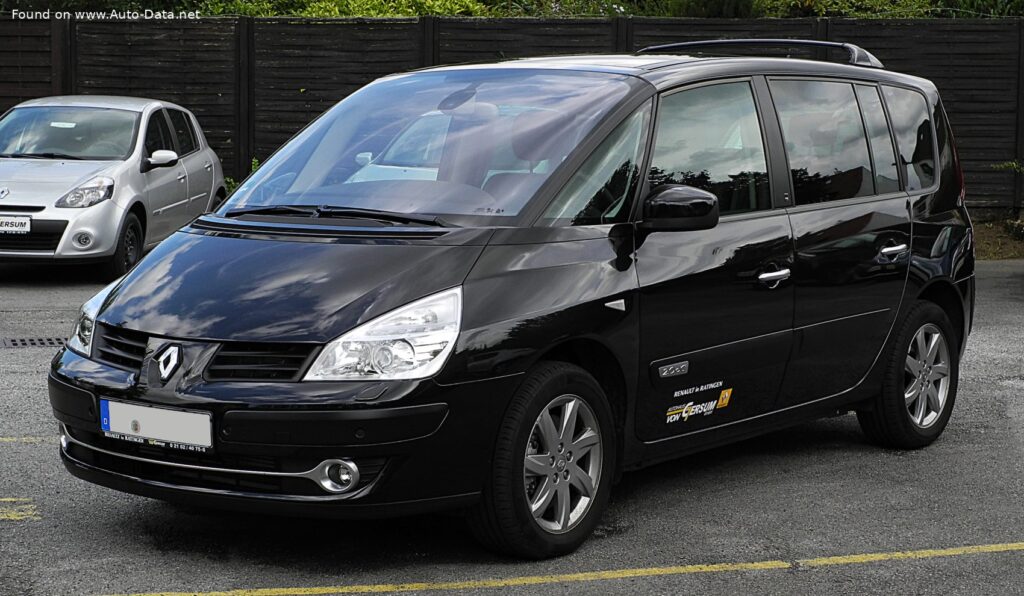
The Renault Espace IV (Phase III, 2010) retained the distinctive, flowing lines that defined the fourth-generation model, a design characterized by its “cab-forward” silhouette and expansive glass areas. This aesthetic was a departure from traditional boxy minivans, aiming for a more dynamic and elegant presence on the road. The Phase III update introduced subtle tweaks, typically involving minor revisions to the grille, headlights, and bumper designs to refresh its appearance. Its dimensions, measuring 183.5 inches in length, 74.57 inches in width (including mirrors), and 70.91 inches in height, provided a substantial footprint, contributing to its commanding road presence and generous interior volume. The 110.35-inch wheelbase was crucial for stability and maximizing passenger space.
Interior Versatility and Comfort
As a 7-seater minivan/MPV, the Espace’s interior was its true highlight. Renault pioneered modular seating arrangements, and the Espace IV exemplified this with individual, removable seats in the second and third rows. This allowed for countless configurations, from a luxurious four-seater with vast cargo space to a full seven-seater for larger families. The minimum trunk space was 10.28 cubic feet (291 liters), but with the rear seats removed or folded, this expanded to an cavernous 101 cubic feet (2,860 liters), rivaling many full-size SUVs for cargo capacity.
The cabin boasted a high level of comfort, with quality materials and thoughtful ergonomics. Features typical for the era included power windows, climate control, and a comprehensive infotainment system, though specific trim levels dictated the exact offerings. The large glass area, including an optional panoramic sunroof, contributed to an airy and open feel, enhancing the travel experience for all occupants.
Chassis, Brakes, and Safety
The Espace IV was built on a robust platform designed to deliver a comfortable and secure ride. It featured an independent McPherson strut front suspension with coil springs and an anti-roll bar, providing precise steering and good handling characteristics. The rear utilized a semi-independent suspension setup with coil springs, balancing ride comfort with load-carrying capability. Braking performance was ensured by ventilated discs at the front and solid discs at the rear, supported by an Anti-lock Braking System (ABS) as standard. The steering system was a rack and pinion type, offering predictable and responsive control. The vehicle rode on 225/55 R17 tires mounted on 17-inch wheel rims, contributing to both aesthetics and ride quality. For a family vehicle, safety was paramount, and the Espace was equipped with a suite of passive safety features, including multiple airbags, although only ABS is explicitly detailed in the provided data.
Technical Specifications
| Renault Espace IV (Phase III, 2010) 2.0 dCi (173 Hp) | |
|---|---|
| General Information | |
| Brand | Renault |
| Model | Espace |
| Generation | Espace IV (Phase III, 2010) |
| Type (Engine) | 2.0 dCi (173 Hp) |
| Start of Production | 2010 year |
| End of Production | 2012 year |
| Powertrain Architecture | Internal Combustion engine |
| Body Type | Minivan, MPV |
| Seats | 7 |
| Doors | 5 |
| Performance Specs | |
| Fuel Consumption (Urban) | 26.7 US mpg (8.8 l/100 km) |
| Fuel Consumption (Extra Urban) | 37.3 US mpg (6.3 l/100 km) |
| Fuel Consumption (Combined) | 33.6 US mpg (7 l/100 km) |
| CO2 Emissions | 185 g/km |
| Fuel Type | Diesel |
| Acceleration 0-60 mph | 8.4 sec |
| Maximum Speed | 126.76 mph (204 km/h) |
| Emission Standard | Euro 5 |
| Weight-to-Power Ratio | 11.4 kg/Hp |
| Weight-to-Torque Ratio | 5.5 kg/Nm |
| Engine Specs | |
| Power | 173 Hp @ 3750 rpm |
| Power per Liter | 86.7 Hp/l |
| Torque | 265.52 lb.-ft. (360 Nm) @ 1750 rpm |
| Engine Layout | Front, Transverse |
| Engine Model/Code | M9R |
| Engine Displacement | 121.74 cu. in. (1995 cm³) |
| Number of Cylinders | 4 |
| Engine Configuration | Inline |
| Cylinder Bore | 3.31 in. (84 mm) |
| Piston Stroke | 3.54 in. (90 mm) |
| Compression Ratio | 16:1 |
| Number of Valves per Cylinder | 4 |
| Fuel Injection System | Diesel Commonrail |
| Engine Aspiration | Turbocharger, Intercooler |
| Valvetrain | DOHC |
| Engine Oil Capacity | 6.97 US qt (6.6 l) |
| Engine Systems | Particulate filter |
| Space, Volume and Weights | |
| Kerb Weight | 4356.33 lbs. (1976 kg) |
| Max. Weight (GVWR) | 5743.04 lbs. (2605 kg) |
| Max Load | 1386.71 lbs. (629 kg) |
| Trunk (Boot) Space – Minimum | 10.28 cu. ft. (291 l) |
| Trunk (Boot) Space – Maximum | 101 cu. ft. (2860 l) |
| Fuel Tank Capacity | 21.93 US gal (83 l) |
| Max. Roof Load | 176.37 lbs. (80 kg) |
| Permitted Trailer Load with Brakes (12%) | 4409.25 lbs. (2000 kg) |
| Permitted Trailer Load without Brakes | 1653.47 lbs. (750 kg) |
| Permitted Towbar Download | 176.37 lbs. (80 kg) |
| Dimensions | |
| Length | 183.5 in. (4661 mm) |
| Width Including Mirrors | 74.57 in. (1894 mm) |
| Height | 70.91 in. (1801 mm) |
| Wheelbase | 110.35 in. (2803 mm) |
| Front Track | 61.97 in. (1574 mm) |
| Rear (Back) Track | 61.26 in. (1556 mm) |
| Front Overhang | 40.39 in. (1026 mm) |
| Rear Overhang | 32.76 in. (832 mm) |
| Ride Height (Ground Clearance) | 6.89 in. (175 mm) |
| Minimum Turning Circle | 36.09 ft. (11 m) |
| Drivetrain, Brakes and Suspension Specs | |
| Drivetrain Architecture | Front-wheel drive, Internal Combustion engine |
| Drive Wheel | Front-wheel drive |
| Number of Gears and Type of Gearbox | 6 gears, manual transmission |
| Front Suspension | Independent, McPherson with coil spring and anti-roll bar |
| Rear Suspension | Semi-independent, coil spring |
| Front Brakes | Ventilated discs |
| Rear Brakes | Disc |
| Assisting Systems | ABS (Anti-lock braking system) |
| Steering Type | Steering rack and pinion |
| Tires Size | 225/55 R17 |
| Wheel Rims Size | 17 |
Legacy and Market Impact
The Renault Espace holds a unique and revered position in European automotive history. Launched in 1984, it was one of the very first modern MPVs, effectively creating a new vehicle segment that prioritized passenger comfort, versatility, and family utility. By the time the fourth generation received its Phase III update in 2010, the Espace had already cemented its reputation as a benchmark for family haulers, despite facing increasing competition.
In its primary European market, the Espace IV competed fiercely with other established players like the Ford S-Max and Galaxy, Volkswagen Sharan, SEAT Alhambra, and its French counterparts, the Citroën C8 and Peugeot 807. What set the Espace apart was its consistent emphasis on innovative design, exceptional interior modularity, and a comfortable, refined driving experience. The 2.0 dCi (173 Hp) engine, in particular, was highly regarded for its blend of robust performance and impressive fuel efficiency, making it a favorite for long-distance family trips across the continent where diesel engines were (and largely remain) popular.
The Espace’s legacy is defined by its commitment to meeting the evolving needs of families. Its ability to transform from a spacious five-seater to a full seven-seater, or even a vast cargo van, showcased its unparalleled adaptability. This flexibility, combined with a focus on safety and comfort, ensured its enduring appeal for decades. Although the MPV segment began to wane in popularity in favor of crossover SUVs in the 2010s, the Espace IV remained a strong contender until its production ceased in 2012, paving the way for the fifth-generation Espace which notably adopted a more crossover-like stance to align with market trends.
Ultimately, the Renault Espace IV (Phase III, 2010) stands as a testament to Renault’s pioneering spirit in vehicle design and its understanding of the family car market in Europe. It delivered on its promise of space, practicality, and efficiency, embodying the very essence of a well-executed multi-purpose vehicle. Its influence can still be seen in the design philosophies of many modern family cars, even those in different segments, solidifying its place as a true automotive icon.