
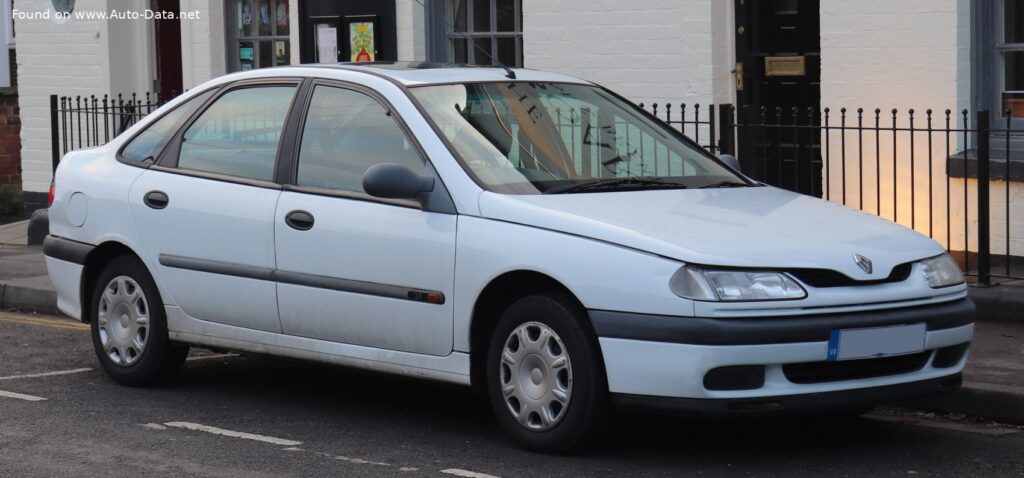
The Renault Laguna, specifically the first-generation model introduced in 1993, represented a significant step for the French automaker in the highly competitive European D-segment. Positioned as a direct successor to the long-serving Renault 21 (or Nevada in some markets), the Renault Laguna 2.2 D (83 Hp) embodied a blend of practical design, comfortable motoring, and a focus on efficiency that was particularly relevant in its primary European markets. While never officially sold in the United States due to Renault’s departure from the North American market in the mid-1980s, the Laguna carved out a strong niche as a dependable family car across the continent, competing with established rivals such as the Ford Mondeo, Opel Vectra, and Volkswagen Passat. The 2.2 D (83 Hp) variant, produced from 1993 to 2000, was a cornerstone of its diesel offerings, appealing to buyers prioritizing fuel economy and robust, long-distance performance.
The Evolution of the First-Generation Renault Laguna
Launched in 1993, the first-generation Renault Laguna (internal code X56) marked a new design direction for Renault, moving towards softer, more aerodynamic lines compared to its predecessor. This design philosophy aimed to enhance both aesthetics and fuel efficiency, a crucial factor for the European market. The Laguna was initially offered as a five-door hatchback, which quickly became its most recognizable form, followed by a station wagon (known as the Laguna Nevada or Grandtour in different regions) in 1995. The vehicle’s architecture was based on a conventional internal combustion engine driving the front wheels, a layout chosen for its packaging efficiency and predictable handling characteristics, making it an ideal choice for families and fleet operators alike. Its production run spanned seven years, concluding in 2000, during which it received a significant facelift in 1998, though the core mechanicals of the 2.2 D variant remained largely consistent.
Powertrain and Performance Characteristics of the Renault Laguna 2.2 D (83 Hp)
At the heart of the Renault Laguna 2.2 D (83 Hp) lay a robust 2.2-liter (2188 cm³) naturally aspirated diesel engine, identified by the engine code G8T. This inline four-cylinder unit was designed for durability and cost-effective operation, delivering 83 horsepower at 4500 rpm. While 83 horsepower might seem modest by today’s standards, for a D-segment family car in the early to mid-1990s, especially a diesel, it provided adequate motivation for daily commuting and highway cruising. More importantly, the engine produced a healthy 104.73 lb.-ft. of torque at a low 2250 rpm. This low-end torque was instrumental in providing accessible pulling power, making the car feel responsive in city traffic and capable on the open road, particularly when laden with passengers and luggage.
Power was delivered to the front wheels via a five-speed manual transmission, a common and reliable setup for the era. This drivetrain architecture, combined with the engine’s characteristics, resulted in a pragmatic performance profile. The Laguna 2.2 D (83 Hp) could accelerate from 0 to 60 mph in a calculated 14.5 seconds, with a top speed of 108.74 mph (175 km/h). These figures underscored its role as a comfortable cruiser rather than a performance machine. However, where this variant truly shone was in its fuel economy. The official combined fuel consumption was an impressive 35.6 US mpg (6.6 l/100 km), with extra-urban figures reaching 52.3 US mpg (4.5 l/100 km). This efficiency was a strong selling point for European buyers facing higher fuel prices and taxation based on emissions, demonstrating Renault’s commitment to economical motoring. The engine’s high compression ratio of 23:1 and precombustion chamber injection system were typical for naturally aspirated diesels of the period, contributing to its characteristic diesel sound and reliable operation.
Design, Features, and Practicality
The Renault Laguna was conceived as a highly practical and user-friendly vehicle, and its design reflected this ethos. The five-door hatchback body type offered excellent versatility, combining the sleek profile of a sedan with the loading convenience of a wagon. With a length of 177.48 inches (4508 mm), a width of 68.98 inches (1752 mm), and a height of 56.77 inches (1442 mm), the Laguna provided ample interior space for five occupants. The 105.12-inch (2670 mm) wheelbase contributed to a stable ride and a spacious cabin, particularly for rear-seat passengers.
Inside, the Laguna focused on comfort and ergonomics. While specific trim levels varied, common features for the era included power steering, a hydraulic system that made maneuvering the 2943.17 lbs. (1335 kg) kerb weight vehicle effortless. Safety features, while not as extensive as modern vehicles, were competitive for the time. The Laguna came equipped with an Anti-lock Braking System (ABS) as a significant enhancement to vehicle control during emergency stops. The braking system utilized ventilated discs at the front for effective heat dissipation and traditional drum brakes at the rear, a cost-effective and reliable solution for the rear axle. Suspension was designed for comfort, with a spring strut setup at the front and a torsion beam at the rear, providing a compliant ride over varied road surfaces. The vehicle rode on 185/65 R14 tires, mounted on 14-inch wheel rims, a common specification for family cars of its segment, balancing ride comfort with handling predictability.
Practicality was further enhanced by the generous trunk space, which ranged from 15.96 cu. ft. (452 liters) with the rear seats in place, expanding to a substantial 31.22 cu. ft. (884 liters) when the rear seats were folded down. This made the Laguna an excellent choice for families needing to transport luggage, groceries, or larger items. The 17.44 US gallon (66 liter) fuel tank, combined with its excellent diesel economy, provided a considerable driving range, making it suitable for long European journeys. The overall design philosophy of the first-generation Renault Laguna was to deliver a comfortable, safe, and highly practical family car that was economical to run and maintain, a formula that proved successful in its target markets.
Technical Specifications: Renault Laguna 2.2 D (83 Hp)
| Brand | Renault |
| Model | Laguna |
| Generation | Laguna (First Generation) |
| Engine Type | 2.2 D (83 Hp) |
| Production Start | 1993 |
| Production End | 2000 |
| Body Type | Hatchback |
| Seats | 5 |
| Doors | 5 |
| Fuel Type | Diesel |
| Fuel Consumption (Urban) | 8 l/100 km (29.4 US mpg) |
| Fuel Consumption (Extra Urban) | 4.5 l/100 km (52.3 US mpg) |
| Fuel Consumption (Combined) | 6.6 l/100 km (35.6 US mpg) |
| Acceleration 0-60 mph | 14.5 sec |
| Maximum Speed | 108.74 mph (175 km/h) |
| Power | 83 Hp @ 4500 rpm |
| Torque | 104.73 lb.-ft. (142 Nm) @ 2250 rpm |
| Engine Layout | Front, Transverse |
| Engine Model/Code | G8T |
| Engine Displacement | 2188 cm³ (133.52 cu. in.) |
| Number of Cylinders | 4 |
| Engine Configuration | Inline |
| Cylinder Bore | 3.43 in. (87 mm) |
| Piston Stroke | 3.62 in. (92 mm) |
| Compression Ratio | 23:1 |
| Valves per Cylinder | 3 |
| Fuel Injection System | Precombustion chamber injection |
| Engine Aspiration | Naturally aspirated engine |
| Valvetrain | OHC |
| Engine Oil Capacity | 6.5 l (6.87 US qt) |
| Coolant Capacity | 9 l (9.51 US qt) |
| Kerb Weight | 2943.17 lbs. (1335 kg) |
| Maximum Weight | 4188.78 lbs. (1900 kg) |
| Maximum Load | 1245.61 lbs. (565 kg) |
| Trunk Space (Minimum) | 15.96 cu. ft. (452 l) |
| Trunk Space (Maximum) | 31.22 cu. ft. (884 l) |
| Fuel Tank Capacity | 17.44 US gal (66 l) |
| Length | 177.48 in. (4508 mm) |
| Width | 68.98 in. (1752 mm) |
| Height | 56.77 in. (1442 mm) |
| Wheelbase | 105.12 in. (2670 mm) |
| Front Track | 58.31 in. (1481 mm) |
| Rear Track | 57.95 in. (1472 mm) |
| Drivetrain Architecture | Front-wheel drive |
| Gearbox | 5 gears, manual transmission |
| Front Suspension | Spring Strut |
| Rear Suspension | Torsion |
| Front Brakes | Ventilated discs |
| Rear Brakes | Drum |
| Assisting Systems | ABS (Anti-lock braking system) |
| Steering Type | Steering rack and pinion |
| Power Steering | Hydraulic Steering |
| Tires Size | 185/65 R14 |
| Wheel Rims Size | 14 |
