
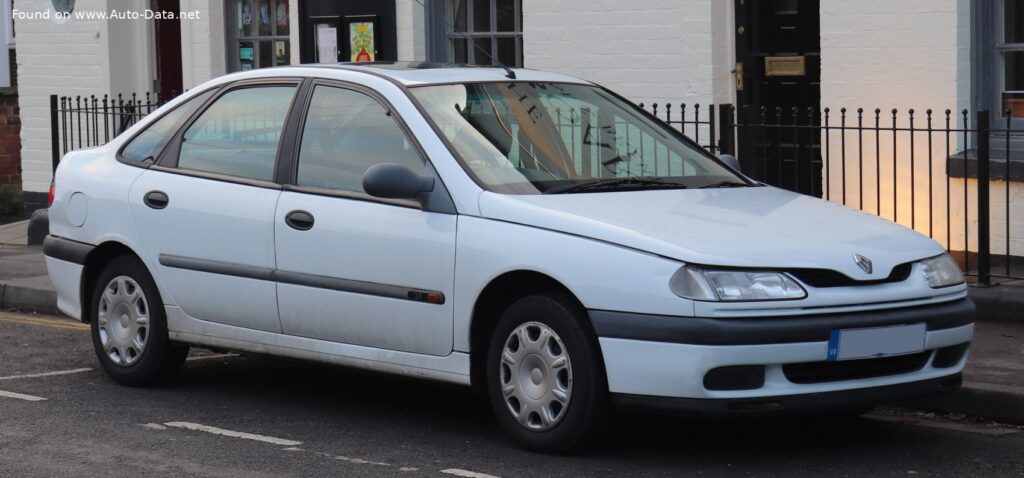
The Renault Laguna, specifically the first-generation model produced between 1996 and 2000, represented a significant contender in the highly competitive European D-segment, often referred to as the mid-size family car segment. As a successor to the venerable Renault 21, the Laguna aimed to blend modern aesthetics with robust engineering and enhanced practicality, establishing a strong presence across European markets where it was a popular choice for families and business fleets alike. The particular variant under scrutiny, the Renault Laguna 2.2 dT (113 Hp), was a notable iteration, distinguished by its turbo-diesel powertrain that offered a compelling balance of fuel economy, torque, and everyday usability, catering to a market that increasingly valued diesel engines for long-distance travel and lower running costs.
Engine & Performance: The Power of the Renault Laguna 2.2 dT (113 Hp)
At the heart of the Renault Laguna 2.2 dT (113 Hp) was Renault’s G8T series 2.2-liter turbocharged direct-injection diesel engine. This inline-four powerplant, with a displacement of 2188 cubic centimeters (133.52 cubic inches), was engineered for efficiency and dependable performance. It delivered a respectable 113 horsepower at 4300 revolutions per minute, a solid output for a diesel engine of its era and size. Crucially for a diesel, it produced a robust 184.39 pound-feet of torque at a low 2200 rpm. This substantial low-end torque ensured strong pulling power, making the Laguna feel responsive in city traffic and capable of effortless cruising on highways, even when fully loaded.
The performance figures for the Renault Laguna 2.2 dT (113 Hp) were competitive for its class during its production run. It could accelerate from 0 to 60 miles per hour in approximately 11 seconds, with 0 to 62 mph (100 km/h) taking 11.6 seconds. The maximum speed was rated at 121.17 mph (195 km/h), demonstrating its capability for sustained high-speed travel on European autobahns. Fuel economy was a major selling point for this diesel variant. In urban driving, it achieved an estimated 24.2 US mpg (9.7 l/100 km), while extra-urban consumption figures were particularly impressive at 42 US mpg (5.6 l/100 km). This efficiency, combined with a generous 17.44 US gallon (66 liter) fuel tank, translated into an excellent cruising range, a key advantage for European motorists.
The engine’s configuration featured an overhead camshaft (OHC) valvetrain and three valves per cylinder, a design choice that aimed for a balance of breathing efficiency and mechanical simplicity. With a high compression ratio of 22:1, characteristic of diesel engines, and direct fuel injection, the G8T engine was optimized for maximum thermal efficiency. The turbocharger played a pivotal role in boosting power and torque delivery, making the 2.2 dT a much more spirited performer than naturally aspirated diesel counterparts. The engine oil capacity was 7.2 liters (7.61 US quarts), and the cooling system required 9 liters (9.51 US quarts) of coolant, indicating a robust design capable of managing thermal loads effectively.
Design & Features: Practicality and Comfort in the Renault Laguna
The Renault Laguna, specifically in its 2.2 dT (113 Hp) variant, was offered as a five-door hatchback, a body style highly popular in Europe for its blend of sedan-like driving dynamics and wagon-like practicality. Its design, characterized by smooth, rounded lines, was a departure from the more angular styling of its predecessors, reflecting the prevailing automotive design trends of the mid-to-late 1990s. The overall length of 177.48 inches (4508 mm) and a width of 68.98 inches (1752 mm) provided a substantial road presence, while the 105.12-inch (2670 mm) wheelbase contributed to a stable ride and a spacious cabin.
The interior was designed to accommodate five occupants comfortably, with attention paid to ergonomics and ease of use. The hatchback configuration was a significant asset, offering exceptional versatility for cargo. The trunk (boot) space ranged from a generous 15.96 cubic feet (452 liters) with all seats in place, expanding to an impressive 31.22 cubic feet (884 liters) when the rear seats were folded down. This adaptability made the Laguna a highly practical vehicle for families, capable of handling everything from weekly grocery runs to vacation luggage.
In terms of features, the Renault Laguna 2.2 dT (113 Hp), typical for a mainstream European D-segment car of its time, included essential safety and convenience technologies. An Anti-lock Braking System (ABS) was a significant safety feature, providing enhanced control during emergency braking. The steering system utilized a rack and pinion setup with hydraulic power steering, offering a direct feel and reduced effort, especially during low-speed maneuvers. The vehicle rode on 195/65 R15 tires, mounted on 15-inch wheel rims, a common specification that balanced ride comfort with adequate grip and durability. While not a luxury vehicle, the Laguna aimed to provide a comfortable and secure environment for its occupants, with a focus on functionality and reliability.
Chassis & Dynamics: A Balanced Driving Experience
Underpinning the Renault Laguna 2.2 dT (113 Hp) was a conventional yet effective front-wheel-drive architecture, typical for its segment and era. The internal combustion engine was transversely mounted, driving the front wheels through a 5-speed manual transmission. This setup was chosen for its cost-effectiveness, packaging efficiency, and predictable handling characteristics, which are desirable in a family-oriented vehicle. The manual gearbox offered direct engagement and control, allowing the driver to fully utilize the engine’s torque band.
The suspension system was designed to provide a comfortable ride while maintaining competent handling. The front suspension featured a spring strut (MacPherson strut equivalent) arrangement, renowned for its ability to balance ride comfort with predictable steering response. At the rear, a torsion beam suspension was employed, a compact and robust design that offered a good compromise between ride quality and packaging efficiency, crucial for maximizing cargo space in the hatchback. This combination contributed to a stable and compliant ride, well-suited for varying road conditions prevalent across Europe, from smooth highways to less-maintained urban streets.
Braking performance was handled by a system comprising ventilated discs at the front and solid discs at the rear, a capable setup for a vehicle of this weight and performance. The ventilated front discs were particularly effective in dissipating heat, reducing brake fade during repeated heavy use. Coupled with the standard ABS (Anti-lock Braking System), the Laguna offered confident and controlled stopping power. The overall weight-to-power ratio of 12.7 kg/Hp (78.8 Hp/tonne) and a weight-to-torque ratio of 5.7 kg/Nm (174.3 Nm/tonne) further underscore the engine’s ability to move the 3161.43 lbs (1434 kg) kerb weight of the vehicle with relative ease, contributing to a feeling of solidity and stability on the road.
Technical Specifications
| Brand | Renault |
| Model | Laguna |
| Generation | Laguna (First Generation) |
| Type (Engine) | 2.2 dT (113 Hp) |
| Start of Production | 1996 year |
| End of Production | 2000 year |
| Powertrain Architecture | Internal Combustion engine |
| Body Type | Hatchback |
| Seats | 5 |
| Doors | 5 |
| Fuel Consumption (Urban) | 9.7 l/100 km (24.2 US mpg) |
| Fuel Consumption (Extra Urban) | 5.6 l/100 km (42 US mpg) |
| Fuel Type | Diesel |
| Acceleration 0 – 62 mph (0-100 km/h) | 11.6 sec |
| Acceleration 0 – 60 mph | 11 sec |
| Maximum Speed | 121.17 mph (195 km/h) |
| Weight-to-Power Ratio | 12.7 kg/Hp (78.8 Hp/tonne) |
| Weight-to-Torque Ratio | 5.7 kg/Nm (174.3 Nm/tonne) |
| Power | 113 Hp @ 4300 rpm |
| Power per Liter | 51.6 Hp/l |
| Torque | 250 Nm @ 2200 rpm (184.39 lb.-ft. @ 2200 rpm) |
| Engine Layout | Front, Transverse |
| Engine Model/Code | G8T |
| Engine Displacement | 2188 cm3 (133.52 cu. in.) |
| Number of Cylinders | 4 |
| Engine Configuration | Inline |
| Cylinder Bore | 87 mm (3.43 in.) |
| Piston Stroke | 92 mm (3.62 in.) |
| Compression Ratio | 22:1 |
| Number of Valves per Cylinder | 3 |
| Fuel Injection System | Direct injection |
| Engine Aspiration | Turbocharger |
| Valvetrain | OHC |
| Engine Oil Capacity | 7.2 l (7.61 US qt) |
| Coolant Capacity | 9 l (9.51 US qt) |
| Kerb Weight | 1434 kg (3161.43 lbs.) |
| Trunk (Boot) Space – Minimum | 452 l (15.96 cu. ft.) |
| Trunk (Boot) Space – Maximum | 884 l (31.22 cu. ft.) |
| Fuel Tank Capacity | 66 l (17.44 US gal) |
| Length | 4508 mm (177.48 in.) |
| Width | 1752 mm (68.98 in.) |
| Height | 1442 mm (56.77 in.) |
| Wheelbase | 2670 mm (105.12 in.) |
| Front Track | 1481 mm (58.31 in.) |
| Rear (Back) Track | 1472 mm (57.95 in.) |
| Drivetrain Architecture | Internal combustion engine drives front wheels |
| Drive Wheel | Front wheel drive |
| Number of Gears and Type of Gearbox | 5 gears, manual transmission |
| Front Suspension | Spring Strut |
| Rear Suspension | Torsion |
| Front Brakes | Ventilated discs |
| Rear Brakes | Disc |
| Assisting Systems | ABS (Anti-lock braking system) |
| Steering Type | Steering rack and pinion |
| Power Steering | Hydraulic Steering |
| Tires Size | 195/65 R15 |
| Wheel Rims Size | 15 |
